BOFIT Weekly Review 44/2026
China’s central bank continues to build up gold reserves
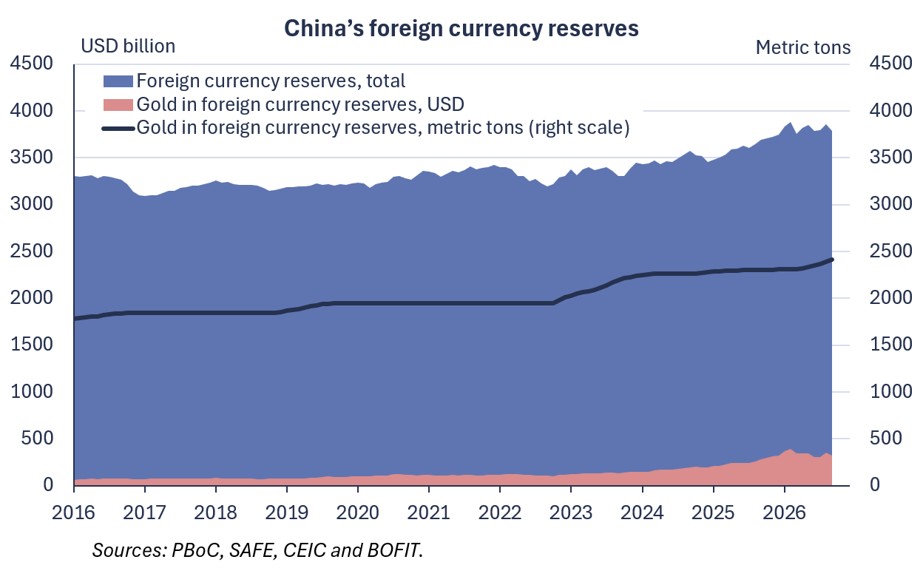
The PBoC reports that it has purchased roughly 100 metric tons of gold this year for its foreign currency and gold reserves. End-September figures put gold reserves held by the central bank at 2,410 tons ($324 billion), making it the fifth-largest sovereign gold holdings after the US, Germany, Italy and France. The share of gold in China’s forex and gold reserves has increased rapidly as a result of gold-buying and a rise in global gold prices. As of end-September, 9 % of China’s $3.8 trillion currency reserves was as gold, up from just 2 % a decade ago. The PBoC has remained largely silent on its motivations for gold accumulation.
Other Chinese entities besides the PBoC have also purchased significant amounts of gold from foreign sources this year. China Customs reports that the volume of imported gold, excluding the PBoC’s monetary gold imports, was about 500 metric tons higher in January-September than in the same period in 2025, an increase of 60 % y-o-y. Reasons for buying gold include investment, jewellery-making and industrial applications. Globally, especially investment demand of gold has gained popularity recently.
In addition to its role a major gold buyer, China is also the world’s largest gold producer. The World Gold Council reports that China produced 384 metric tons of gold last year, about 10 % of global gold production. Russia was the world’s second largest gold producer (345 tons). Finland, at 9 tons, was Europe’s largest producer. While gold production in China has increased slightly in recent years, annual production volumes are far from their peak of around 450 tons a year in 2014–2016.
China’s government wants to expand Hong Kong's role in the international gold trade. According to the new 5-year plan for Hong Kong published in September (BOFIT Weekly 40/2026), the aim is to make the city a major hub for gold trading, storage and transaction clearing. Some PBoC gold is reportedly stored in Hong Kong.