BOFIT Weekly Review 45/2026
Russian GDP growth remains sluggish despite huge increases in government spending
The pace of Russian economic growth remained low in September. The preliminary estimate from Russia’s economic development ministry finds GDP grew just 0.5 % y-o-y in September and was only up by 0.6 % y-o-y during the first nine months of this year. The divergence in Russia’s two-track economy continues, with sectors linked to the war growing rapidly supported by government spending, while particularly the oil industry has been hard hit by Ukrainian strikes. Inflation has been fuelled by the government’s ballooning deficits and lost production capacity caused by Ukrainian strikes. The central bank has paused rate cuts and needs to keep the key interest rate high in order to fight inflationary pressures. The government finds it increasingly difficult to fund its rising expenses and its borrowing needs are already hurting the financing possibilities of private sector firms.
Output still supported by war-linked industries and consumption; oil industry battered by Ukrainian strikes
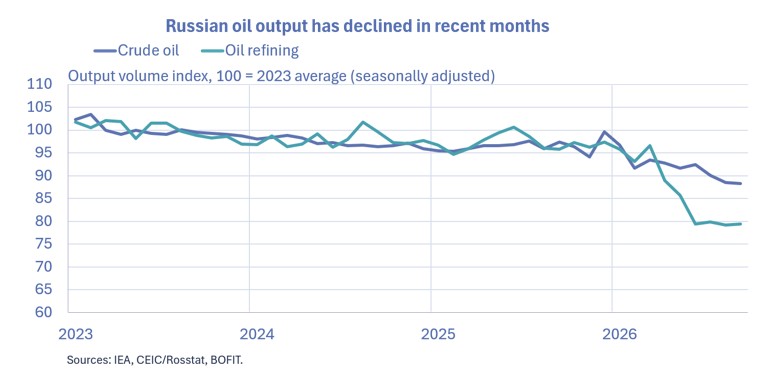
Industrial output growth increased slightly to 2 % y-o-y in September. While monthly figures vary widely, the level of industrial output has been nearly flat over the past two years. Zooming in on the industrial output figures, we see industry-specific trends diverging further this year, with oil production and related industries bearing the brunt of Ukrainian strikes. Output of extractive industries overall contracted 4 % y-o-y in September and oil refining fell by 17 %. Although Rosstat no longer releases statistical data on Russia’s oil production, the International Energy Agency (IEA) estimates Russia pumped about 9 % less crude oil in September than a year earlier.
Manufacturing growth has been led by industries serving the war effort, which saw solid growth again in September. The revived on-year growth in Russia’s car industry in recent months largely reflects last year’s low basis reference. Some of the new growth, however, reflects increased assembly of Chinese vehicles in plants abandoned by Western car manufacturers. Russia’s high recycling fees on foreign-made vehicles is likely part of the motivation for Chinese carmakers to move their assembly operations to Russia as carmakers in Russia receive compensation from the state to offset recycling fees. Even with this enticement, however, roughly 40 % fewer passenger cars were produced in Russia during January-September this year than during the same period in 2021.
Retail sales continue to grow, rising by 4 % y-o-y in September. While the pace of growth slowed from last spring, it has remained fairly stable since summer. Much of the slowdown reflects the weakening trend in real wage growth, which has fallen to around 3 % y-o-y in recent months. Russia’s unemployment rate also ticked up slightly in September, but still remains close to historical lows at just over 2 %. The central bank’s latest company surveys also suggest slight easing in Russia’s tight labour market conditions.
In the wake of a sharp decline at the start of this year, construction activity has gradually revived, with growth in September again hitting 3 % y-o-y as in previous months. In contrast, the agricultural sector continues to struggle. While monthly output has varied considerably, agricultural output overall during January-September shrank by 3 % y-o-y. Production of many vegetable crops and plant-derived products has decreased. In addition, Ukrainian strikes have particularly disrupted Russian grain exports, which are shipped primarily via the Black Sea.
CBR keeps key rate unchanged at 14 % in the face of rising inflation pressures
At its monthly inflation meeting on October 23, the Central Bank of Russia (CBR) decided to hold its key rate at 14 %. Despite sluggish economic growth, inflation has accelerated in recent months and inflation expectations remain high. The CBR estimated that seasonally-adjusted annualized rate (SAAR) of inflation was 8 % in the third quarter, up from 5 % in the second quarter.
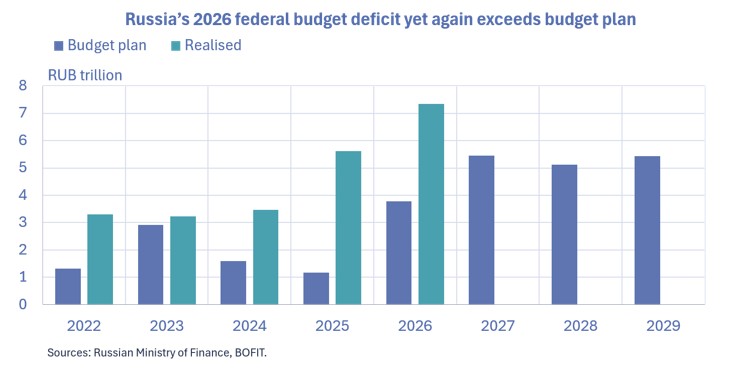
The CBR sees that the pick-up in inflation largely reflects such transient factors as temporary reductions in production capacity (due to Ukrainian attacks) and hikes in administratively regulated rates for municipal services in early October (this year’s annual rate increases were postponed due to the Duma elections in September). The CBR views that inflation risks are still elevated due to various factors, including extended production disruptions or a larger-than-expected budget deficit. The CBR estimates the government’s latest budget framework does not add to inflationary pressures, but if fiscal policy is actually looser than planned, monetary policy could have to be tighter than currently anticipated. The budget deficit has consistently exceeded the approved budget plan in recent years.
In conjunction with the rate announcement, the CBR released its updated economic forecast. This year’s GDP forecast range was narrowed to 0.5–1.0 %, while next year's forecast had been lowered from 1.5–2.5 % to 1–2 %. Next year’s growth forecasts of both private consumption and fixed investment were revised slightly down. Nevertheless, the CBR raised its inflation forecast a bit. Inflation in the final months of this year is now expected to run in the range of 7.1–7.6 % and average 5.2–5.7 % next year. The CBR sees inflation declining to its target level of 4 % by the end of 2027, but it requires tighter monetary policy than anticipated earlier. The CBR now expects its key rate to average 12.5–13.5 % next year, up from July's forecast estimate of 10.5–12.5 %.
This year’s federal budget deficit will significantly overshoot initial budget plan
Preliminary finance ministry figures show federal budget revenues rose by 10 % y-o-y in the first nine months of this year. Oil & gas revenues, however, were down by 17 % y-o-y. The IEA estimates that the price of Russia export oil averaged $71 a barrel during the first nine months of this year, up from $59 a barrel in the same period last year. Despite higher dollar prices, the finance ministry claims that Russia’s oil & gas revenues have been depressed by the ruble’s appreciation against the dollar and government compensation payments to refiners (the so-called damper mechanism). There is always a lag between the recent rise in oil prices and any increase in budget revenues. The IEA estimates that the average export price of Russian crude climbed to $93 a barrel in September. Prelimany information from the Ministry of Finance suggests that there was a notable increase in oil and gas revenues in October.
Federal budget revenues from sources other than oil & gas increased by 19 % y-o-y. Value-added tax (VAT) revenues were up 27 % in January-September, reflecting the two-percentage-point hike in VAT rates at the beginning of this year. Government revenues from corporate profit taxes increased by 8 % y-o-y in January-September.
Federal budget expenditures rose by 15 % y-o-y in the first nine months of this year. The 2026 spending estimate has been boosted significantly, making it 4.5 trillion rubles higher than in the original budget plan for this year. At the same time, the official predicted deficit for this year has been nearly doubled from the original budget. This year’s federal budget deficit is now expected to come in at about 7.3 trillion rubles (3 % of GDP). According to the finance ministry, the additional spending will be financed mainly from sources other than increases in this year’s scheduled borrowing. The approach seeks to ease credit access for private firms and support the stability of financial markets.