BOFIT Forecast for Russia 2026–2028
2/2026, published on 5 October 2026
Amidst struggles with structural constraints and rising imbalances, the Russian economy has seen its growth stagnate at around 1 percent this year and is on track to slow further to around ½ percent next year. Increased government expenditure, which is crucial to sustaining Russia’s war of aggression on Ukraine, should be sufficient to maintain a very modest level of output growth. High global oil prices have helped ease Russia’s fiscal distress, but the government continues running budget deficits in coming years. Financing the budget deficit has become more difficult, but Russia is still able to sustain the financing and production required for its war of aggression. Balancing continued growth in government spending with efforts to curb inflation is becoming increasingly difficult, and the risk of a weaker-than-forecast economic performance is high.

Tough policy choices ahead
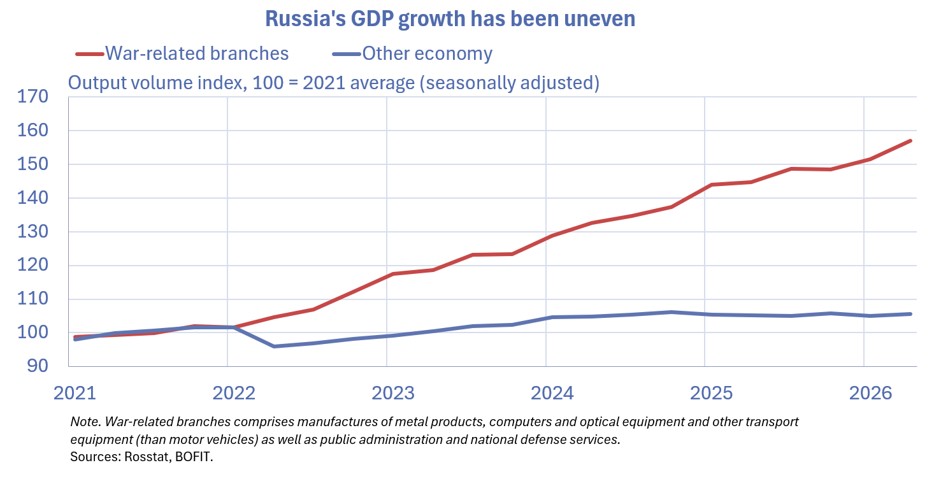
Russian GDP growth has slowed significantly. GDP grew by just 1 % in 2025, and growth in the first half of this year was even weaker. Growth has slowed as the economy has increasingly run up against its capacity constraints and macroeconomic imbalances have accumulated. Economic performance has been highly uneven. War-related sectors have expanded rapidly, whereas growth in the broader economy has remained weak. With the sharp increases in government spending in recent years driving near-̀full utilisation of labour and production capacity, tight monetary policy is required to contain inflation. Although the slowdown of growth has partly eased the most severe bottlenecks, these factors continue to weigh on output growth.
The Russian government now faces increasingly difficult economic policy choices. As long as Russia continues its war of aggression against Ukraine, war-related spending will need to increase. This will widen the government budget deficit and add to inflationary pressures and other economic imbalances. Sticking with such policies could eventually precipitate a severe economic crisis. On the other hand, if the authorities seek to keep the deficit in check, it would likely require cuts to non-military spending and further tax hikes. Such policies could depress growth and make the costs of the war increasingly tangible for ordinary citizens.
Military situation in Ukraine unchanged, oil prices expected to fall
The forecast is again subject to high uncertainty as we are forced to rely on assumptions about developments in Russia’s external environment. We assume the military situation in Ukraine will remain largely unchanged, with fighting largely confined to Ukrainian territory. We also expect that Ukraine continues its strikes against targets in Russia and international sanctions pressure on Russia remains unchanged.
While sanctions continue to restrict access to foreign financing and technology, Russia has managed to mitigate some of the effects of sanctions through third-country assistance. Russia must still sell its crude oil at a discount relative to comparable grades. The average discount on Russian crude in past 12 months was around $20 a barrel. We assume this level of discount remains roughly the same throughout the forecast period. Based on the pricing of oil futures contracts in late September, and assuming a $20 discount, the average export price of Russian crude oil is expected to average $72 a barrel this year, $66 next year and $57 in 2028.
War spending keeps on rising
Robust government spending growth in recent years has been a major driver of the Russian economy, rising by an average of 15 % a year between 2022 and 2026. Growth has mainly come from war-related expenditure, estimated to now account for about 20 % of total government spending. Even with tax hikes and recent increases in oil prices, state revenues have failed to keep up with spending growth. Oil & gas revenues currently represent roughly 20 % of federal budget income. As a result, state finances are in deficit for their fifth year in a row. Last year’s deficit corresponded to nearly 4 % of GDP. Based on the latest official estimates, the 2026 deficit should amount to about 3 % of GDP.
We expect the Russian government to further raise spending next year. While war spending will continue to increase rapidly, other spending should remain subdued. Raising revenue has become increasingly difficult as most taxes have already been hiked. Russia’s budget will remain in deficit throughout the forecast period. Despite growing financing challenges, Russia should still be able to cover its deficits in coming years.
Russia’s government debt is still low, equivalent to roughly 15 % of GDP. Debt-servicing costs, however, have risen rapidly with soaring interest rates and the government has encountered some problems with recent debt issuances. Domestic banks remain capable of financing government borrowing, and the government could turn to the central bank for assistance as a last resort. As of end-August, Russia’s National Wealth Fund held liquid assets valued at about 4 trillion rubles (approximately €42 billion or 1.7 % of GDP). There has also been recent discussion of the possibility of mobilising other foreign exchange reserves held by the central bank in order to support the economy.
The incessant rise in government spending has fuelled inflationary pressures despite slowing other demand growth. The Central Bank of Russia (CBR) has been forced to maintain its key rate at a high level with only gradual rate cuts. In September, the CBR board decided to keep the key rate unchanged at 14 % on signs of increasing inflationary pressures. Consumer prices were up by 6 % y-o-y in August, and inflation expectations remain elevated. Recent ruble depreciation and Ukrainian strikes have added to inflationary pressures. The CBR expects its key interest rate to average around 11 % next year.
Slower private consumption growth
Households have benefited from the effects of government spending programmes. The tight labour market has pushed up wages and household gains in purchasing power have outstripped the pace of inflation. While labour market pressures appear to have eased a bit in recent months and the pace of wage growth has slowed, real wages still rose by about 4 % y-o-y in the second quarter. Regulatory changes have also limited growth of consumer credit. These factors in combination have moderated consumption growth.
We expect consumption growth to slow gradually over the forecast period. It will remain positive, however, thanks to near-full employment and still rising wages. Household savings levels, which have increased in recent years, should also provide a cushion for households. On the other hand, Russia’s persistently high inflation continues to erode consumer purchasing power and restrain consumption growth.
Investment outlook remains weak
Fixed investment grew rapidly during the initial years of the Ukraine war. Investment in the military-industrial complex has been particularly strong, but there have also been massive investment projects in energy, chemicals and logistics. Fixed investment has also been supported to some extent through government measures. In recent months, however, Russia appears to have experienced a complete reversal in investment trends. Preliminary data show fixed investment in the first half of this year contracted by 10 % y-o-y.
The outlook for fixed investment remains weak throughout the forecast period. With a number of mega-projects either completed or in their final stages, their contributions to investment activity have waned. Corporate profits have also declined in recent years. Interest rates on corporate loans remain high, and capacity utilisation rates in many industries have begun to fall. Many companies face weaker demand outlooks. Such conditions decrease the willingness of companies to make large capital investments. While repairing damage to critical facilities and infrastructure from Ukrainian strikes require additional investment in the oil-refining and logistics industries, growth in fixed investment overall is expected to decline slightly further next year.
Muted foreign trade trends
It has become increasingly difficult to forecast Russian foreign trade trends as Russian authorities now release less statistical information on trade than previously. Figures from the Energy Institute’s Statistical Review of World Energy show that the export volumes of Russia’s top export commodities (oil, natural gas and coal) have fallen significantly in recent years. Moreover, estimates from the International Energy Agency (IEA) reveal that the volume of Russian oil exports in August 2026 declined by roughly 10 % from a year earlier. Much of the drop reflects the effects of Ukrainian drone and missile strikes on Russian refineries and oil terminals, as well as the resulting export restrictions imposed by Russia. Given the production and shipping challenges facing Russia, we do not expect export volumes to increase during the forecast period.
The available data on Russian imports only relate to value, not volumes. After years of modest performance, Russian imports of goods and services have lately shown a distinct uptick. The value of imports in the first seven months of this year rose by 12 % y-o-y. Some of the boost in the value of imports reflects last spring’s ruble appreciation episode. In recent months, the ruble has given back some of those gains. We expect import growth to slow during the forecast period in response to sluggish demand and a weaker ruble. With import growth slowing and oil prices remaining relatively high, Russia's current account surplus is expected to remain on surplus through the entire forecast period.
Russian growth likely to slow further
With the caveat of the large risks associated with this forecast, we expect Russian GDP to grow by around 1 percent this year, and a half percent annually in 2027 and 2028. As Russia’s economic situation has deteriorated, unexpected shifts such as a change in the conduct of the war could, however, quickly and substantially weaken Russia’s economic performance.
The main external risks in this forecast relate to oil prices and the course of the Ukraine war. A prolonged conflict in Middle East that sustains high prices of oil and other commodities would provide Russia with a bit of leeway in pursuing its war on Ukraine and bolster its capacity to sustain spending levels that still grow the economy. An oil price below our basic assumption, in contrast, increases Russia’s fiscal distress. The stepping-up of Ukrainian strikes, which have already caused significant damage to the Russian economy, could lead to an even weaker economic performance than in our baseline scenario. A further tightening of international sanctions would exacerbate many of Russia’s economic problems.
Russia’s domestic risks relate mostly to its incompatible economic policy goals. If Russia increases federal spending excessively in the coming years, economic imbalances will worsen further and could eventually lead to an economic crisis. On the other hand, if the government adopts austere fiscal policies and cuts public spending, the economy could fall into recession as government support to the economy diminishes. In addition, a deterioration in problems within the banking sector could result in weaker-than-expected economic performance.
With considerable slowing of the economy and a weak economic outlook, Russia faces increasingly painful choices from continuing the Ukraine war. For the time being at least it appears the government is willing to accept the pain and make its choice. Even with the risks of continuing the war, there are no signs that the economy faces an immediate collapse into crisis. The financing and production required by the war can still be maintained. However, Russia’s long-term growth prospects will continue to deteriorate as long as it continues its war of attrition in Ukraine.
Russian GDP growth
| 2023 | 2024 | 2025 | 2026f | 2027f | 2028f | |
| Change in GDP volume, % | 4.1 | 4.9 | 1.0 | 1 | ½ | ½ |
Sources: Rosstat, BOFIT.