BOFIT Weekly Review 43/2026
Ukraine’s economic outlook dims with ongoing destruction of export infrastructure
Ukraine’s economic growth came to a halt during the first half of 2026, with its GDP volume remaining at roughly the 2025 level. Industrial output contracted by 1 % y-o-y in the January-August period. Much of the decline was driven by Russia’s focus on destruction of key logistical infrastructure and major production facilities. The mining & mineral extraction sector was dragged down by a 19 % y-o-y drop in mining of metallic ores. In the manufacturing sector, metallurgy suffered from increased Russian bombing, contracting by 13 % y-o-y in the first eight months of this year. One of Ukraine's most significant steel producers, Zaporizhstal, has been under attack since August and production has been halted. Demand from the domestic defence industry, however, has partially sustained the manufacturing sector.
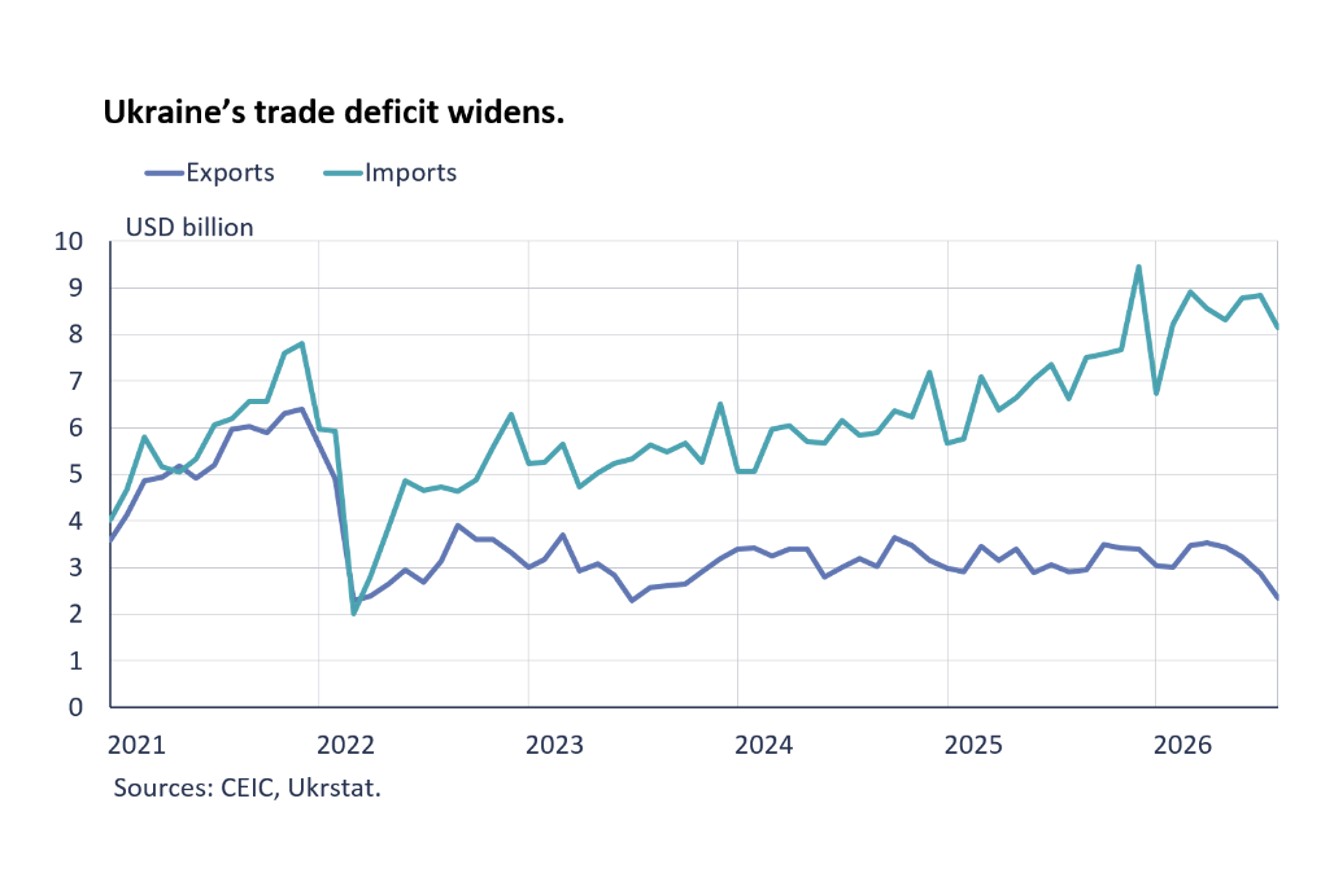
Ukraine’s export and import trends continue to diverge, with differences becoming ever starker since 2025. In January-August 2026, Ukraine’s trade deficit exploded by 50 % y-o-y due to a massive increase in imports (up 26 %). The value of imports has been driven by rising energy prices, destruction of the domestic energy sector, as well as an ever-growing need for machinery, equipment and spare parts essential for defence. The value of Ukraine’s exports, in contrast, grew by less than 1 % in the first eight months of this year, despite an excellent harvest season for Ukraine's main export commodities (grains and oilseeds). A growing trade deficit weakens Ukraine’s ability to finance defence costs and increases the need for external financing.
Ukrainian port traffic at near standstill; railway bombing increases
Attacks on ports have particularly hurt Ukraine’s food exports by sea, while attacks on the nation’s railway systems have limited overland exports. In August, rail freight transport decreased by almost 30 % y-o-y amidst deteriorating security conditions. Russia has targeted moving trains, trainyards and rail stations in five regions of Ukraine during September and October. Given the near-complete shutdown of its Odesa ports, Ukraine has entered into discussions with Moldova and Romania on reducing rail freight transit fees and other tariffs to allow for increased quantities of grain exports by rail. A significant share of the food commodities for export is currently in temporary storage, meaning that many farmers have seen their anticipated income delayed or cancelled. Ukraine’s agriculture ministry estimates that the situation will have a negative effect on sowing for the next harvest.
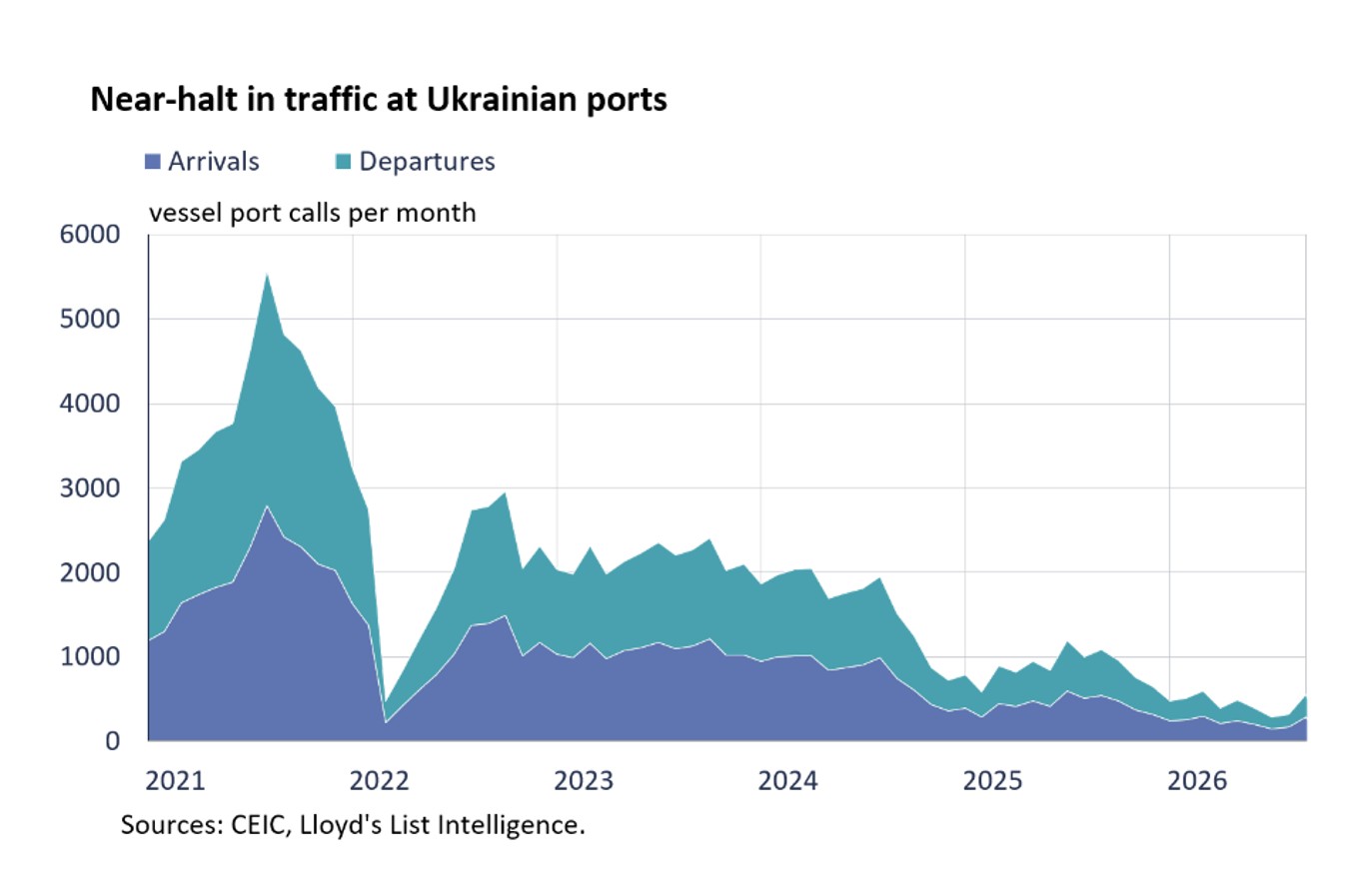
Since 2022, Ukrainian port access has been limited to ports in the Odesa region and smaller ports at the mouth of the Danube (particularly the commercial port of Reni and Izmail seaport). Russia has this year stepped up its strikes on the ports of Odesa, through which 90 % of Ukraine’s goods exports have traditionally shipped, thereby bringing Ukraine’s shipping to a near-halt. Moreover, the smaller riverboats that operate on the Danube are unable to compensate fully for the massive cargo capabilities of seafaring container ships. Russia’s systematic targeting of Ukraine’s Danube ports with drone attacks, combined with the Danube’s historically low levels due to drought and the insufficient capacity at cargo terminals along the Danube, Ukraine only managed to export about 20 % of its potential grain export volumes in August. Ukraine is one of the world’s largest food exporters, playing a key role as a food supplier for countries in north Africa and the Middle East. Ukraine is currently in talks with India, Turkey and Egypt on securing transport of food products in the Black Sea. Russian exports through the Black Sea have also become more difficult, but so far Russia has rejected attempts to create a safe route for the export of food products. Ukraine and Russia together account for about a quarter of global grain exports. A large part of Russia’s grain exports pass through the Black Sea.
Assistance payments withheld due to Ukraine’s foot-dragging on reforms
The EU has had to suspend scheduled tranches of support for Ukraine due to its lack of action on mandated reforms. As of end-September, the EU was withholding 5 billion euros in lending that would have been released if Ukraine had met its lending conditions. Estimates of Ukraine's public financing needs have increased, with Ukraine declaring it needs an additional $27 billion in funding by the end of this year. The country’s expenses have been increased by weaker-than-expected tax revenues, intensified fighting and heavier destruction. Ukraine has proposed accelerating the release of EU defence support funds earmarked for 2027, while the EU has reiterated that Ukraine needs to show progress in implementing reforms.
Ukraine’s unicameral parliament, the Verkhovna Rada, is under pressure to enact some 35 laws by mid-November in order to fulfil the lending terms set out by financing agencies. The government itself also needs to take a number of key decisions. In particular, Ukraine’s government has had difficulties in taking action to strengthen the country's legislative bodies and anti-corruption authorities. The selection of a new prosecutor general through an open call rather than political appointment has become a major point of contention. Ukraine’s previous prosecutor general, who was charged with corruption, resigned from his position and fled the country in September. To make matters worse, the Ukrainian government and lawmakers have sunken back into their long-standing political confrontational stance, with some representatives in president Zelensky's own party opposing the government’s proposals. A roughly $18 billion assistance package from the EU, International Monetary Fund and World Bank depends on successful progress in implementing the mandated measures. Ukraine also announced in October that the country’s funding needs for 2027 have increased to $70 billion. The EU has already earmarked a 90-billion-euro loan for 2026 and 2027 loan, but it is insufficient to cover Ukraine’s needs. As a result, the EU is seeking additional funding from its member states, as well as its partners such as the UK, Canada and Norway.