BOFIT Weekly Review 40/2026
Hong Kong releases its first five-year plan
On September 16, Hong Kong published its first five-year plan for economic and social development (2026–2030). The plan supports mainland China’s five-year plan for the same period. The Hong Kong special administration region (SAR) had previously not used five-year plans in guiding economic and social development as the role of the state has traditionally been significantly smaller than in mainland China. The new plan seeks to align Hong Kong’s development with China's innovation and development plans and deepen integration. Some observers worry that the introduction of a five-year plan represents an initial step towards increased government regulation and limitation of Hong Kong’s free market economy.
The plan aims to improve Hong Kong’s position as a centre of international trade and finance. In addition to bolstering Hong Kong’s role as an offshore yuan hub, commodity trading, particularly the roll-out of the clearing and settlement system for gold next year, will be developed and regulatory cooperation with mainland China and foreign countries increased. There is also a desire to increase technology and innovation, with a heightened focus on such fields as artificial intelligence, robotics and microelectronics. Cooperation in the Greater Bay Area with Guangdong province and Macao will be deepened and construction of the new 2.5 million resident Northern Metropolis in Hong Kong’s New Territories along the Chinese border accelerated.
The five-year plan seeks to uphold China’s “one country, two systems" principle, while keeping its common law frameworks intact. Hong Kong acts as an important intermediary between mainland China and the rest of the world thanks to its open capital markets, predictable business environment and rule of law. Hong Kong is important to Chinese companies seeking to penetrate global markets. Hong Kong chief executive John Lee stressed that the introduction of the plan would not undermine Hong Kong’s market economy system or its independent judiciary.
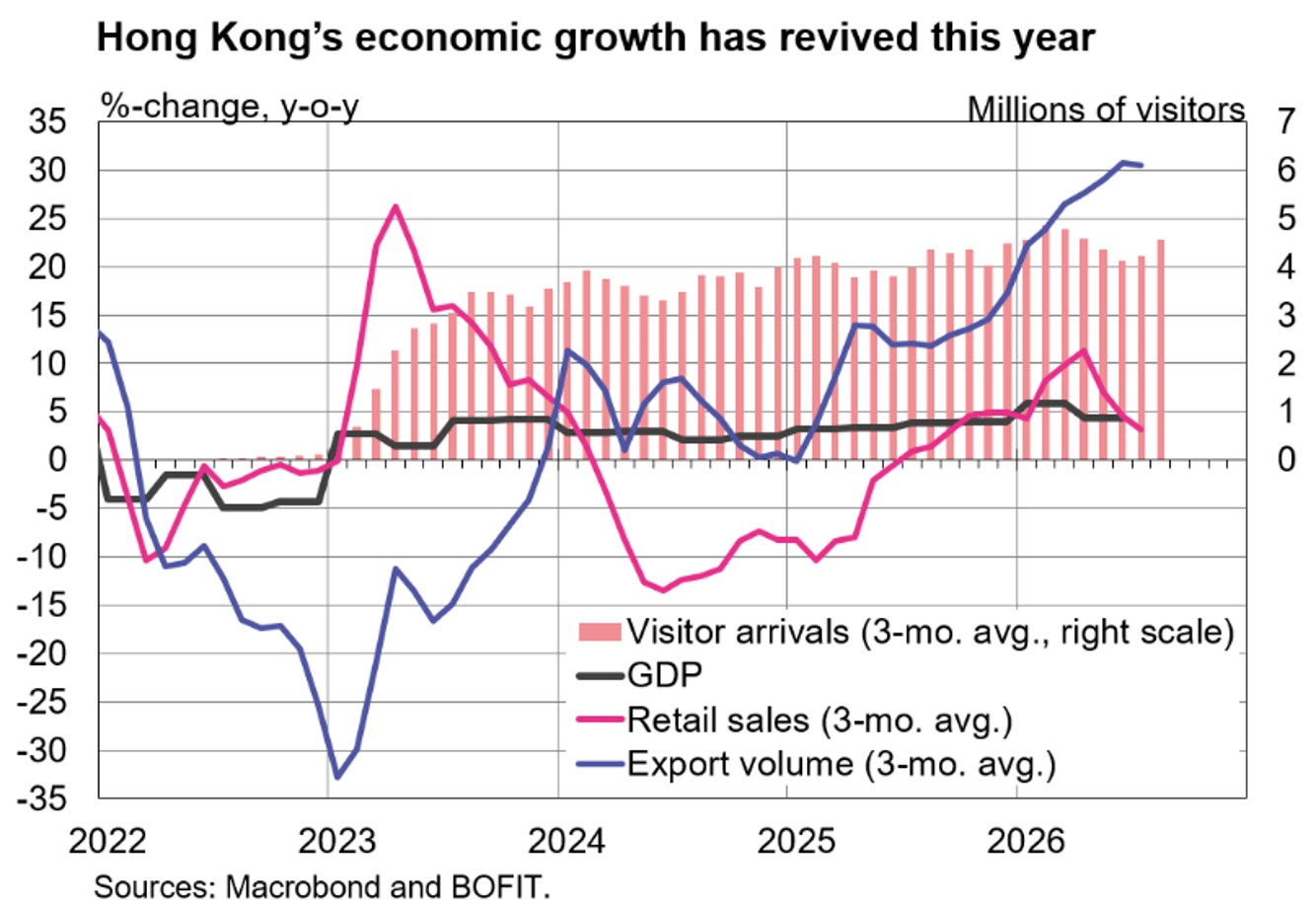
Hong Kong posted a strong first-half performance with the SAR’s GDP climbing by 5.1 % y-o-y (and outpacing growth of 3.5 % for the all of 2025). Foreign trade growth was particularly strong. In January-August, the value of exports increased by 42 %, while the value of imports rose by 43 %. Much of the growth reflects higher prices, but export volumes also climbed by 29 % in January-July. Retail sales have also revived since last year, with the volume of retail sales up by 6.6 % in January-July. Hong Kong tourism was up 11 % y-o-y in January-August, but still ran below pre-pandemic levels.
China’s other special administrative region, Macao (MSAR), has posted strong economic growth in recent years, but growth figures are volatile due to fluctuations in casino revenues and tourist flows. Last year, the MSAR’s economy grew by 4.8 %. Gaming sector accounts for about 45 % of the economy, and gaming revenues increased by 9 % last year. The number of tourists arriving in Macao has already recovered to pre-pandemic levels. The overwhelming majority of tourists come from mainland China. However, as in mainland China, domestic consumption and investment have remained weak. Macao released its third five-year plan in August. It also pledged to deepen the implementation of China’s “one country, two systems" principle and promote development in the Guangdong-Hong Kong-Macao Greater Bay Area. Macao seeks to build upon its special role between China and Portuguese or Spanish-speaking countries. The plan aims to diversify the industrial structure so that the share of non-gaming sectors in the economy would increase to around 60 % by 2030. Last year, the size of the Hong Kong economy was 2.2 % that of the mainland China economy, while Macao’s economy was a mere 0.3 %.