BOFIT Weekly Review 44/2026
Slight rise in China’s official 3Q growth figure
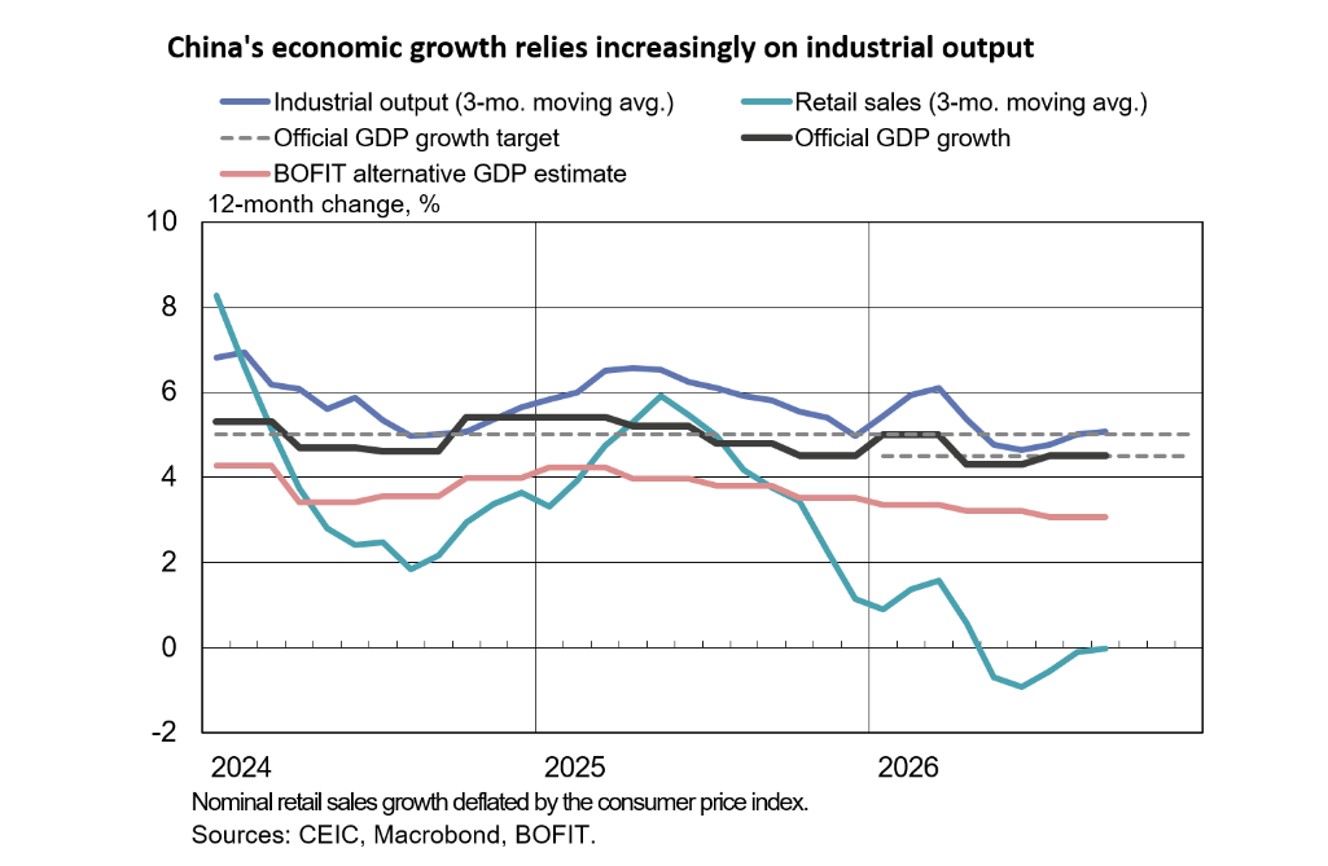
Official figures show the Chinese economy grew in the third quarter at an annual pace of 4.5 %, with a quarter-on-quarter gain of 1.2 %. Growth accelerated slightly from the second quarter (4.3 % y-o-y and 0.9 % q-o-q). Growth in 2026, which has overall remained within the government’s official target range of 4.5–5 %, continues to be supported mainly by industrial output and exports. Domestic demand growth remains tepid.
BOFIT’s alternative GDP calculations suggest that economic growth has slowed over the course of the year, and in the third quarter it was already more than one percentage point below the official figure. As in the second quarter, however, the range of our alternative calculation scenarios remains quite wide. In conjunction with the release of the latest BOFIT Forecast for China 2026–2028 on Monday (Nov. 2), we will be holding our regular briefing on the Chinese economy (in Finnish).
Industrial output rose by 5.5 % y-o-y in September. Growth was distinctly higher in high-tech industries, such as electronics manufacturing, specialized machinery and vehicle manufacturing. By contrast, output contracted in industries such as coal mining, production of building materials, as well as production of metals other than iron and steel.
The value of goods exports increased by as much as 36 % in dollar terms. Some of the increase in the value of exports reflects higher export prices, but the volume of exports has also grown rapidly. During the first eight months of this year growth in the volume of exports averaged around 10 % y-o-y. Export growth this year has been largely concentrated in a few high-tech industries, while growth trends in more traditional export sectors have been distinctly more sluggish.
Growth in domestic demand remains flat. Real growth in retail sales, estimated using consumer price inflation, was still close to zero in September. Car sales were down roughly 20 % y-o-y in nominal terms. Retail sales of building materials and materials for interior decoration and furniture also experienced negative growth. The slide in fixed investment continued in September, declining in nominal terms by about 7 % y-o-y in January-September. Fixed investment declined in most of major sectors, but high-tech investment continued to climb. Investment growth was particularly high in information services, aerospace, electronics and communications equipment. The real estate sector correction continued with no signs of slowing. The volume of apartment sales measured in floorspace decreased by 20 % in September, while the volume of new building starts fell by 25 % y-o-y.
Consumer price inflation remained at a modest 0.9% annual pace in September. Core inflation, which excludes prices for food and energy, rose at 1.0 %. The rise in industrial producer prices, on the other hand, accelerated to 5 % y-o-y. The rise in producer prices largely reflects higher prices for energy and other raw materials.
While the People’s Bank of China (PBoC) continued to keep its overall monetary policy stance unchanged, it announced new targeted easing measures in late September. The central bank lowered its pledged supplementary lending (PSL) rate for policy banks from 1.75 % to 1.5 % and expanded the scope of its funding programmes. PSL funding provides the government with a means of channelling inexpensive financing to strategic investment projects. Even with the rate cuts, however, the stock of PSL financing has declined sharply in recent years. At the beginning of October, China introduced a new interest-subsidy programme for first-time apartment buyers. Under this programme, the government commits to covering one percentage point of the loan interest rate on loans up to 1 million yuan as long as five years. In addition, the central bank increased the quotas for investment in technology and equipment, as well as for refinancing programmes aimed at small and private enterprises. Reporting on the lending stocks of these programmes shows declines up to the first quarter of 2025, after which publication of the figures was discontinued. Higher quotas therefore do not necessarily imply an increase in actual funding, and the overall impact of the targeted easing measures is likely to remain limited.