BOFIT Weekly Review 44/2026
China’s domestic lending slows further
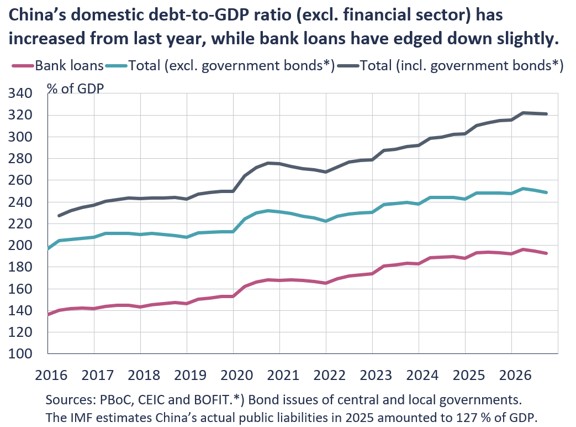
China’s bank lending stock grew by just 4.8 % y-o-y in September. The pace of lending growth has slowed in recent years, and is currently at its lowest level since the data series began in 1998. Demand for loans has been subdued, even though monetary policy has attempted to allocate inexpensive financing to select sectors. The domestic loan stock of Chinese banks equalled 194 % of GDP as of end-September. Loan stock growth has been slightly lower than the growth in nominal GDP, so its size relative to GDP decreased slightly from last year (195 % of GDP in September 2025).
The stock of bank lending to households fell by 3.6 % y-o-y and amounted to 39 % of GDP as of end-September, largely a reflection of the contraction in mortgage loan stock. The amount of mortgage loans issued to households was 35.9 trillion yuan (25 % of GDP). The residential mortgage loan stock has declined from almost 39 trillion yuan (32 % of GDP) in September 2022. The stock of other loans granted to households has also shrunk this year. The stock of bank lending to non-financial corporations and government organisations combined continued to grow at about 7 % y-o-y.
Growth in the PBoC’s broader measure, aggregate financing to the real economy (AFRE), has also slowed, with the outstanding stock up by 7.1 % y-o-y in September. In addition to bank lending, AFRE includes non-financial corporations and government bond issues, share emissions as well as shadow banking instruments. The stock of government bonds grew fastest, up 13.7 % y-o-y. The government bond category in AFRE covers bonds issued by central and local governments (including special purpose bonds), but does not capture, for example, financing obtained through off-budget local government financing vehicles or the debt of state funds. The stock of corporate bonds also increased by 9.3 %. The total stock of shadow banking sector instruments remained roughly at the same level as a year earlier. At the end of September, AFRE corresponded to 321 % of GDP (315 % in September 2025). Much of the growth came from the stock of government bonds, which corresponded to 72 % of GDP (up from 67 % in September 2025).