BOFIT Weekly Review 34/2026
China finds its stride in global artificial intelligence race
China has been catching up with the United States in its development of AI models and related infrastructure. Chinese AI companies operate somewhat differently than their US counterparts, who are currently investing heavily in compute cluster build-outs (large data centres) and AI models that utilise those vast resources. More constrained Chinese firms have responded to their challenges, particularly export restrictions, with their own innovations. Compute is scarce in China as the US, Japan and the Netherlands have tightened rules on exports of advanced chip manufacturing technology to China. In particular, the Dutch ASML has restricted exports to China of its high-end ultraviolet lithographic machines, essential in manufacture of advanced microchips. US-based firms Nvidia, AMD and Intel are also banned from exporting their most advanced chips to China. These limitations have forced Chinese developers to focus on different aspects of AI development. A recent Brookings Institute commentary notes that Chinese developers, due to export restrictions and tighter access to financing, have focused on the calculation efficiency of models and increasing the size of their user bases. China also has a strong position in AI-related supply chains, controlling many of the critical raw materials essential for microchip manufacturing (BOFIT Weekly 32/2026).
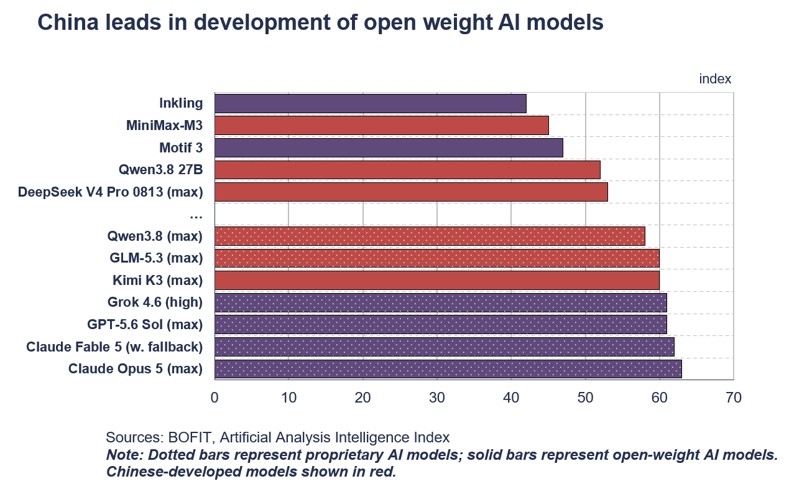
Chinese developers have also improved the efficiency of their AI models by relaxing certain accuracy requirements to optimise speed and cost per task. To increase user numbers, many Chinese developers have decided to keep their models open, so that the parameters used in the development of the models are public and downloadable (i.e. “open weight”). Chinese developers hope to increase their market share with the help of open models, and thereby generate revenue flows from the sale of cloud and support services as companies and application developers build products using Chinese models. Currently, of the five top-performing open-weight models, four have been developed in China. Media reports note that several European firms, including Siemens, have been experimenting with Chinese open-weight AI models in their own systems. China is also emphasising development of AI integration with cars, phones, robots and AI glasses. The AI+ programme set forth by China’s State Council seeks to integrate AI capabilities into manufacturing, healthcare, transport and communications, as well as public administration. In addition, the topic of “embodied” AI (AI-integrated robots and drones) was promoted as a national goal in China’s latest five-year plan (2026–2030).
A comparison by Epoch AI, which studies the use of artificial intelligence, however, finds that while Chinese models still lag in performance by about 7 months compared to the leading US models, the user numbers for Chinese models have soared. According to Liu Liehong, head of China’s National Data Administration, daily token consumption of Chinese models was about 140 trillion in March, an increase of about 40 % from last year and a thousand-fold increase from around 100 billion a day at the beginning of 2024. In China, however, the profitability of its AI industry is weak as the strategy of publishing open models largely relies on future revenue streams.
Chinese advances in development of artificial intelligence are reflected in the production of high-tech and digital products (BOFIT Weekly 34/2026). Chinese investment in artificial intelligence and AI infrastructure continues to increase, despite subdued capital investment in other fields. Although China’s total on-year investment decreased in January-July, investment in frontier technologies, information services, microchips and circuit board manufacturing increased sharply. Growth in these fields likely reflects the data-centre build outs of large online commerce companies. For example, Alibaba’s investments in the fiscal year ending in March rose to 126 billion yuan (about €15 billion), up from 86 billion yuan in 2025. Alibaba’s increased investment focused largely on cloud computing and data centres. Alibaba, through its subsidiary Alibaba Cloud, is the developer of Qwen, a leading family of Chinese LLMs. Tech-giant Tencent also announced a near three-fold increase in its investments in the second quarter, up to 53 billion yuan (€6.7 billion). The scale of spending is still an order of magnitude less than in the US, however. The Rhodium Group thinktank estimates that data-centre investment of US corporations last year exceeded that of Chinese firms by about ten times.
AI-related spending is already evident in China’s trade data. China Customs reports that the value of integrated circuit and microassembly imports reached a cumulative $362 billion year-to-date, a 58 % increase from last year’s January-July numbers. The jump partly accounted for the increased growth in the overall value of Chinese goods exports. On the other hand, much of the trade growth represents higher prices. In the first seven months of the year, import volumes increased at a much slower pace than value—around 8 % for integrated circuits. The price of computer RAM (random access memory) has risen sharply as large manufacturers have concentrated their capacity on memory required for AI servers. This has benefited Chinese manufacturers CXMT and YMTC, whose shares of the global DRAM (dynamic RAM) and NAND RAM (not-and flash RAM, non-volatile storage memory) markets have increased.