BOFIT Weekly Review 33/2026
Higher oil prices boost Russia’s export earnings, but fiscal deficit widens
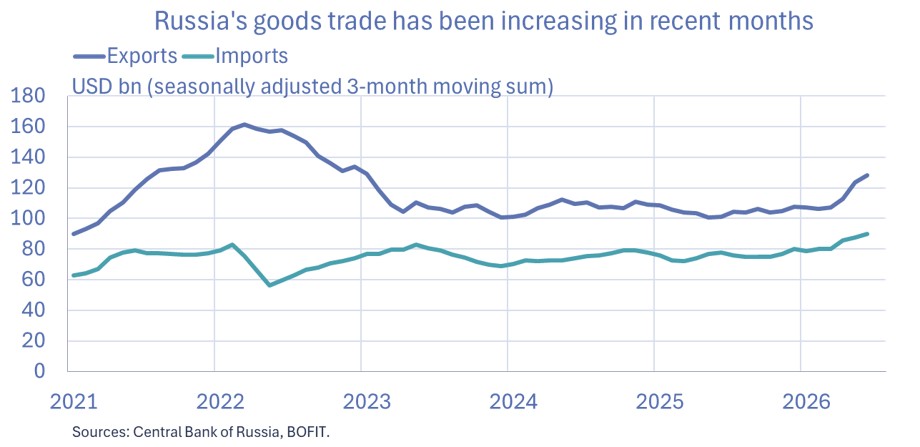
Russian goods exports and imports up in recent months
Preliminary figures from the Central Bank of Russia (CBR) show that the value of goods exports in January-June rose to 226 billion USD, a 16 % gain from a year earlier. The goods exports trend has been heavily influenced by oil prices as fossil fuels account for over half of Russia’s goods exports. With the outbreak of the Iran war in late February, oil prices on world markets and the price of Russia crude oil surged to levels well above those of spring 2025. The International Energy Agency (IEA) estimates that the average export price of Russian oil in the first half of this year was 17 % higher than in 1H25. Oil prices have subsided somewhat in recent months. The IEA put the average export price of Russian crude in June at $65 a barrel and $60 a barrel in July.
The IEA also notes that Russia’s exports of refined oil products have declined sharply in recent months, especially in July, when exports of refined oil products fell to about half of their 2025 daily average (a drop from about 2.6 million to 1.4 million barrels a day). Exports of refined oil products have been diminished by Ukraine’s drone attacks on Russian production and transport facilities and Russian export bans on many refined oil products. The decline in exports of refined oil products has been partly offset by increased crude oil exports. The volume of Russian total oil exports (crude oil and refined oil products) in July declined, however, by roughly 5 % from the 2025 daily average to around 7 million barrels a day.
The value of Russian metals and food exports has also increased significantly this year as global commodity prices have generally risen. By contrast, exports of machinery, equipment & transport vehicles have declined markedly. These products have accounted for about 6 % of Russia’s goods exports this year.
The value of Russia’s goods imports has also risen in recent months. The value of goods imports in 1H26 climbed to 161 billion USD, a 14 % increase from 1H25. Russian goods trade, however, was strongly in surplus, with the first-half surplus climbing to 65 billion USD. Russian customs figures show that import growth this year has been led by products in the machinery, equipment & transport vehicle category. These imports accounted for about half of all goods imports. Imports of textiles and chemical products have also grown rapidly. The increase in imports has been supported in part by the ruble’s relatively strong exchange rate.
Notably, Russian exports to Asia have increased this year. Russian customs statistics show Asian countries now account for 80 % of Russia’s total goods exports. The increase in imports has been more broad-based, with imports up from all regions other than Africa. Asian countries now provide for almost 70 % of Russia’s imports.
Federal budget deficit continues to balloon
According to preliminary finance ministry figures, Russia’s federal budget revenues increased in January-July by 9 % y-o-y. The growth was driven by higher value-added tax (VAT) revenues, which were up 25 % y-o-y due to the hike in VAT rates at the start of this year. Oil and gas revenues in January-July were still down 17 % y-o-y, although they have recovered in recent months on higher oil prices. The impact of higher oil prices in dollars on budget revenues has been limited by the relatively strong ruble exchange rate. In January-June, the average ruble price of Russian oil was actually about 4 % below the government’s 2026 budget assumption.
Federal budget spending continued to rise in July, but spending growth has slowed significantly in recent months compared to the spring. Federal budget expenditures in July increased by 6 % y-o-y, meaning that there was no growth in real terms. In the first seven months of this year, however, spending rose by 15 % due to a burst of spending in the spring. The finance ministry explained that the growth in spending reflected front-weighting of expenditures and that its expects the situation to normalise as the year continues. Nevertheless, the finance ministry also appears to have revised upward its federal budget expenditure estimate for this year by 1 trillion rubles, while keeping its revenue projection for the year unchanged.
In January-July, the federal budget deficit climbed to 6.5 trillion rubles, or nearly 3 % GDP. Most of the shortfall will be financed with the issuance of additional debt. At the end of June, president Vladimir Putin signed an amendment into law that will allow the government to take on additional debt this year. In Russia’s most recent sovereign bond auction, however, the government struggled to find buyers for government bonds (BOFIT Weekly 31/2026). As of end-July, Russia’s National Welfare Fund held roughly 3.7 trillion rubles in liquid assets.
Ruble’s real exchange rate strengthens
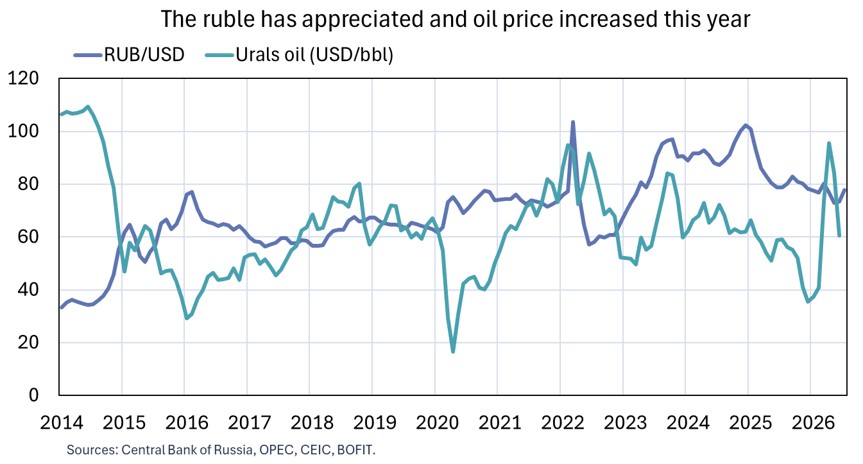
The ruble’s exchange rate today is largely shaped by extensive Western sanctions and Russia’s efforts to regulate capital movements. As a result, the ruble’s exchange rate no longer reflects the sentiments of international investors as to the Russia’s economic prospects or oil prices. Although the ruble’s exchange rate has weakened in recent weeks against the US dollar, euro and yuan, its exchange rate against those currencies is still about 30 % higher than at the end of 2024. In July this year, the ruble averaged 78 to the dollar, about the same level as in July 2025.
The correlation between oil prices the ruble’s exchange rate has historically been fairly loose. Following the CBR’s abandoning of a nominal exchange rate target at the end of 2014, the ruble’s exchange rate tracked changes in oil prices in 2015–2017 quite closely. Currency purchases in compliance with the governments 2017 “fiscal rule” then smoothed exchange rate fluctuations and reduced the link between oil prices and ruble rate swings. Since early 2022, the connection between the price of oil and the ruble’s exchange rate seems to have been almost completely severed due to war and sanctions.
Sanctions have meant that the ruble’s exchange rate is today determined almost exclusively by domestic supply and demand for foreign currency. The ruble’s appreciation may also reflect to some extent the structural changes in the Russian economy due to its wartime footing. Even if the trade surplus brings foreign currency into the country, Russian people and businesses have fewer and fewer opportunities to use foreign currency in Russia. The significance of imports for the economy has decreased, and rubles are increasingly used as the currency of payment for imports, which has further diminished forex demand. Moreover, with the reduction of Russia’s foreign debt, less forex is needed to service that debt. High interest rates and fears of restrictions on capital movements have motivated Russians to store their wealth in rubles rather than foreign currency-denominated investments. The nominal exchange rate is by no means a reading of confidence in Russia’s economic trends.
However, the nominal exchange rate does play a major role in government oil revenues as the oil production tax is based on the average export price of Russian crude in dollars. Nominal rate appreciation lowers production tax revenues in rubles. On the other hand, nominal exchange rate appreciation makes imported goods cheaper, which reduces inflationary pressures.
In addition to rising nominal exchange rates, Russia’s inflation has outstripped that of its main trading partners, thereby driving up the ruble’s real exchange rate. The Bank of International Settlements (BIS) calculates that the ruble’s real effective (trade-weighted) exchange rate has risen by roughly 30 % since 2020, putting it currently on a level similar to that of 2013–2014. Real ruble appreciation further erodes the already weak competitiveness of Russia’s domestic industries, making excessive ruble appreciation problematic.