BOFIT Weekly Review 34/2026
Chinese domestic demand remained weak in July; no major policy changes on the horizon
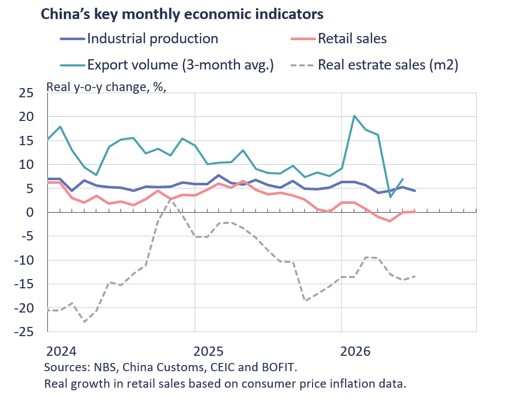
China’s National Bureau of Statistics (NBS) reports that retail sales, a rough measure of domestic consumption, grew in July by just 0.6 % in nominal terms. Real growth was likely close to zero. Although China does not release reliable monthly-level fixed investment figures, trends remain weak. There have been no signs of recovery in the housing market. Real estate investment in the first seven months of this year contracted by 19 % y-o-y, while apartment sales measured in terms of floorspace declined by 12 %.
Industrial output growth has been noticeably stronger than domestic demand, but even that slowed slightly in July to 4.5 % y-o-y. Manufacturing of high-tech products rose by 17 % y-o-y, while growth in manufacturing of lower value added products was much weaker.
Exports continued to support Chinese industrial growth. The value of goods exports in US dollars increased by 24 % in July, while the value of goods imports rose by 28 %. However, due to increased prices, the growth in the volume of trade has been much slower than value growth in recent months. The China Association of Automobile Manufacturers (CAAM) reports that domestic production and sales of new cars in the first seven months of this year was down from the same period last year. In contrast, China’s car exports have boomed, with 6.1 million cars exported in January-July, an increase of nearly 70 % y-o-y.
Weak fixed investment trends and the struggling housing market have reduced loan demand. The stock of bank loans grew by just 5 % y-o-y in July. The People’s Bank of China’s broadest credit measure, aggregate financing to the real economy, rose by 7.4 % y-o-y, led by issuance of central and local government bonds (up 14 %) and corporate bonds (up 9 %).
Consumer price inflation slowed to 0.5 % y-o-y in July. Producer prices also declined on a month-on-month basis, but grew still by 3.5 % y-o-y. Producer prices have been boosted mainly by higher energy prices, and producer prices for consumer goods continued to slide (down 0.8 % in July). The capacity utilisation rate in manufacturing also continued to decline, reaching in July its lowest level since early in the Covid-19 pandemic in 2020. Fierce domestic competition and underutilisation of capacity in several sectors are expected to again depress producer prices as the effects of recent energy price spikes wane.
The end-July politburo meeting, which focused on economic issues, ended without any announcements of significant changes in policy directions. Reflecting the government’s desire to implement economic policies more efficiently, domestic demand is set to be strengthened by increasing consumption of services and high-quality supply. On the fiscal side, releases of public funds will be accelerated, but the press release from the meeting made no reference to increased funding from the budget framework adopted in March. Funds allocation will emphasise support for new infrastructure and key government construction projects. The monetary policy stance was described as “relatively loose,” despite the fact that the PBoC has not implemented any headline monetary policy easing since spring 2025.