BOFIT Weekly Review 32/2026
China retains dominance of critical raw material production
This year’s Global Critical Minerals Outlook, which was released in July by the International Energy Agency (IEA), shows that the mining and refining of critical minerals is increasingly concentrated in the hands of a few producer countries, not to mention refining and processing of rare earth elements (REEs). One insight, however, is that REE refining and procession is increasingly happening outside China as well, though in relatively small capacity. Global investment in critical minerals, on the other hand, declined by 9 % last year. China thus continues to account for a significant share of critical mineral processing. China is the largest or second-largest refiner of key critical materials, including lithium (74 %), cobalt (76 %), battery-grade graphite (94 %), copper (47 %) and nickel (31 %). China is not necessarily a dominant player in mining output, however. For example, China’s global share of copper, cobalt and nickel ore production is only 2–8 %, though Chinese firms own many mines abroad. In contrast, refining of the REEs used in permanent magnets (84 %) and mining of REEs generally (59 %) is heavily concentrated in China, even if China’s share of refining magnetic REEs fell last year from its over 90 percent share in previous years. The REEs used in permanent magnets (neodymium, praseodymium, dysprosium and terbium) are important for electronics and the defence sector, as well as in the manufacture of electrical motors and wind turbines. In 2023–2025, the growth in energy mineral production (includes manganese, nickel and natural graphite) was concentrated in a few producer countries. Indonesia dominated in nickel production, while China accounted for over three-quarters of the total increase in processing of other energy minerals. Chinese-owned firms, however, control about 75 % of Indonesia’s nickel refining capacity.
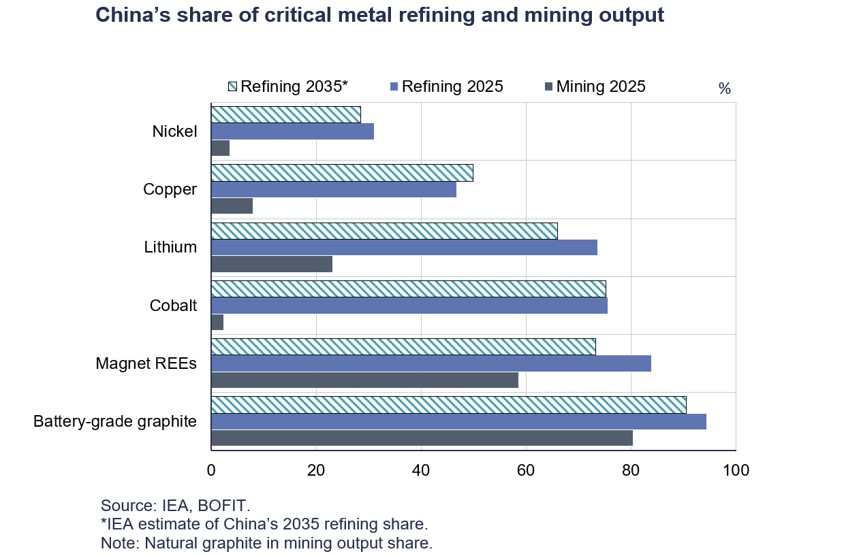
China has achieved strategic critical mineral dominance through long-term government-supported investment in the production chains for critical minerals domestically and abroad. The IEA estimates that Chinese firms invested roughly $120 billion between 2023 and 2025 in foreign mining operations, as well as over $15 billion in domestic ore exploration in 2024. China’s strong grip on upstream production in the critical mineral value chain has generated a large market share in terms of intermediate and final products that utilise them, including magnets, silicon wafers, battery materials and semiconductor components. These intermediate products, as well as other components incorporating critical minerals, are essential in the production of electrical vehicles, solar panels and manufacture of wind turbines – all fields where Chinese firms hold significant market shares.
China’s export restrictions have expanded considerably since we visited this topic last year (BOFIT Weekly 26/2025). The number of commodity-group codes subject to export controls tripled from December 2023 to April 2025, and the value of exports of restricted products rose to more than $11 billion last year. In October 2025, the restrictions were extended to products manufactured outside China contain REEs of Chinese origin, but enforcement of the restrictions was subsequently postponed until November 10, 2026. The IEA estimates that the full implementation of the export restrictions risk approximately $6.5 trillion in annual production outside China. In June, China added ten US companies to its export control list, including Nevada-based rare earth producer MP Materials Corp., which operates the only REE mine in the US, and Oklahoma-based REE processor USA Rare Earth.
At the G7 summit in Evian, France in June, the G7 members agreed on reducing their dependence on REEs and permanent magnets. By 2030, no single country outside the G7 bloc should control over 60 % of the supply of REEs and permanent magnets. On August 5, Oxford Economics released a forecast and policy predictions concerning permanent magnets, laying out the policy measures Western governments use to support domestic REE production through e.g. price floors, government financing and long-term supply contracts. This approach, however, has the potential to create surplus alternative capacity at higher cost. If so, REE supplies outside China could remain permanently more expensive than their Chinese equivalents, even when there is no physical scarcity on world markets. For example, the US Department of Defense established a ten-year price floor of $110 per kilogram for neodymium-praseodymium (NdPr) products to guarantee MP Materials operational stability. REE price differences between China and Western countries have already emerged. According to the IEA, European prices of gallium and the heavy REEs dysprosium and terbium are about five times higher than China’s domestic market prices. Although REE ore reserves are geographically dispersed, their exploitation requires significant investment in separation and processing, fields where China has a strong position.
The IEA estimates that China’s share of natural graphite mining production will decrease from 80 % to about 53 % by 2035, but processing of battery-grade graphite will remain above 90 %. China’s REE processing capacity outside China would cover about half of its projected mining output in 2035, while refining activities would only account for about a third. Diversification focused solely on mining could shift dependence on China for critical minerals down the value chain rather than reducing it.