BOFIT Weekly Review 35/2026
Russia’s diverging economic trends continue
Production trends vary considerably from industry to industry
Preliminary Rosstat figures show Russian GDP grew by 1.3 % y-o-y in the second quarter of 2026. Due to the contraction in economic activity early this year, GDP growth was just 0.6 % y-o-y in the first half overall. Output trends also varied substantially from branch to branch. Preliminary figures indicate that most 2Q growth was driven by higher retail sales and production of services, while production in extractive industries and construction declined by nearly 2 % y-o-y.
The latest business climate survey conducted by the Central Bank of Russia (CBR) found diverging trends also in fixed investment in the second quarter. The economy overall saw fixed investment recover slightly from the low point at the start of the year. The most positive investment figures were posted in retail sales and services, as well as consumer goods manufacturing. Construction sector activity, however, showed further deterioration in the second quarter. Extractive industries also experienced weak fixed investment trends, even with slight improvement from their lows at the start of the year.
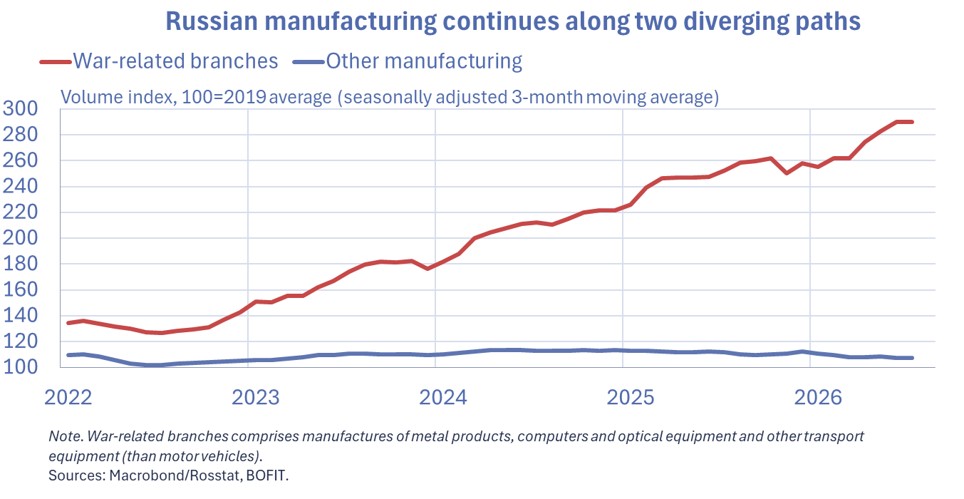
The latest industrial output figures suggest economic growth remained subdued in July. The seasonally-adjusted volume of industrial output remained essentially unchanged from previous months. The volume of industrial output also remained unchanged on a yearly basis. Mining & quarrying output contracted by 3 % y-o-y in July, while manufacturing output rose by 2 %. For the first seven months of this year, mining & quarrying output contracted by 1 % y-o-y, while manufacturing grew by 0.5 %. As in previous years, manufacturing growth was largely supported by industries linked to the war, and output continued to contract in most other industries. The seasonally-adjusted volume of industrial output in branches not directly linked to the war effort was lower this summer than at the beginning of 2022.
The CBR business climate index reading suggests companies are expecting their business prospects to improve in coming months in comparison to realized development, but their expectations have moderated in nearly all industries. The outlook is considered particularly bleak by construction companies, as they are expecting demand and investment to continue declining also in coming months. Firms in extractive industries also anticipate slight reductions in output and fixed investment. Manufacturers and retailers, in contrast, see a mild brightening of their business prospects and increased fixed investment opportunities later this autumn.
Different development tracks at the regional level
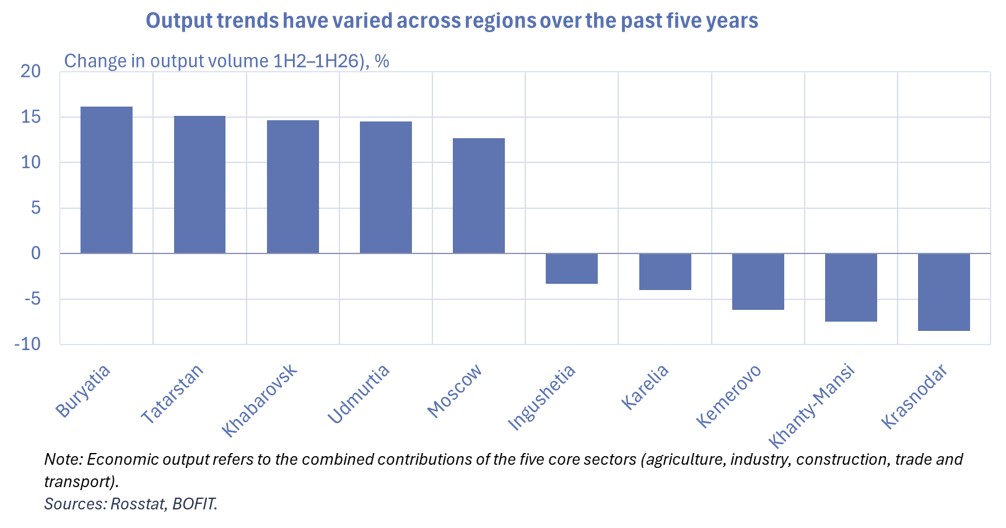
Since the full-on invasion of Ukraine in 2022, Russia’s economic development has been highly varied at the regional level –and 2026 has been no exception. Although the release of regional GDP data only occurs after long lags, Rosstat’s composite output indicator based on five core sectors of the economy (agriculture, industry, construction, trade and transport) comes out monthly. This composite indicator suggests that during 2022–2026 growth has occurred in four of Russia’s eight federal districts – the Far Eastern, Volga, Central and Northwestern federal districts. In the remaining federal districts (Southern, North Caucasian, Ural and Siberian federal districts), the level of production in 1H26 was lower than in 1H21.
Output trends also vary considerably within the federal districts. The highest output growth was recorded in regions benefiting from growth of the military-industrial complex (e.g. Udmurtia and Tatarstan), Russia’s main metropolises (Moscow and St. Petersburg), as well as regions with large natural resource development projects in the Far East (Magadan and the Jewish Autonomous Oblast). Weakest economic development has been seen in regions that include regions bordering Ukraine (e.g. Bryansk and Krasnodar), the poor republics of southern Russia (Ingushetia, Karachay-Cherkessia), as well as commodity-producing regions hit hard by Western sanctions on Russian exports (e.g. Komi, Kemerovo and the Khanty-Mansi Autonomous Okrug).
Price trends have also fluctuated across regions. Consumer prices nationally were about 44 % higher this summer than in early 2022. Price trends have been slightly above average in the North Caucasian, Siberian and Southern federal districts, while the Central, Northwestern and Ural federal districts experienced below-average consumer price inflation. Prices at the regional level have risen most rapidly in several border regions (e.g. Kamchatka, Murmansk and Kaliningrad) and in the poorer republics in Russia’s southern parts (Tuva, Ingushetia and Buryatia). The rise in prices was slightly below average in certain regions in the Far Eastern federal district (e.g. Chukhotka and Khabarovsk), as well as in Moscow and St. Petersburg.
Downward revisions in Russian GDP growth forecasts for this year
Most recent forecasts see weaker Russian GDP growth this year than previously expected. Inflation forecasts have also been revised upward. The outlook for the Russian economy has dimmed following a weak first-half performance, moderating oil price trends and Ukraine’s drone strikes.
The imbalances in the economy have further widened and risk levels have increased. The rapid growth in government expenditure and ballooning deficits have complicated government finances and fuelled inflation. The rise in fuel prices has also contributed to an acceleration in inflation as Ukrainian drone strikes have reduced Russian production capacity. Russian banking sector situation has recently raised some worries as liquidity has tightened, due, among other things, to a rising demand for cash. The situation in the banking sector is examined in more detail in a forthcoming BOFIT blog posting.
The CBR’s July forecast update noted that GDP is now expected to grow by 0–1 % this year, a reduction from 0.5–1.5 % in its previous forecast. CBR officials explained the reduced outlook reflected such factors as transient declines in production capacity in some industries. Specifically, the forecasts for fixed investment and exports were revised downward. The decline in the export forecast also reflects a temporary drop in export capacity. The GDP forecast for 2027 remains in the range of 1.5–2.5 %. At the same time, the central bank raised its inflation forecast and now expects consumer prices to rise by 5.9–6.2 % this year (up from 5.1–5.6 % in the CBR’s spring forecast). The CBR also raised its 2027 inflation outlook to a range of 4.3–5.2 %. The CBR’s spring forecast still anticipated Russia achieving its official inflation target of 4 % a year by 2027.
The IMF’s updated forecast released in July sees Russian GDP growing at an annual rate of 1.1 % this year and next year. The August compilation of institutional forecasts from Consensus Economics finds that the average of GDP growth forecasts is 0.7 % this year and 1.2 % next year. The inflation forecast average is 6.2 % for 2026 and 4.6 % for 2027.