BOFIT Weekly Review 46/2026
PBoC moves to slow yuan appreciation even as discussion of the currency's undervaluation intensifies
The People’s Bank of China (PBoC) announced it would raise the foreign exchange reserve requirement for banks by 200 basis points to 6 percent, effective Sunday (Nov. 15). The move slightly reduces the amount of foreign currency (mainly dollars) in the financial system, helping to restrain yuan appreciation. The reserve requirement for foreign currency deposits was last raised during the yuan’s appreciation episode in summer 2021, and subsequently lowered to its current level in autumn 2023 after the currency weakened. According to news reports, many Chinese banks have also significantly increased interest rates on dollar deposits. The move should encourage depositors to hold on to their forex, thereby reducing appreciation pressure on the yuan.
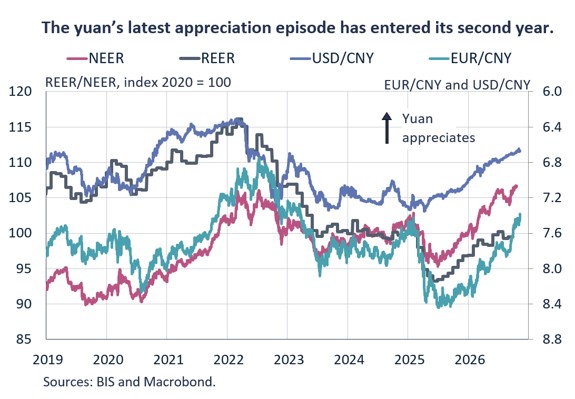
The latest appreciation episode of the yuan, which began last year, has continued in recent months. The yuan has gained 5 % against the dollar since the start of the year and 10 % against the euro. China’s real effective (trade-weighted) exchange rate, or REER, was up 3 % in September from the start of the year. According to the Netherlands Bureau for Economic Policy Analysis (CPB), an organisation that monitors the volume and prices of global trade, Chinese export prices calculated in US dollars were 15 % higher in August than at the end of 2025, while prices in global trade overall were up by 10 %. Domestic producer prices have also risen, with Chinese on-year producer price inflation hitting 5.7 % in October. However, the rise has not been passed on to domestic consumer prices, which were up by only 0.7 %.
Despite the currency appreciation, the debate on the weakness of the exchange rate has intensified as Chinese trade surpluses have increased. The IMF’s 2026 External Sector Report asserts that China’s REER was roughly 17–25 % undervalued in 2025. The IMF estimate is based on the change in the exchange rate at which the current account surplus would be at the equilibrium level implied by medium-term fundamentals and desirable policies for the Chinese economy. The economic fundamentals contributing to the undervaluation are weak domestic demand and low prices. In addition, China’s industrial policy increasingly supports export-focused production. The PBoC, in comments on exchange-rate trends last month, stated that China's foreign trade gains largely reflect the increasing competitiveness of Chinese industries and that the country has never sought to bolster its competitive advantage by currency devaluation.