BOFIT Weekly Review 47/2026
Russia’s rising military spending has crowded out other expenditure and depleted its savings
Federal budget spending growth slowed in October
According to preliminary figures released by Russia’s finance ministry, federal budget revenues grew by 11 % y-o-y in first ten months of this year. Growth in October reached 18 % y-o-y as oil & gas revenues were lifted by higher prices. While federal budget spending also rose by 13 % y-o-y in January-October, the on-year pace of spending growth in October was just 2 %. The federal budget deficit for the first ten months of the year was 5.2 billion rubles, roughly 2 % of GDP. The Ministry of Finance expects the deficit to reach 7.3 trillion rubles (3 % of GDP) by the end of this year.
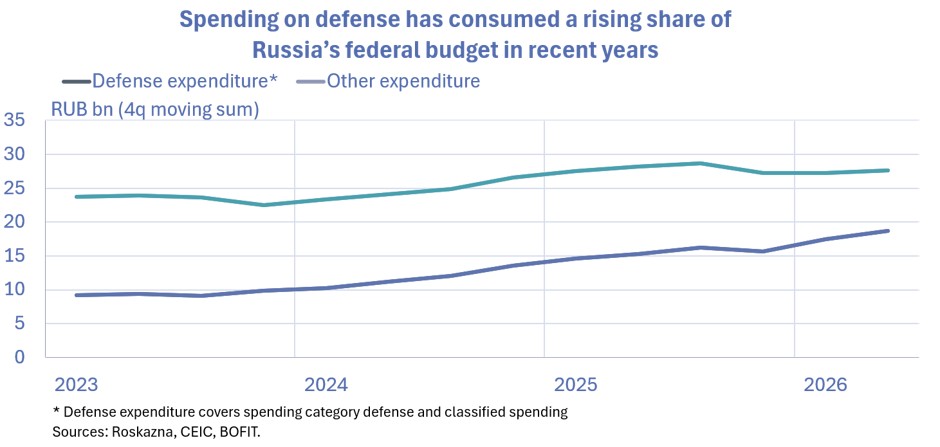
While some more detailed information on federal budget allocations in January-September have also been released, about a third of these budget figures hide information on how the money was spent, i.e. secret or classified spending lines. The combined value of classified spending and defense expenditure can be regarded as a rough estimate of Russia’s war-related spending. In reality, the total is likely to be even higher, as some war-related expenditure is also included under other spending categories. Defense spending and classified spending together accounted for roughly 40 % of total federal budget expenditures in the first nine months of this year. These expenditures rose by nearly 30 % y-o-y, while other spending was up by just 6 %. As prices have risen at the same pace, there has been essentially no increase in other spending in real terms. However, in July-September, the growth of war-related expenses slowed significantly. Expenditures increased by only 6 % after the large spending surges early this year.
Some other federal budget spending categories have seen substantial cuts this year. Funding for housing and municipal services, for example, was reduced by 15 % y-o-y in January-September. The cuts likely reflect reduced government funding programmes for housing loan subsidies and apartment production. Federal spending on healthcare contracted by 8 % y-o-y in January-September. Healthcare is only partly funded from the federal budget, and the federal contribution has been decreasing in recent years (covering just 23 % of total healthcare spending this year). Moreover, social expenditures in the federal budget have been nearly flat in recent years. High inflation has savaged social spending in real terms. The share of the federal budget in financing social expenditures has also narrowed, falling below 30 % this year.
Russia’s fiscal rule seeks to mitigate economic impacts of changes in oil prices
Russia’s fiscal policy has been guided by a fiscal rule, the rule on use of oil & gas revenues to replenish or drain National Wealth Fund. The purpose of the rule is to dampen the impacts of fluctuations in oil prices and oil revenues on fiscal policy and the ruble’s exchange rate. Similar budget rules are common in countries where a large share of state tax revenues derive from natural resource extraction. When oil & gas prices are high, the additional revenues are to be set aside as savings, and when prices fall, the savings can be withdrawn to cover government expenses.
Under the fiscal rule, Russia’s federal budget projects oil & gas revenues using a relatively conservative oil price assumption. Oil & gas revenues that exceed the base projection should be used to purchase foreign currency or gold, assets that are then deposited in the National Welfare Fund (NWF). If actual oil & gas revenues fall below the base projection, forex can be withdrawn from the NWF, exchanged for rubles and used to finance budget deficits. The finance ministry announces beforehand forex operations planned for the coming month. The forex purchased or sold is applied to offsetting the difference between the realised oil price and forecast assumption. The CBR conducts these operations on the finance ministry’s behalf.
In recent years, however, Russia has repeatedly slipped in its application of fiscal rule to deal with the rapid growth in spending on the Ukraine war. The NWF has been drained to cover government deficits without regard for prevailing oil prices or base revenue projections.
National Welfare Fund’s liquid assets have evaporated
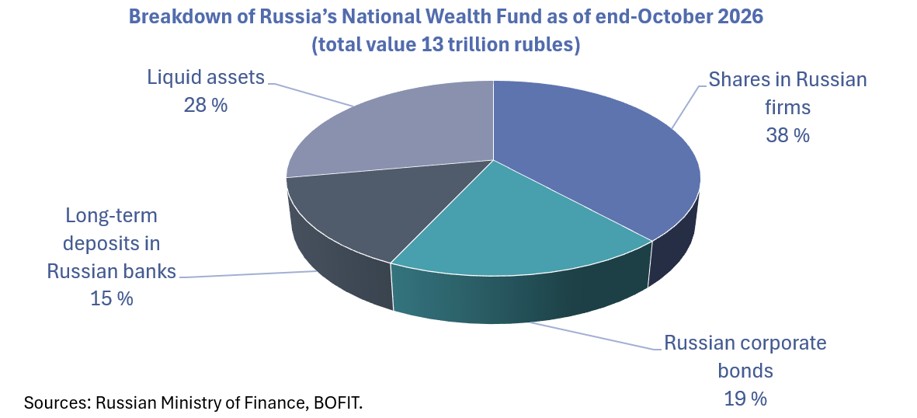
National Welfare Fund assets as of end-October totalled 13 trillion rubles or 5.6 % of GDP. Some 30 % of NWF assets are reported to be held in readily accessible liquid forms. The remaining assets are tied up typically in longer-term investment projects. Converting them to cash would be difficult, at least in the short term.
In the first years of the Ukraine war, NWF assets were relied on heavily to cover deficits and support the economy. This year, assets valued at about 500 billion rubles have been withdrawn from the NWF. In February 2022, the fund held liquid assets valued at around 9.7 trillion rubles (6 % of GDP). According to latest figures for end-October 2026, the value of liquid assets was about 3.6 trillion rubles (1.5 % of GDP). The liquid assets consist of gold and yuan-denominated assets.
Other NWF assets include shares and corporate bonds of Russian firms, as well as long-term deposits in Russian banks. The largest equity asset is the government’s majority stake in the shares of Sberbank, Russia’s largest bank. Other major NWF shareholdings include the state railways corporation (RZD), the government’s financial institution for housing and urban development (DOM.RF), as well as banks VTB and Gazprombank. The largest bond holdings involve state-owned defence contractor Rostech and state road construction company Avtodor.
Sanctions limit central bank’s control over Russia’s foreign currency reserves
The liquid assets of the National Wealth Fund (NWF) are part of foreign currency reserves held by the central bank. The Central Bank of Russia (CBR) is tasked with managing Russia’s foreign currency reserves on behalf of the finance ministry. The CBR uses NWF funds when conducting forex transactions in accordance with the fiscal rule. In addition to fund assets, the foreign currency reserve also covers the actual foreign currency assets on the central bank’s balance sheet. Due to economic sanctions imposed on Russia, the CBR cannot access a large part of these assets.
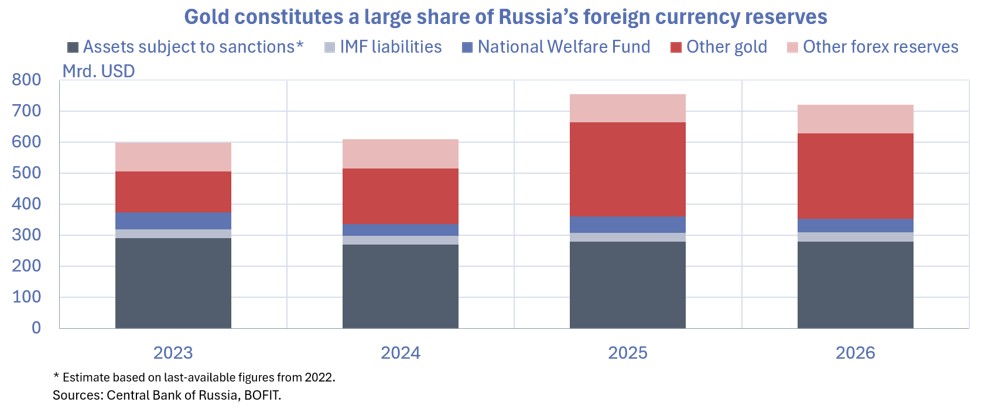
Changes in Russia’s foreign exchange reserves in recent years have largely reflected sharp fluctuations in the price of gold, given the large share of gold in the reserves. However, the physical amount of Russia’s gold holdings has been quite stable in recent years, declining by only about 3 % this year. As the CBR is sanctioned by the Western countries, its possibilities to sell gold are also limited. Many sanctioning countries have also placed restrictions on importing gold from Russia.
CBR figures put the value of Russia’s foreign currency reserves at about $720 billion as of end-October. Of that, the gold holdings were valued at around $290 billion and about $30 billion were Russia’s IMF liabilities (SDRs and reserve position in IMF). Actual foreign currency-denominated assets amounted to about $400 billion. The most recent breakdown of Russia’s foreign currency assets was published in early 2022. At that time, 70 % of foreign currency assets were held in currencies of sanctioning countries, and due to sanctions cannot be accessed by the CBR.
Based on these figures, an estimated 30% of the foreign-currency assets and 60% of the total gold and foreign exchange reserves are actually under the control of the Russian central bank. The value of the gold and foreign exchange reserves controlled by the CBR would thus be roughly $412 billion, including $44 billion in NWF liquid assets.