BOFIT Weekly Review 46/2026
Newest BOFIT forecast sees slowing growth and greater economic imbalances in China
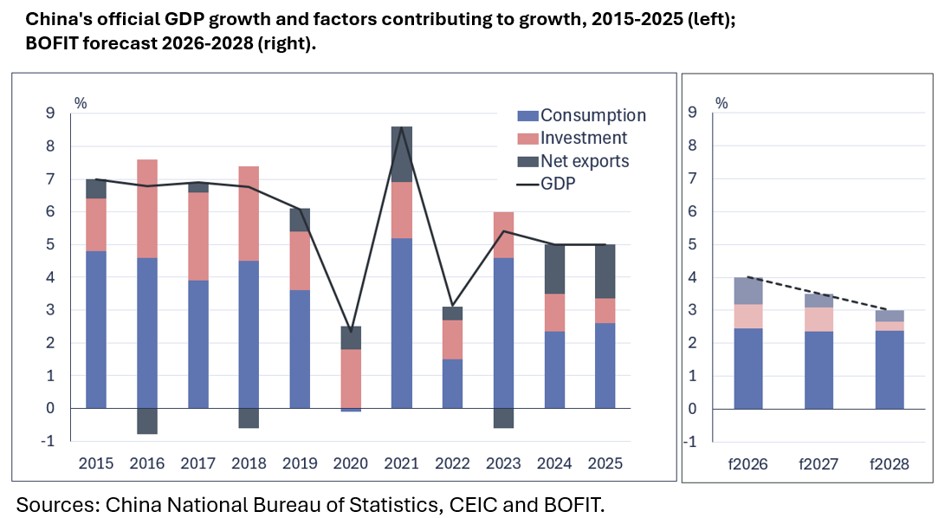
BOFIT last week published its latest Forecast for China for 2026–2028. While the pace of Chinese growth continues to beat that of most large economies, growth has slowed this year. We now expect China’s real economic growth to come in at around 4 % this year, around 3½ % in 2027 and about 3 % in 2028. In official statistics, this year’s GDP growth is one again expected to fall within the government’s target range of 4.5–5 %, but the overall picture of economic development points slower actual growth than this. Factors depressing growth include sluggish domestic demand, a rapidly ageing population, declining returns from China’s investment-driven growth model and slow productivity growth.
The structure of growth has also become increasingly unbalanced. The prolonged decline in housing prices and weak labour markets have dampened consumer confidence and depressed consumption growth. Authorities have announced new, limited measures to support consumption, but they are not enough to alter household behaviour. A broad based, consumption-driven turnaround in growth is not in sight.
The correction of the real estate sector continues. China’s shrinking population, large stocks of unsold or unfinished apartments and weak demand limit the sector’s recovery. While the downturn in the real estate sector is expected to moderate during the forecast period, the sector can no longer be relied upon as a significant growth engine. The pace of investment is not expected to pick up significantly over coming years as real estate investment remains low, and underutilised capacity and weak profitability in many industries reduce the need for new capital investment. Instead, investments are increasingly concentrated in sectors prioritised by the government, such as semiconductors, robotics, electric vehicles (EVs), battery technology, renewable energy and digital infrastructure. However, the ability of these investments to replace the real estate sector’s earlier role as an engine of economic growth is more limited.
The Chinese economy is also becoming increasingly reliant on exports. Export growth is driven in particular by high-tech products such as artificial intelligence, battery technology and EVs. The development of more traditional export sectors, on the other hand, has been more subdued. China’s export success is supported by the country’s vast production capacity, advances on the technological frontier, well-functioning production chains, hefty government subsidies for industry and an weak currency. Export growth is expected to continue throughout the forecast period, but gradually slow down closer to global trade growth. The current account surplus will nevertheless remain large, so its external imbalances are unlikely to diminish significantly.
China’s export success and mounting trade surpluses have aggravated global trade tensions. Bilateral trade between the United States and China has been constrained by high tariffs and technology restrictions, forcing some trade to pass through third countries. Trade tensions between the European Union and China are also on the rise. China’s increasing dependence on export-driven growth simultaneously makes it more vulnerable to shifts in global trade.
While the government’s fiscal and monetary policies are geared to supporting growth, room to manoeuvre in the policy space has narrowed. Fiscal policy is particularly constrained by the rapid rise in government debt. When the debt of off-budget local government financing vehicles (LGFVs) is taken into account, China’s government-debt-to-GDP ratio rose to 127 % last year (and should reach 135 % this year according to the latest IMF estimate). China’s current policy focus seems to be on dealing with faltering economic growth rather that a strong stimulus response. Monetary policy is also constrained as interest rates in China are already distinctly lower than in other major economies. Interest rate cuts would further weaken bank profitability, motivate higher capital outflows and fuel yuan depreciation pressures. Moreover, China’s biggest problem at the moment seems to be weak demand, not financing costs.
Risks to the economic outlook are tilted to the downside. Further problems in the real estate market, weakening finaced of local governments and growing credit risks in the banking sector could reinforce one other and cause financing conditions to tighten further. Tighter trade policies and increased geopolitical tensions could also erode the export outlook. In addition, gaps in statistical reporting and censorship continue to make it difficult to assess the true state of the economy, which may also increase the possibility of policy missteps. On the upside, growth could surprise positively if, for example, social security reforms bolster consumer confidence, the real estate sector stabilises faster than expected or the government moves ahead with a larger-than-expected stimulus response.