BOFIT Weekly Review 42/2026
Global economy continues to grow despite Iran war
The global economy has experienced exceptional turbulence this decade, including the Covid-19 pandemic and rising geopolitical tensions. Despite these shocks, global economic growth has exceeded forecaster expectations as countries, firms and consumers have managed to adapt to a changing environment. This surprising resilience is on full display this year with the global economy humming along despite the Iran war and disruption in global energy supplies. Despite a clear increase in energy prices, even steeper price hikes have been avoided by exploiting alternative supply routes for oil and refined oil products in the Middle East and through the depletion of national oil inventories. The decline in China’s crude oil imports in the early stages of the Iran war also helped to bring balance to global oil markets. Capital investment in artificial intelligence (AI) has been another factor supporting the global economy. The AI boom, which has been particularly pronounced in the United States, has helped sustain US economic growth as well as growth in semiconductor-chip-exporting countries in East Asia (especially Taiwan and South Korea, and also China).
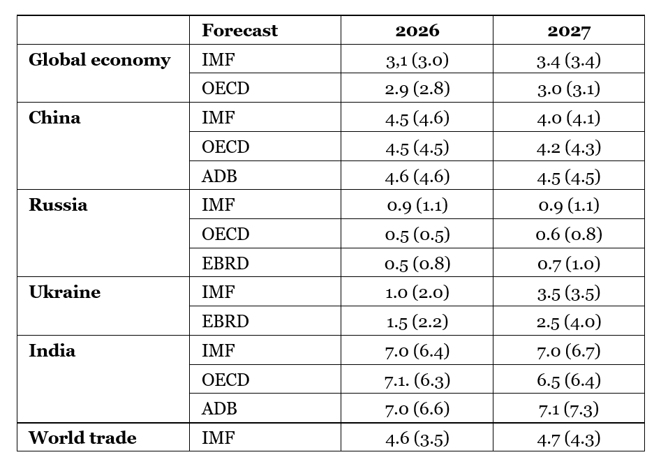
Against this background, the International Monetary Fund (IMF) this week slightly raised its outlook for growth of the global economy to 3.1 %, despite the protracted crisis in the Middle East. Global economic growth, however, is increasingly focused on countries outside the Middle East that currently benefit from high energy prices, or AI investment. The OECD’s September forecast reflected slightly greater concern than the IMF over the impact of rising inflation on household demand, but still sees economic growth as exceeding expectations this year with the Middle East crisis. The IMF, OECD and Asian Development Bank (ADB) all expect the Chinese economy to grow by around 4.5 % this year. On November 2, BOFIT releases its own Forecast for China in conjunction with a Finnish-language briefing on the Chinese economy. The outlook for Russian economic growth has been revised downwards in the latest forecasts of the IMF and European Bank for Reconstruction and Development (EBRD). BOFIT’s latest Forecast for Russia sees the Russia economy growing at around 1 percent this year and half a percent next year.
Most forecast risks are on the downside. If the crisis in the Middle East continues, national inventories of energy commodities will start to deplete, which could lead to a sharp increase in energy prices from current levels. The public sector was able to support households and companies affected by high energy prices in the early stages of the Iran war, but the recent increases in interest rates, combined with high levels of public debt, makes this more difficult. Moreover, the huge AI rollout is based on expectations of continued strong demand for computing capacity. If expectations fade, this could considerably slow growth in countries at the forefront AI investment, as well as in global trade. On the other hand, AI is also expected to strengthen economic growth as the work processes related to its use develop. There is no strong evidence at this point on of the effects of AI on productivity gains at the macroeconomic level, although AI has been demonstrated to increase productivity in certain tasks.
Growth outlooks (%) for the global economy and several countries, with previous institutional forecasts in parentheses.