BOFIT Weekly Review 42/2026
China-EU trade talks yield results
An EU trade delegation led by trade commissioner Maros Sefcovic was in Beijing last week to meet with a Chinese trade team led by vice premier He Lifeng and trade minister Wang Wentao. Sefcovic said a goal of the discussions was to find ways to put trade relations on a more equal and balanced footing. The negotiations, as noted in the joint statement, resulted in a promise from China to limit its exports of hybrid cars to Europe. Following the talks, sources specified that the EU is imposing an annual import quota on Chinese hybrid cars of 350,000 units next year, with a 6 % increase in the quota each subsequent year. Sefcovic noted the quota restricts imports of hybrid cars from China to less than half the current EU estimate of 800,000 hybrids this year. The import quota applies to all car manufacturers with production in China.
China also agreed to continue the expedited processing of export licences for rare earth elements (REEs) and permanent magnets to Europe. Sefcovic added that understanding had been reached on reducing tariffs for certain products. The sides further agreed to continue discussions on a range of issues, including access of European medical devices to the Chinese market.
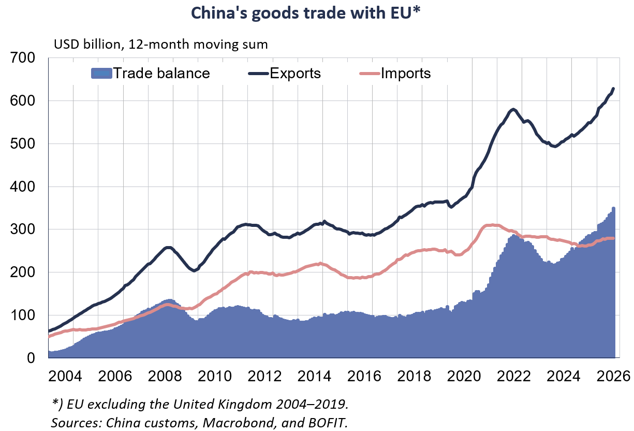
Pressure from European governments and industries to achieve results in trade negotiations has increased significantly in recent months. Europe has been unable to stem the rising tide of price-competitive Chinese imports – an avalanche of goods now seen as a threat to Europe’s manufacturing base. Earlier in October, Germany and France sent a joint letter to the EU, demanding swift and decisive action to protect the EU from market-distorting foreign competition. While the swift progress in negotiations has generally been received positively in Europe, the price competitiveness of Chinese products in comparison to European products remains quite strong. In other words, the current trade concessions do little to reduce the trade imbalance overall.
A slight relief for car manufacturers outside China also came with an announcement from China’s finance ministry this week that it will reduce the value-added tax (VAT) rebate on exports of electric and hybrid vehicles from 13 % to 9 % from the beginning of April 2027. According to some estimates, this tax incentive may be gradually phased out altogether in the coming years. In many countries, including Finland, exports are not subject to VAT.
According to China Customs, both the country's goods exports and imports have increased by more than 20 % y-o-y this year. Trade in goods with the EU has grown more slowly. China Customs reports the value of Chinese goods exports to the EU in the first nine months of this year amounted to $486 billion (up 16 % y-o-y). Almost half of China’s exports to the EU consisted of machinery and electrical equipment, while slightly over 10 % were vehicles, just under 10 % chemical and plastic products, as well as slightly less than 10 % textiles, clothing and footwear. In the same period, China imported $208 billion (up 6 % y-o-y) in goods from the EU. Nearly 40 % of imports consisted of machinery and electrical equipment, slightly less than 20 % chemical products and just under 10 % transport equipment. Chinese Customs calculates that China’s January-September trade surplus with the EU amounted to just under $280 billion.