BOFIT Weekly Review 41/2026
Russia’s growth slows further, government finances remain in the red
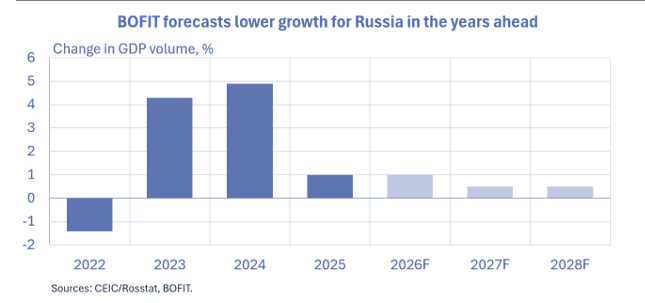
Trends in the Russian economy have been weak this year. Rosstat reports Russian GDP grew by just 0.6 % y-o-y in the first half of 2026. The economic development ministry estimates that 12-month growth during January-August was slightly higher at 0.8 %. Growth is expected to slow further in the years ahead. Russia’s this year’s budget deficit will be again larger than originally planned. The government’s just-released three-year budget framework assumes that deficits continue throughout the 2027–2029 period. Even these projected deficits, however, could understate the eventual deficits when realised. Despite Russia’s troubled economic outlook, the country has sufficient resources to sustain the production capacity and financing needed to pursue its war on Ukraine.
BOFIT forecast sees Russian economic growth slowing further
Our latest BOFIT Forecast for Russia sees Russian GDP growth slowing further next year to around ½ percent. Higher government spending remains a key driver of growth, although economic bottlenecks limit its impact. We assume the war situation and sanctions pressures remain largely unchanged, while oil prices decline gradually. Russia can sustain the production and financing needed to continue waging war, but its economy has become more vulnerable to unanticipated shocks. Thus, the risk of Russia’s economy slipping onto a worse growth path is substantial.
As in previous years, government spending is expected to increase rapidly next year as the war requires ever-higher spending. Most of the increase in spending is directed towards war-related expenditures, while growth in other spending remains more subdued. Government finances will remain in deficit throughout the forecast period, with most of the deficit financed by additional government borrowing.
Monetary policy will continue to be tight as government spending and deficits continue to rise. The Central Bank of Russia (CBR) halted its gradual interest rate-cutting in September in response to rising inflationary pressures, keeping its key interest rate at 14 %. Consumer prices rose by 6 % y-o-y in September. The central bank warned that monetary policy would have to be tightened if the government eases fiscal policy more than already expected. The recent CBR forecast sees the key rate averaging 10.5–12.5 % next year and 8–9 % in 2028.
High interest rates are toxic for fixed investment growth. Preliminary Rosstat national account figures show fixed investment contracted by 8 % y-o-y in the first half of this year. Financing of new investment has been constrained by lower corporate earnings and high financing costs. Firms also feel less pressed to make additional investments at the moment. The slowdown in economic growth has reduced capacity utilisation in many industries and the demand outlook has deteriorated.
Private consumption should continue to grow next year, but growth should slow gradually. Russia’s tight labour market also appears to have eased slightly in recent months. There have even been minor indications of rising unemployment and a slowdown in wage growth. While high inflation has eroded consumer purchasing power, Russians can dip into their savings built up in recent years to make up for flagging income growth.
The weak trend in Russia’s foreign trade is likely to continue. Exports have been limited by sanctions and Ukrainian strikes on Russian infrastructure. Import growth should also be subdued by slowing growth in demand and a weak ruble. Russia’s current account surplus, however, is expected to remain in surplus through the forecast period.
Our latest forecast comes with a host of upside and downside risks. Sudden shifts in the course of the war could lead to significantly worse economic performance than in our baseline scenario. Swings in oil prices could also hurt or boost the Russian state’s fiscal room to manoeuvre. The balancing of the government’s conflicting fiscal and monetary policy goals during wartime is increasingly difficult to achieve. Failure by the government to reconcile its dissonant economic policies could precipitate an economic recession.
Implementing Russia’s latest three-year budget framework could be difficult
The Russian government submitted its 2027–2029 budget framework to the lower-house Duma for consideration at the end of September. The government also provided adjustments to this year’s budget estimate, especially with respect to spending and the deficit.
Projected 2026 spending has been raised by 7 % from the level of last year’s approved 3-year budget framework. The revenue estimate has been revised only slightly upward. At the same time, this year's deficit is expected to significantly exceed the budget forecast, climbing again to last year’s record level, 8.6 trillion rubles (4 % of GDP).
The new budget framework sees consolidated budget revenues increasing by 7 % in 2027. In terms of the federal budget, oil & gas revenues are expected to decline by 8 % next year. The budget assumption for the average export price of Russian oil next year is $53 a barrel. The contribution of oil & gas revenues to the federal budget would fall to 16 %. The federal budget’s other revenue streams are expected to increase 8 %. Growth in taxes on revenues (e.g. corporate profit taxes and income taxes on private individuals) is expected to reach 24 % next year. Sales taxes (includes VAT, excise taxes and customs duties) would rise by 11 %. The framework proposes several revenue-raising measures, including adding interest and dividend income to the personal income tax base, imposing windfall taxes on certain mining companies, and extending VAT to foreign online commerce. Government revenues in 2028–2029 are expected to increase by about 6–7 % y-o-y.
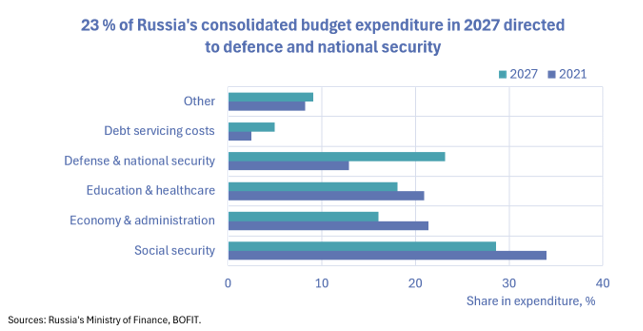
The budget framework projects a 4 % increase in consolidated spending next year. In real terms, total spending would be flat, with some categories apparently facing cuts even in nominal terms. On the other hand, spending in the “defence” category is set to climb again to record levels. Next year’s budget allocates about 17 trillion rubles (200 billion USD) to defence, nearly five times more than in 2021. Spending tied to the war is also included in national security spending. Defence and national security together are expected to gobble up about 23 % of consolidated budget expenditure next year. Among the major spending categories, social security should account for about 30 % of expenditure next year, with the economy & public administration, education and healthcare categories each garnering around 10 % of spending. The budget calls for increased spending on the order of 5–6 % a year in 2028 and 2029.
The budget framework sees federal finances remaining in deficit throughout the next three-year period, although the deficit is expected to shrink gradually. Next year’s deficit would amount to 6.5 trillion rubles or 2.6 % of GDP. In the following years, the deficit would gradually fall to around 2 % of GDP. Throughout the entire 3-year period, the deficit would largely be financed through increased government borrowing. The value of the debt stock in 2029 would be about double that of 2025.
Russia’s new budget framework appears difficult to implement as Russia continues its war in Ukraine. Both government spending and the deficit could well exceed next year’s budget forecast, a situation discussed in a BOFIT blog item posted this week (in Finnish). Deficit financing is likely to become more difficult as several tax hikes have already been implemented, and the government’s debt-servicing costs continue to rise.