BOFIT Weekly Review 31/2026
Weak first half for Russian economy; EU expands sanctions
Russia’s State Statistics Service (Rosstat) reports that the output of five core sectors of the economy (agriculture, industrial output, construction, transportation, and wholesale and retail trade), that roughly captures trends in GDP growth, increased by 0.2 % y-o-y in the first six months of the year. This positive figure suggests a mild recovery in economic activity following a weak start to the year. GDP contracted by 0.2 % y-o-y in the first quarter.
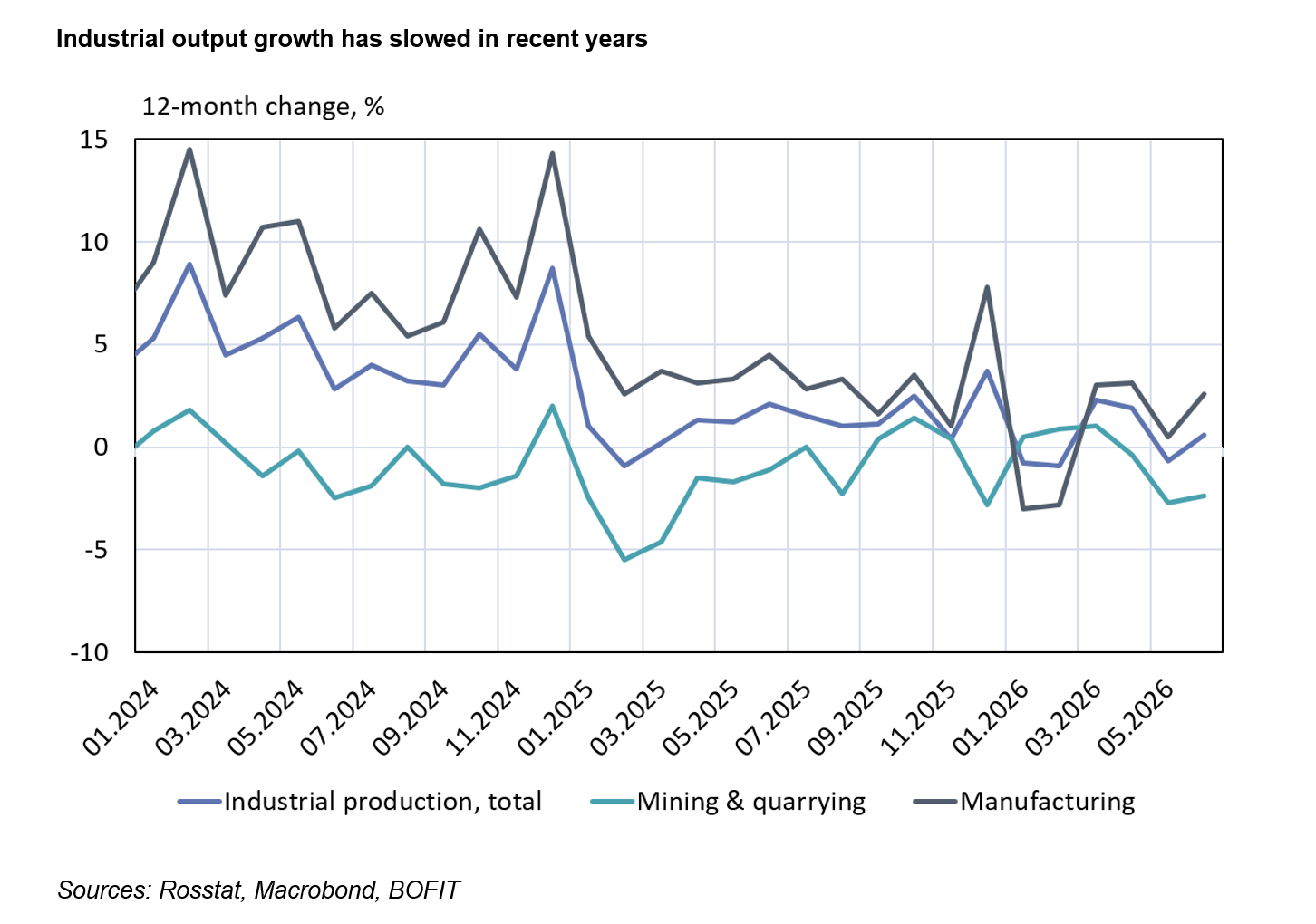
Industrial output, up 0.4 % y-o-y in January-June, contributed strongly to growth. Growth came almost exclusively from the manufacturing sector, and specifically serving the military-industrial complex. For example, production of transport vehicles other than automobiles increased by 32 %, production of other metal products rose by 9 %, production of computers and optical equipment increased by 4 %, and pharmaceutical manufacturing was up by 14 %. Output declined slightly in other manufacturing industries, as well as in the mining & quarrying sector (especially oil production). The production interruptions caused by Ukrainian drone strikes were distinctly reflected in the decline in the production of coke and petroleum products. June output of these industries fell by 12 % m-o-m and 22 % y-o-y.
Economic growth in the first half also got a boost from retail sales (up 5.4 % y-o-y) and hotel & restaurant services (up 6.1 %). In contrast, growth in private services slowed slightly to 2.6 %. The general weakness of economic growth was clearly reflected in household income trends. Real disposable income growth slowed to 1.5 % in 1H26, down from 7 % y-o-y in 2025.
Exports of refined oil products plummet
In recent months, Ukrainian drone strikes have damaged Russian oil refineries and the infrastructure related to oil transport and storage at an accelerating pace. The International Energy Agency (IEA) estimates that Russian crude oil output averaged 8.9 million barrels a day in June, which was roughly 120 kb/d more for the month than in May, but about 4 % (400 kb/d) below the June 2025 output.
About ten monthly attacks on key oil refineries were reported in May, June and July. Several refineries have been hit on multiple occasions. Almost every refinery in western Russia has now come under attack from Ukraine. The IEA estimates that Russian refinery runs at the beginning of July were down about 1.6 million barrels (30 %) from July 2025. The difficulties of refineries and the destruction of infrastructure have caused significant shortages of diesel fuel and gasoline. At the same time, the retail prices of fuels have risen markedly, despite tax subsidies for oil companies. As usual, regions have been tasked with dealing with the practical challenges of fuel shortages. Many regional governments have resorted to temporary rationing measures to cope with the situation.
Prior to Ukraine’s attacks on oil infrastructure, Russia exported about 4.8 million barrels of crude oil a day and over 2.5 million barrels in refined petroleum products. With Ukrainian strikes and subsequent export bans on gasoline and jet fuel, Russia’s exports of refined products plummeted to 1.9 million barrels in June, while crude oil exports increased slightly. At the beginning of July, the export of diesel fuel was also banned, a move likely to further reduce raffinate export volumes. Russia now imports more refined oil products from Belarus, especially gasoline.
The export price of Russian crude oil has tracked world market prices, but the price difference between benchmark Brent and Urals loaded at the Baltic port of Primorsk and Black Sea port of Novorossiysk has consistently remained around $20–25 a barrel all this year. The IEA notes that the Urals price in June averaged around $61 a barrel. The average price of Urals and ESPO blends, which Russia uses as the reference basis for setting its mineral extraction tax, was $64 a barrel in June, a level slightly higher than this year’s federal budget assumption ($59).
CBR lowers key rate
Consumer price inflation accelerated slightly in June, with prices up 6 % y-o-y on average. Prices of municipal services and certain basic foodstuffs were clearly higher than a year ago. However, much of the current inflation burst was a response to the problems in oil refining caused by drone strikes and soaring fuel prices. The consumer price of motor gasoline in June was 20 % higher than a year earlier.
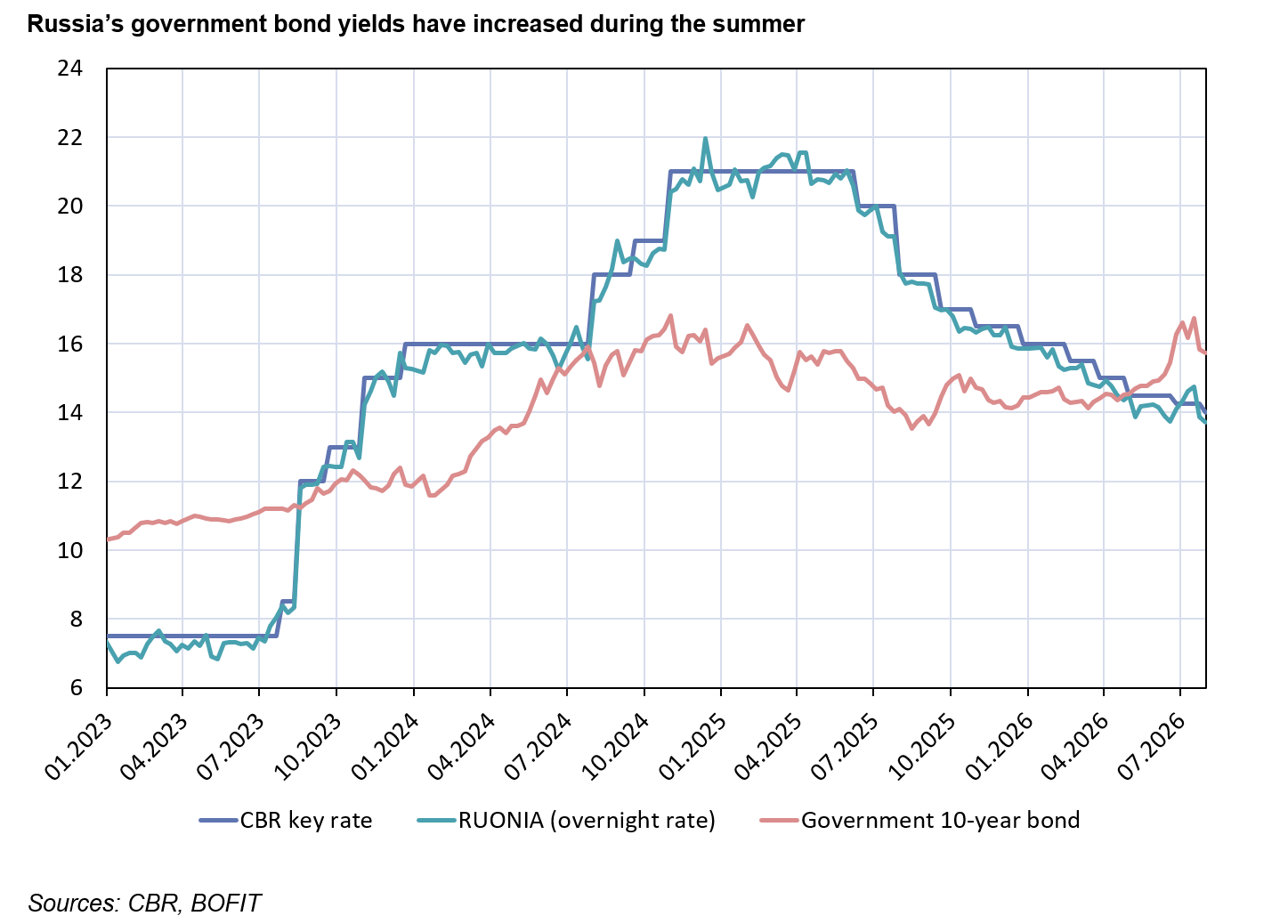
CBR decision-making requires constant balancing between inflationary pressures, economic growth and government debt-servicing costs. At its regular monetary policy meeting on July 24, the CBR board decided, despite inflationary pressures, to lower the key rate by 25 basis points to 14 %. The CBR noted that the latest flaring of inflation comes from transient factors, leaving room for a rate cut. At the same time, the CBR revised its forecast GDP growth range for this year slightly downward from 0.5–1.5 % to 0–1 %. The board also significantly amended its 2027 rate outlook, stating that the key rate and average inflation will be higher than in its previous 2027 outlook. The changes reflect larger public sector deficits than previously forecast.
Financing budget deficits has become more challenging
Russia’s 2026 budget act sets the federal budget deficit at 3.786 trillion rubles. With increased spending and falling oil revenues, the January-June deficit had already climbed to 5.731 trillion rubles, roughly 2.5 % of GDP. The updated budget plan released in mid-July now puts the entire 2026 deficit at 4.828 trillion rubles. Achieving this goal is challenging to say the least. Given that significantly higher revenues towards the end of the year are highly unlikely, federal spending cuts would be needed to stay within the budget framework. Spending cuts, however, are also off the table, at least until after the Duma elections in September. Some budget-balancing could result from postponing scheduled expenditures to 2027 and some spending obligations could be delegated to regional governments. Even with these measures, however, government borrowing is likely to well exceed original budget projections (5.5 trillion rubles).
Despite CBR cuts in the key rate, government bond yields have continued to rise this summer. At the beginning of the year, the yield on 10-year government bonds (OFZs) was about 14.5 %, slightly lower than the CBR’s key rate. Interest rates have clearly exceeded the key rate since May. The issuance of new ruble-denominated bonds in the first half of the year proceeded as planned, but investor sentiment has soured in recent weeks. In the wake of a string of failed bond auctions, the finance ministry on July 20 suspended new bond issues to “calm” the markets. Higher bond yields would result in higher debt-servicing costs for government debt than budgeted.
A possible reason for the lack of interest on the part of banks could involve the explosive growth in use of cash and the resulting strains on liquidity. In June, the narrow measure of cash in circulation (M0) was nearly 2 trillion rubles higher than a year earlier, with the result that banks have increased their reliance on the CBR to provide liquidity. Greater reliance on cash could reflect increased economic uncertainty, dipping into household savings, as well as avoidance of new taxes. Growth in household bank deposits has slowed throughout the first half of the year, and, despite a decline in policy rates, some large commercial banks have raised their deposit rates.
The Russian government naturally would like to see interest rates decline quickly and debt markets return to normal. Otherwise, the financing of the expenses inflated by the war would have to be shouldered increasingly by state-owned enterprises, the pension fund, and the CBR. The 1.5 trillion rubles of debt planned for July-September is still fairly modest relative to the size of the Russian economy and the banking sector. For example, the first-half profits of Russia largest bank, state-owned Sber, amounted to 995 billion rubles.
EU expands sanctions on Russia
On July 23, the European Commission approved its 21st round of Russian sanctions. The latest sanctions package includes a full broadside of measures aimed at Russia’s financial sector, oil exports and entities involved with the military.
The EU decided to keep its crude oil price ceiling at its current level for all of 2027. This is to ensure that Russia does not enjoy a windfall caused by increased oil prices due to the Iran war. Under previous practice, the price cap would have been raised in line with world market prices. Another 41 vessels were added the EU’s shadow fleet list, bringing the number of black-listed ships to 692. The listed tankers are likely to find shipping operations outside the sanctions very difficult.
Extensive new measures target the banking sector. EU extended its transaction ban on 33 additional Russian banks. The transaction ban implies, among other things, exclusion of banks from the SWIFT system, which prevents the sending and receiving of international payment orders through the global SWIFT network. The transaction ban covers a total of 103 banks and a number of crypto operations. Moreover, the EU also significantly extended its list of sanctioned companies. The assets of listed companies and entities with operations in the EU have been frozen. This list now includes almost all major Russian banks and money transfer companies.
The EU expanded export bans on various goods and further restricted imports of e.g. certain ores from Russia into the EU. Imports of liquefied natural gas (LNG) from Russia are set to end in January 2027.
Sanctions and export restrictions were also imposed on several third-country (e.g. China, Turkey and Kyrgyzstan) entities suspected of conspiring to circumvent sanctions. Extending sanctions to entities in other countries is a relatively new measure in EU’s sanction toolkit, but these are seen as necessary to assure sanctions bite. For example, the efficacy of US sanctions largely derives from their impacts on countries other than the target country. China has earlier responded to US company-specific sanctions with its own counter-sanctions on US firms. Following the announcement of the new EU sanctions, China responded immediately by imposing export bans on 14 European firms. China’s export ban applies to Chinese products, software and technologies classified as dual-use items. It is too early to assess the impact of China’s retaliatory measures.