BOFIT Weekly Review 32/2026
China-Russia bilateral goods trade increased rapidly in the first half of this year
China Customs reports the value of exports and imports of goods both grew by over 20 % y-o-y in the first six months of 2026. China’s first-half exports were valued at $61 billion, while the value of imports climbed to $74 billion. Trade between the two countries contracted in 2025, but with rapid growth goods exports and imports this year are on track to hit record highs. There is no country-specific data available on trade in services overall. However, based on available figures, tourism between the countries show an increase, which has been facilitated by the 30-day visa-free regime introduced last September by China and December by Russia. Presidents Xi Jinping and Vladimir Putin have met over 40 times since 2013, with the most recent meeting being Putin’s visit to Beijing in May. The next meeting might occur next month at the BRICS summit in India.
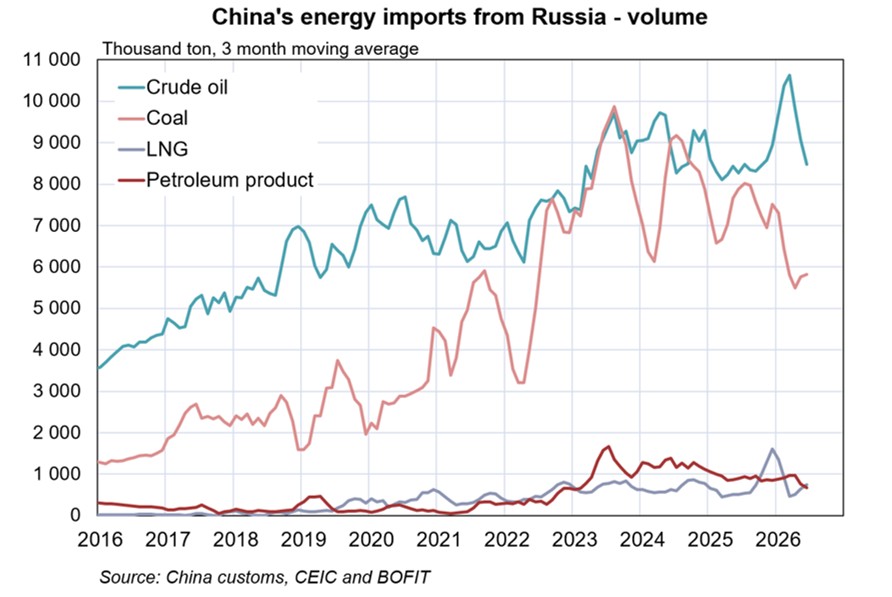
Energy accounts for the bulk of China’s imports from Russia. As the Iran war has complicated shipping of oil and natural gas from the Middle East, China has increased its energy purchases from Russia and other energy-producing countries (with the exception of the United States). In the first months of this year, China imported an exceptionally large amount of oil from Russia, but in recent months import volumes have settled backed to normal levels. First-half imports amounted to 57 million metric tons, an increase of 17 % y-o-y. The value of oil imports rocketed (up 30 % y-o-y), however, as the Iran war has put upward pressure on global oil prices. Customs data for recent months show China has been buying Russian crude at a discount well over 10 % relative to the price of oil imports from other suppliers.
The volume of China’s liquefied natural gas (LNG) purchases from Russia in the first half was up by almost 27 % y-o-y as China scrambled to make up for Qatari supplies disrupted by the Iran war. Reuters reports that China is opening a second LNG terminal this autumn to receive gas from Russia from the sanctioned Arctic LNG-2 project.
The value of Russian pipeline gas purchased by China contracted by 6 % y-o-y in the first half of this year. Since the full-on invasion of Ukraine in 2022, China has ceased reporting of its pipeline gas imports broken down by country. The volume of coal imports (down 20 % y-o-y), as well as the value of coal imports, have declined sharply this year. As a result of the export bans imposed by Russia, imports of oil products have also fallen significantly (volume down by 11 % y-o-y), although the value of oil product imports has remained close to zero due to higher prices.
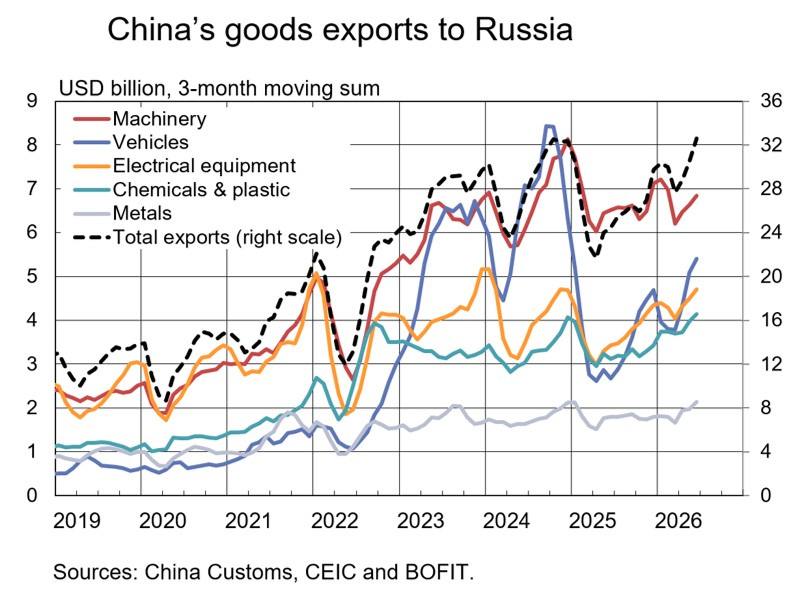
China’s exports to Russia consist largely of manufactured products, with automobiles playing a particularly prominent role. China’s car exports to Russia contracted significantly last year after Russia raised its recycling fees on foreign imports. China’s exports of cars to Russia rebounded strongly to 448,000 vehicles in the first half of this year (up 150 % y-o-y), despite the fact that recycling fees remain in force and the passage of Russia’s new law in March requiring that taxis are Russian-made. Chinese car manufacturers also have established manufacturing facilities in Russia. By some estimates, Chinese makes already constitute over half of Russia’s new car market.
China’s exports of other goods to Russia have also increased. Exports of textiles, clothing and footwear in January-June were up 23 % y-o-y, while export of chemical industry products increased by 26 % and electrical equipment by 32 %. Among the broader export categories, only the export of mechanical machinery showed a weaker performance (up only 2 % y-o-y).