BOFIT Weekly Review 30/2026
China's vehicle exports shift into high gear
Chinese car production this year rose to a cumulative 15 million vehicles, of which roughly 5.3 million were exported, with over a million sent out in June – a new record. Exports grew fastest in the second quarter of the year, when nearly three million vehicles were exported from China. If China's monthly growth in vehicle exports follows previous years’ trends and the current growth pattern, this year's cumulative vehicle exports could reach 13 million. The value of Chinese car exports in the first half of this year amounted to roughly €79 billion. The value of car exports in the same period last year was €54 billion. Compared to June 2025, car exports increased by 71 % in June. Moreover, cumulative vehicle exports in 2025 only reached the 5-million mark in September and never exceeded the 1-million mark in a single month. Chinese vehicle production rose to 35 million vehicles in 2025 (30 million in 2024). The production capacity of China’s automotive sector is currently estimated at around 45–50 million units a year.
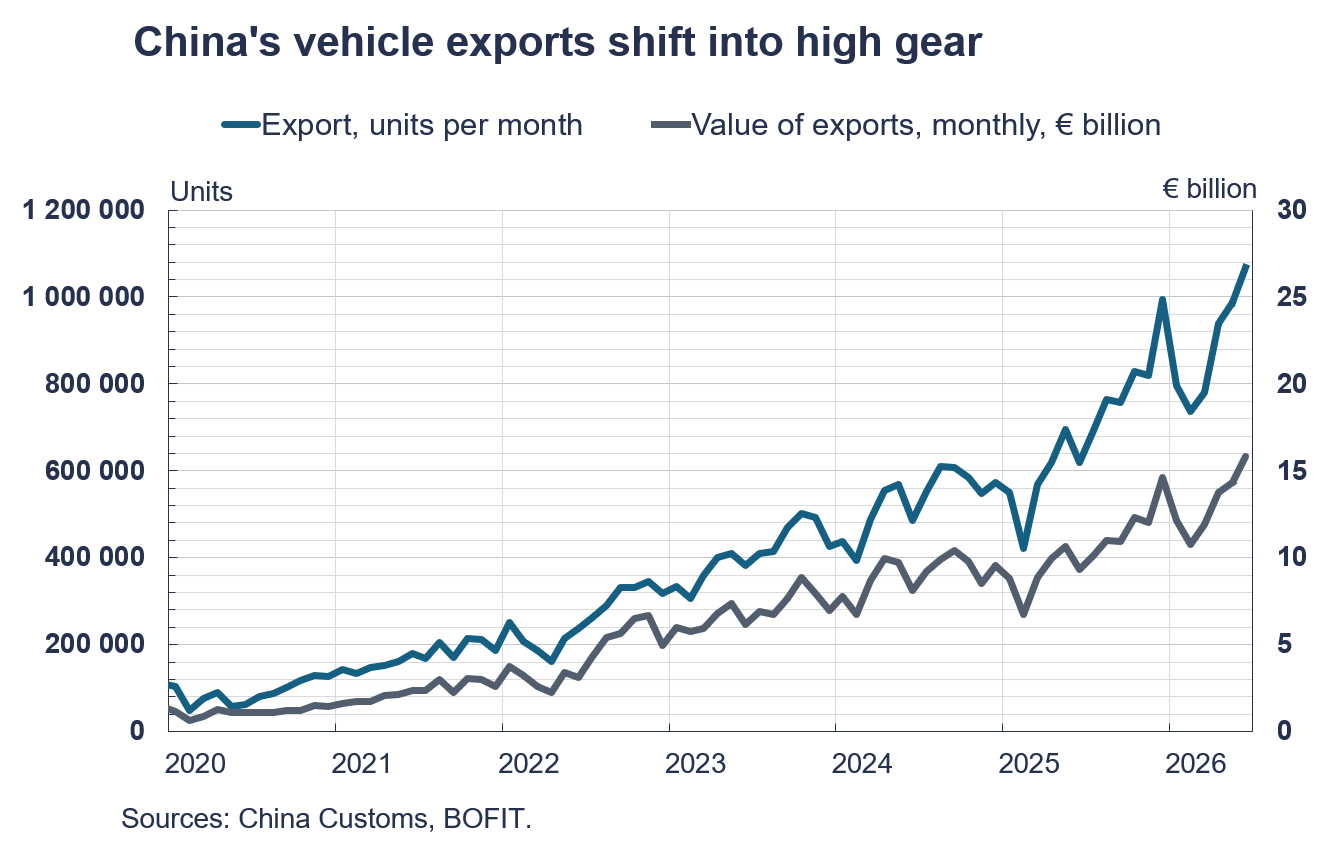
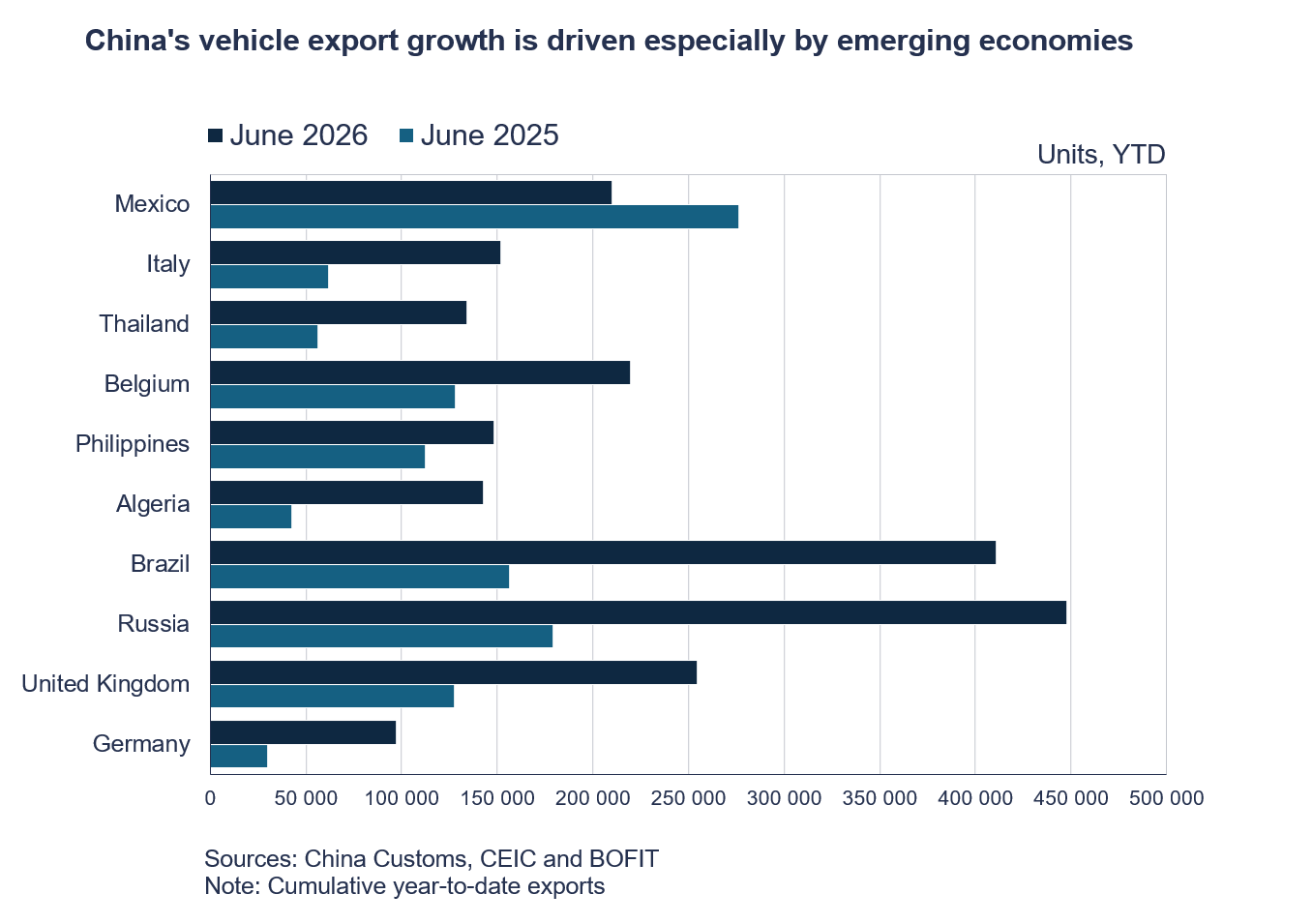
Export volumes have risen briskly. Although fewer than 5 million cars were exported in 2023, that number had already risen to around 8 million in 2025. Developing economies are a chief destination of Chinese car exports. China Customs figures show that exports of passenger cars to Brazil in the first half of this year reached 410,000 units, up 160 % from the same period a year earlier. In the same period, exports to Russia were up 150 % (448,000 units). Growth in the share of fully electric and hybrid vehicles has been particularly high. The China Association of Automobile Manufacturers (CAAM) reports that June exports of electric (EV) and hybrid vehicles for the first time accounted for over half of monthly car exports (523,000 units). European EV exports saw highest growth in the United Kingdom, Belgium, Italy and Germany. China’s car exports to Germany in June were up 235 % y-o-y (20,400 cars) and the UK 120 % (62,400 cars). Likewise, China exported nearly 60,000 cars to Belgium, while China Customs reports that only 89 cars were exported to Finland in June.
China’s exemption from the sales tax on electric cars was halved at the start of the year and should be completely phased out by next year. The government is also ending its consumption tax exemption for lithium-ion batteries. Overcapacity in the automotive industry and cut-throat competition in the industry have pushed car prices down in China, with the average retail car price down by about 20 % from two years ago. As a result, international markets have become much more attractive than the domestic market for Chinese car manufacturers. BYD, China’s largest carmaker had record international sales in June (175,000 cars, a 95 % y-o-y increase). International sales accounted for 43 % of total sales, while domestic sales contracted by 22 %. Correspondingly, the international sales of SAIC and Geely hit record highs in June. SAIC sold 146,000 vehicles outside China (up 61 % y-o-y) and Geely 103,000 (up 157 %). While domestic sales were down for both car companies, Geely took it on the chin with a reported 30 % drop in sales from 2025.
The European Automobile Manufacturers’ Association (ACEA) reports than European registrations of new passenger cars in June rose by 13 % y-o-y, and that EV registrations were up by 51 %. The share of Chinese makes in Europe has increased rapidly. In the second quarter of 2026, Chinese carmakers, including BYD, SAIC, Geely, Chery and Leapmotor, outsold Japanese carmakers in Europe for the first time ever. Chinese car brands account for about 10 % of the European market. In contrast, the position of European manufacturers in the Chinese market has suffered. Volkswagen’s market share in China fell to 9.7 % last year, down from nearly 15 % in 2015. In its heyday, Volkswagen’s China operations delivered profits of $5 billion a year, but this year VW’s China profits are expected to be in the range of $200–700 million.
In October 2024, the EU imposed countervailing compensatory tariffs on Chinese EVs, which, depending on the make and model, range between 7.8–35.3 % on top of the base 10 % import tariff. Tariffs only briefly slowed China’s car export growth, however. According to the Rhodium Group think tank, exports soon returned to pre-tariff levels, with manufacturers shifting their focus to plug-in hybrids and cars with internal combustion engines that are exempt from compensatory tariffs. The European Commission is considering extending additional tariffs to plug-in hybrids.