BOFIT Weekly Review 29/2026
Ukraine’s economy recovers after hard winter
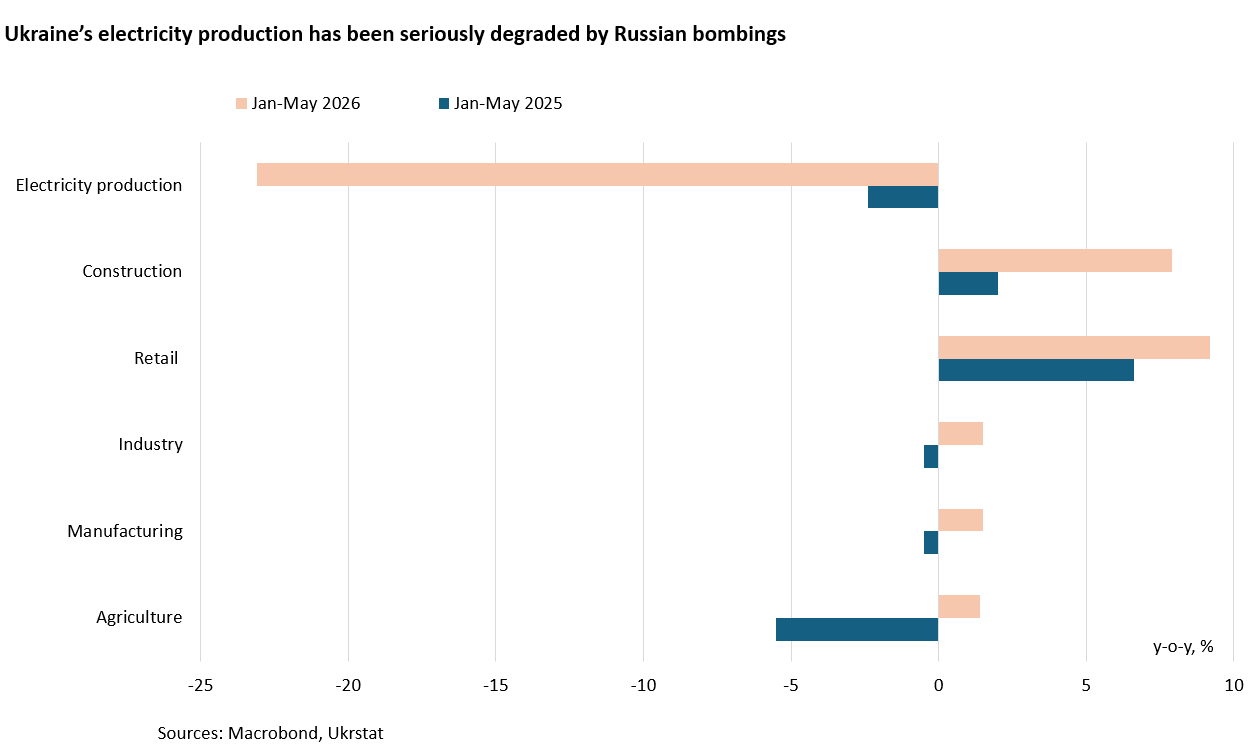
Following a rough winter, calculations by Ukraine’s economy and ecology ministry show 12-month economic growth took off in March. For the first five months of the year, Ukraine’s GDP volume recovered to the same level as in the same period in 2025. In the first quarter of this year, Ukraine’s economy contracted by 0.6 % y-o-y due to Russian bombing of the country’s energy sector and transport infrastructure, as well as an exceptionally cold winter. The April-May energy situation recovered quickly with the conclusion of the warming season. Ukraine's energy production suffered extensive damage, with energy production down almost 25 % in January-May compared to the same period a year earlier. In the main sectors of Ukraine's economy, annual growth in the first five months of the year was largely positive, with retail and construction volumes growing rapidly. The positive trend in retail sales was driven by ongoing brisk growth in real wages. Similarly, construction activity remained high, namely with defence-related fortification and other construction accelerating sectoral growth overall.
Ukraine’s trade deficit grew by over 50 % y-o-y in January-May. Imports were boosted especially by energy imports (annual growth over 60 %) and other products essential to Ukraine, including military equipment and related spare parts. At the same time, on-year export growth was relatively modest.
The rise in fuel and fertiliser prices caused by the Iran war has hampered economic recovery, but lower prices for raw food products, in particular, dampened consumer price inflation and resulted 12-month inflation to fall to 7.2 % in June. Despite the slowdown, the National Bank of Ukraine’s leadership decided at their June meeting to keep the key interest rate unchanged at 15 % for the third time this year, noting that the country’s economic slowdown mainly reflected transient factors related to the harvest season. Core inflation, which omits changes highly volatile categories such as food and energy, accelerated in June to 8.1 %. In addition, June fuel prices were up by over 30 % y-o-y.
Ukraine's financing needs for the current year fully covered, but funding for a third of the 2027 deficit still unclear
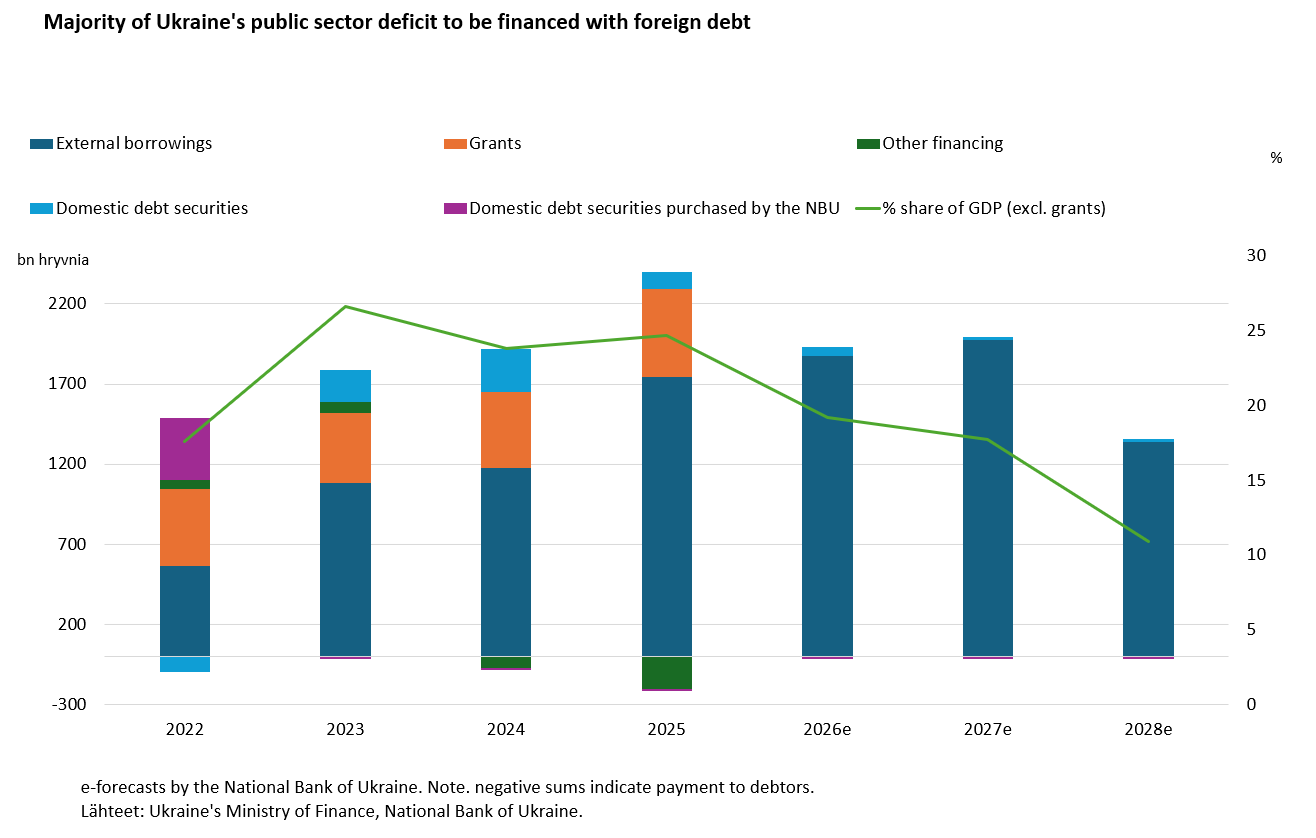
The revised budget plan for 2026–2029 submitted by the Ukrainian government to the Verkhovna Rada, the country’s unicameral parliament, increases 2026 defence spending. The spending adjustment was expected as the original 2026 defence budget approved in December 2025 planned for defence expenses below last year’s realized levels. Although a large part of support provided to Ukraine comes in the form of loans, the country is also set to receive donations this year. Thanks to these donations, the budget deficit is set to decrease from the original projection of 19 % of GDP to around 12 %. The needs of 2026 have been secured, especially thanks to EU funding, but about a third of the funding needed for 2027 has yet to be secured. Ukraine’s finance ministry estimates the country’s total medium-term funding needs at $146 billion for 2027–2029.
Despite delays in implementing reforms, the EU releases first instalment of €90 billion Ukraine support loan
The EU has released to Ukraine a €3.2 billion tranche of this year’s €8.35 billion macro-financial assistance (MFA) which is part of a larger €90 billion support loan. Although Ukraine has not yet implemented certain legislative and policy changes required by the EU, the Ukrainian parliament in May approved a memorandum of understanding agreeing to implementation of the EU’s requisite reforms. Specifically, implementation of reforms related to the fight against corruption and tax reform need to be made for the release of the remaining €5.2 billion MFA funding for this year in two instalments. Daniil Hetmantsevin, chairman of the economy, taxation and customs committee in the Verkhovna Rada, said that the tax reforms called for under the terms of the MFA should be submitted to the parliament for consideration already by late August, with final approval by the end of the year. Two-thirds of the Ukraine support loan (€60 billion) are already earmarked for defence spending during 2026 and 2027. That funding will be provided directly in the form of materiel support for defence purposes. The EU’s €90 billion support loan is financed by a loan taken by EU and guaranteed by the EU budget. Ukraine is required to repay the loan if Russia pays war reparations.
Ukraine and the International Monetary Fund (IMF) reached a staff-level agreement on proceeding with the latest Extended Fund Facility (EFF) for Ukraine after its initial audit of its lending programme and despite Ukraine’s failure to implement all the reforms specified under the $8.1 billion EFF. The disbursement of the next EFF tranche of the $690 million to Ukraine is subject to the approval of the IMF Executive Board and its scheduling is still uncertain. According to the IMF, Ukraine has met all quantitative criteria, but the country has been late in implementing two structural reforms, as well as a controversial value-added tax (VAT) reform, another EFF condition, on which there has been no progress to date.