BOFIT Weekly Review 18/2026
China eliminates remaining import tariffs on African nations
At the beginning of the year, China announced it would get rid of all remaining tariffs on goods from Africa as of May 1. The lifting of tariffs applies to the 53 of Africa’s 54 nations with which China has diplomatic relations. The sole excluded country is Eswatini, which has officially recognised Taiwan. China had earlier introduced a zero-tariff policy for Africa's 33 least-developed countries, meaning that Africa's middle-income and largest economies benefit most from the May expansion. The tariffs exemption applies to all product groups. Prior to the tariff elimination, imports from Africa were subject to most-favoured-nation (MFN) tariff levels. China's average MFN import tariff is around 6 % for chemicals, minerals and metals, and between 10 % and 25 % for agricultural products.
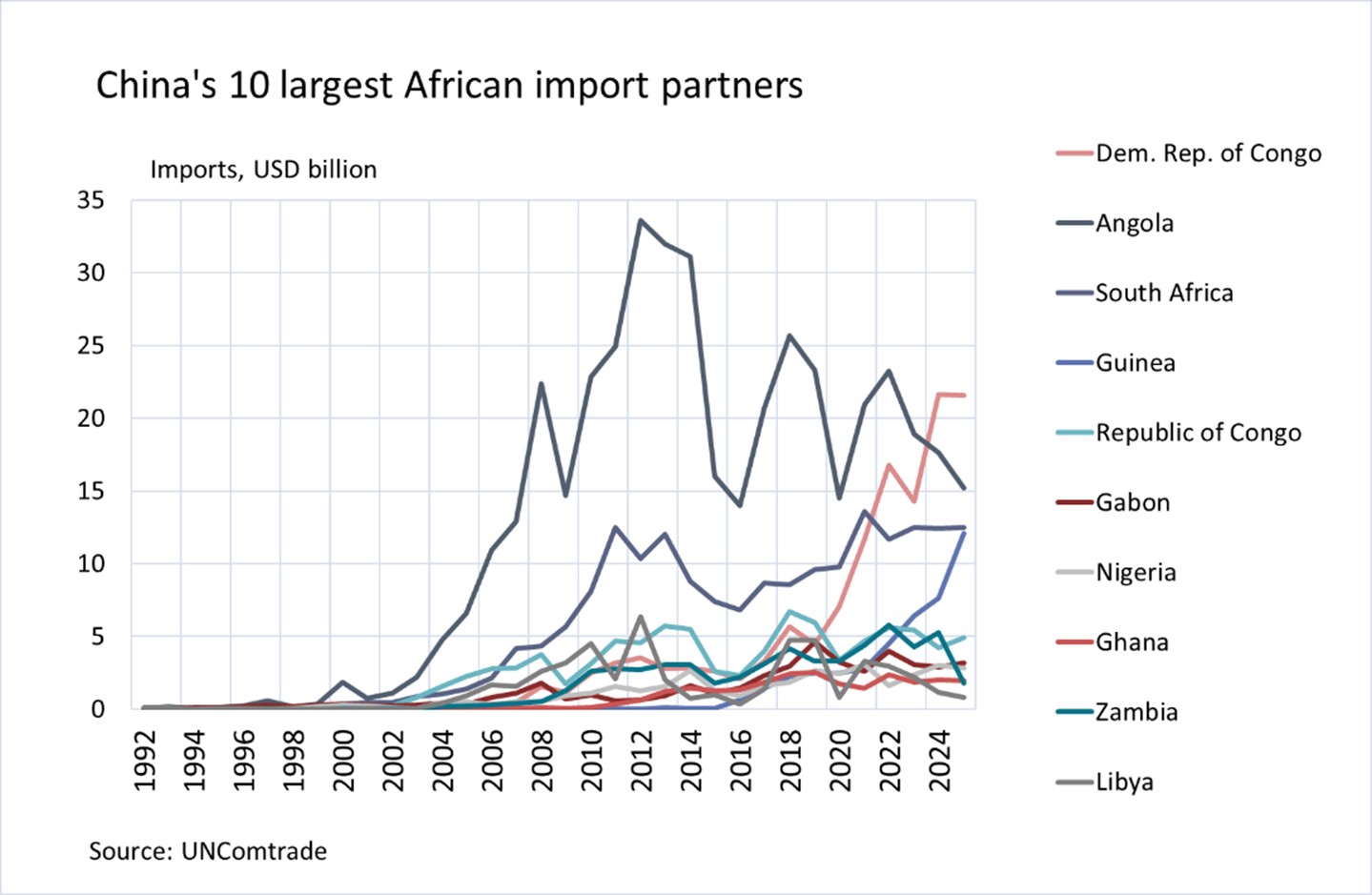
China mainly imports raw materials from Africa. Nearly 70% of Africa’s exports to China are oil, gas and other minerals. Metals constitute the second largest product group, accounting for about a quarter of China’s imports from Africa. Fruits and vegetables represent about 3 % of China’s imports from Africa, followed by chemicals (1.5 %) and plastics (1 %). China’s metal imports focus on the Democratic Republic of Congo (DRC), South Africa and Zambia, while the biggest suppliers of oil and other minerals are Angola, Guinea and South Africa. Fruits and vegetables are mainly imported from Ethiopia and Nigeria, chemicals from Namibia and plastics from Ivory Coast. Africa’s total share of China’s goods imports was 6.5 % at the end of 2025.
Correspondingly, Africa accounted for about 6 % of Chinese goods exports at the end of 2025. China’s largest export markets in Africa are South Africa, Nigeria and Egypt. China’s exports to Africa have soared in recent years, with growth accelerated especially by machinery and vehicles, as well as high-tech products related to solar power and batteries. About a quarter of Africa’s imports come from China. By the same token, just under a fifth of African exports go to China. China is by far the most important export market especially for those African countries whose exports rely heavily on a single raw material. These include, in particular, Angola (oil), the DRC (copper and cobalt), Guinea (bauxite) and Zambia (copper).
China’s direct investments (FDI) in Africa reflect the industries that produce the products it imports. Figures from the Rhodium Group show that over half of Chinese investment in Africa is focused on metals, minerals and other basic commodities, while roughly a quarter of investment went to the energy sector. During the period 2012–2025, China made over $100 billion in FDI to Africa, of which roughly $20 billion went to the DRC. Chinese firms currently hold significant stakes in the country, particularly in the mining industry. The next largest FDI destinations are South Africa (about $12 billion), Nigeria (about $10 billion), Egypt (about $8 billion) and Mozambique (about $7 billion). China’s largest investments in Africa are not automatically reflected with a simultaneous increase in exports - for example, Egypt’s exports to China have declined over the years. At the same time, exports to China from countries such as the Ivory Coast, Senegal and Rwanda, have grown rapidly, despite low FDI levels.
In addition to direct investment, China has provided generous credit arrangements to African countries, especially for the financing of infrastructure and energy projects. According to Boston University’s Global Development Policy Center, the total value of Chinese lending during 2000–2024 amounted to roughly $180 billion. Nearly $50 billion of that sum went to Angola. In addition to Angola, countries such as the DRC and Djibouti owe about half of their foreign debt to China. The loans have gone mainly to construction of roads, bridges, railways and power plants, but at the same time have increased concerns about debt sustainability and the economic independence of African countries.
The elimination of tariffs allows China to develop its trade relations and open up new markets at a time when Western trade policy is tightening. For China, it is important to ensure the smoothest possible operation of its supply chains and unfettered access to the critical minerals it needs for its industries and the green transition. By branding itself as the first large economy to eliminate import tariffs on African countries, China is binding the economies of the African continent ever closer to itself. The move increases China’s influence in Africa and challenges the position of the EU and the US in the Global South.