BOFIT Weekly Review 18/2026
China increases oil imports from Southeast Asia and Russia to make up for lost Persian Gulf imports
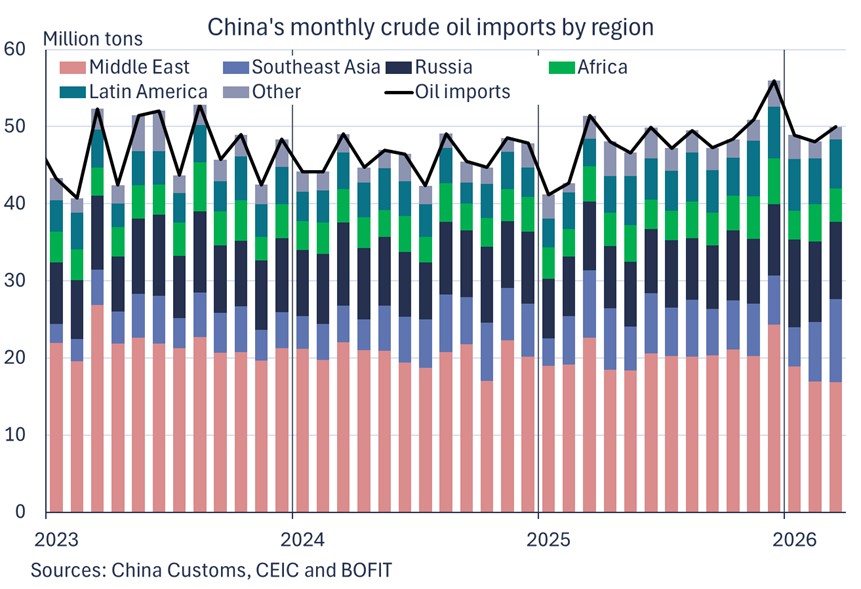
China Customs reports that nearly as much crude oil was imported into the country in March as in March 2025, and that oil imports on-year actually increased in the first quarter of this year. By some estimates, China’s domestic oil production and oil imports in March were still larger than the country’s own oil needs, so the country continued to stockpile oil in its strategic reserves. In recent months, the volume of oil purchased from countries in the Middle East has declined slightly. The contraction was expected to intensify in April as the flow tankers departing the Persian Gulf ended with closure of the Strait of Hormuz. China has made up for lost imports from the Middle East by increasing imports from Southeast Asia, particularly Indonesia. Southeast Asian oil imports can originate from elsewhere as transfer of cargoes from one ship to another is common in the region to disguise a cargo’s true country of origin. China’s oil purchases from Russia have increased to record levels, while oil imports from the rest of the world have remained fairly stable.
China purchases natural gas from abroad both as gas transmitted by pipeline in gas form and as liquefied natural gas (LNG) shipped by tankers. China Customs reports that slightly fewer metric tons of pipeline gas were imported last year than tons of LNG. The volume of pipeline gas imports in the first quarter of this year remained at the same level as in 1Q25, with the lion’s share of pipeline gas pumped in from Russia and Turkmenistan. LNG imports were weak in March with import volumes down by 20 % y-o-y. Imports from Qatar declined sharply (-43 % y-o-y), while purchases from Australia, another key LNG supplier, also decreased significantly (-27 % y-o-y). Although import volumes typically fluctuate from month to month, import volumes from both Australia and Qatar were exceptionally small in March. In addition to energy products, the Middle East is a major source of fertilisers, including the nitrogen fertiliser urea, ammonia, phosphorous-based fertilisers and sulphur. As of March, there were no signs of shortages in China's fertiliser imports, and fertiliser imports continued to be exceptionally high as in the preceding winter months.
Diversification of energy suppliers in order to reduce risk has long been a cornerstone of Chinese energy policy. China’s domestic production is sufficient to cover a quarter of its domestic oil needs and over half of its gas needs. In addition, its strategic oil reserves are massive. President Xi Jinping said in talks last week with Saudi Arabia's Crown Prince Mohammed bin Salman that the Strait of Hormuz should be open for normal passage.