BOFIT Weekly Review 39/2026
Russia’s struggles with weak economic trends and rising inflationary pressure
While Russia’s output growth has slowed again in recent months, inflationary pressures have risen due in part to Ukrainian strikes on Russian infrastructure. The strikes, have translated to higher fuel prices among other things. Loose fiscal policy has also increased the risk of higher inflation. The federal government deficit continues well above the amount budgeted for the entire year. The finance ministry is currently finalising its latest three-year budget framework. Higher-than-expected government spending could alter Russia’s inflation outlook next year if the federal deficit continues to balloon.
Subdued economic trends in July
Following a brief pick-up in economic activity last spring, Russia returned to a retrograde path in July. The economic development ministry’s preliminary estimate shows GDP grew by just 0.6 % y-o-y in July. The ministry offered a similar growth figure for the first seven months of this year as well.
Industrial output figures have remained stagnant for a while, with little change in the trend in July or August. Mining and quarrying output, which includes the oil & gas industries, fell in July by roughly 3 % y-o-y. The International Energy Agency (IEA) estimates Russian crude oil production declined by roughly 7 % y-o-y in August. Growth in manufacturing, which is largely driven by industries linked to the war, remained moderate. Production of petroleum products contracted, however, due to refinery damage caused by Ukrainian drone and missile strikes. In July and August, production of refined oil products declined by nearly 20 % y-o-y. Construction activity stabilised following a dip in production at the start of this year. The level of construction activity in July was similar to that of July 2025.
Growth in retail sales, that reflects trends in consumer spending, slowed in July, but still maintained a fairly brisk pace of 5 % y-o-y. As in earlier months, the on-year growth in consumer-related services remained at around 2 %. Consumption growth continued to be supported by robust employment conditions and wage hikes reflecting Russia’s tight labour market. There are signs, however, that labour market tightness is slightly easing. Growth in real wages has slowed and in June the average real monthly wage was up 3 % from a year earlier.
Fixed investment down this year
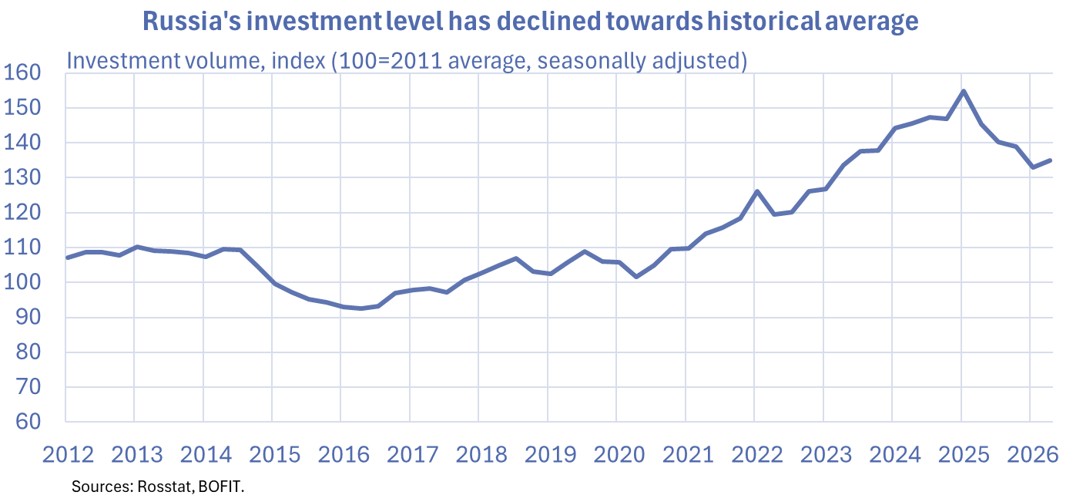
Investment trends have been exceptionally weak this year. Fixed investment fell by 14 % y-o-y in the first quarter, and by 7 % y-o-y in the second quarter. For the first half overall, the drop was roughly 10 %. There are several factors contributing to the weak investment trends. Financing for capital investment has become more difficult due to weak company earnings. Combined corporate profits in the first half of this year fell by 13 % y-o-y, with every third corporation posting a loss. Corporate financing possibilities have also been hurt by high interest rates and debt-servicing costs. In July, the average rate on a corporate loan of over one year was 13 % p.a. Capacity utilisation has also declined slightly in many industries amid a deteriorating demand outlook that has dampened the investment appetites of many firms.
Investment by foreign companies in Russia has remained minimal, accounting for just 0.1 % of fixed investment in the first half of this year. The allure of investing in Russia was hardly helped last week by president Vladimir Putin’s decree on “temporary seizures” of several foreign-owned companies operating in Russia. The take-overs included the Russian operations of Swiss-based food and beverage giant Nestlé and the French retailer Auchan, which saw oversight of their Russian subsidiaries transferred to a small, previously unknown Russian firm. In public discussions officials have linked the take-overs to factors such as the parent company’s domicile in an “unfriendly country” and failure to invest adequately in the Russian market. The fate of seized subsidiaries remains unclear. In several similar earlier cases, seized subsidiaries were sold to Russian buyers at substantial discounts.
The recent contraction in fixed investment can also partly reflect its high growth in previous years. In 2021–2024, fixed investment grew at an average pace of 8 % a year. Investment growth has been especially rapid in industries serving the war effort. Investment has also been driven by large projects are not directly linked to the war in the oil & gas industry, the chemical industry and the logistics sector. Many of these projects have now been completed or reached a point where the impact of the investment on growth has lessened. Indeed, the shares of oil & gas industry and land transportation projects have diminished relative to overall investment this year. Fixed investments could decline further as they are still quite high by historical standards.
CBR suspends rate cuts
Financing costs are likely to remain high also in the coming months, as the Central Bank of Russia (CBR) decided to keep the key rate unchanged at 14 % in its September meeting. The CBR had been gradually cutting its key rate since June 2025. The CBR press release noted that a pause in interest rate cuts was necessary due to uncertainty surrounding the inflation outlook.
Higher fuel prices were a major cause of the acceleration in inflation this summer. The CBR estimates that some of the inflationary shock has already translated to the wider economy in the form of increased corporate costs and higher inflation expectations. August consumer prices were up by 6 % y-o-y. The inflation outlook has also been clouded by uncertainty surrounding the nearly-finalised three-year budget framework. The CBR views that inflation risks have heightened further. Key risks include more accommodative fiscal policies and delays in restoring production capacity lost from Ukrainian attacks.
CBR governor Elvira Nabiullina has also offered commentary on progress in the introduction of a digital ruble at the beginning of September. After the first three weeks of its launch, approximately 200,000 digital ruble accounts have been opened in Russia. Russia’s largest banks and major retailers are required to accept digital rubles as payment. This obligation will gradually extend to smaller banks and businesses. A private individual or company may only have one digital ruble account. Initial interest in adopting the digital ruble has been muted. For comparison, in June there were 320 million payment cards in active use (transactions conducted during this year) in Russia. The central bank expects the digital ruble to gradually become increasingly common in payments over the next 5-7 years.
Federal budget remains deeply in deficit
Preliminary finance ministry figures show Russia’s federal budget revenues rose by 9 % y-o-y in January-August. The higher revenues mainly reflected a sharp increase in value-added tax (VAT) revenues from the increase in VAT rates at the start of this year. Government coffers were also boosted in August by 700 billion rubles in dividend payments from state-owned enterprises. Revenues from oil & gas, however, were down by 17 % y-o-y in the first eight months of the year. Ukrainian attacks have depressed oil export volumes, denying the government of some of the benefit of high prevailing oil prices. The IEA estimates the volume of Russian oil exports in August fell to its lowest level since 2018.
Federal budget spending increased by 15 % y-o-y in January-August, and continued to significantly outpace the budget forecast. For Russia to reach compliance with 2026 budget plan, federal spending would need to be cut by roughly 15 % below the 2025 level for the rest of this year. In October-December last year federal spending was reduced by nearly the same amount. In 1Q26 GDP contracted and expenditure increased sharply.
The federal budget deficit contracted slightly in August, although for the first eight months of the year, the deficit was still 5.8 trillion rubles (2.5 % of GDP), a level well above the budget deficit planned for all f 2026. According to finance minister Anton Siluanov the deficit for all of 2026 should amount to roughly 3 % of GDP. Most of the deficit will be financed through government borrowing. After weak responses to this summer’s government bond auctions and a multiweek suspension of auctions, the finance ministry returned to the market early this month with a successful auction of roughly 1 trillion rubles in variable-rate bonds. The National Wealth Fund was only used to cover the budget deficit at the start of this year, when roughly 460 billion rubles were withdrawn. Liquid assets in the National Wealth Fund at the end of August amounted to roughly 4 trillion rubles (1.7 % of GDP).
The finance ministry is currently finalising its latest three-year budget framework, which should be submitted to the Duma by the end of September. According to preliminary information about the government’s budget discussions, federal spending is expected to rise again in 2027, but more slowly than in previous years. Military expenditure will remain a priority. Several moderate tax increases are planned, yet the budget is still expected to show a deficit. The deficit is projected to reach 2% of GDP—approximately twice the level set out in the current budget framework. In recent years, actual spending and deficits have consistently exceeded initial projections.