BOFIT Weekly Review 38/2026
China injects new funding for large banks and insurance companies; mergers for small rural banks
On Sunday (Sept. 6), eight state-owned banks and insurance companies announced plans to arrange a directed share issue with the finance ministry acting as the share subscriber. The national tobacco company and its subsidiaries will also be subscribing to share issues for two commercial banks. The issues will raise a total of 360 billion yuan (47 billion euros or 0.2 % of GDP). At the same time, state ownership in the funded entities will increase slightly. The capital injections are designed strengthen banks’ and insurers’ balance sheets. The main justification for pumping money into banks seems to be to give them greater leeway in channelling funding to various sectors of the economy in fulfilling the government’s economic policy objectives and reverse the recent slowdown in economic growth.
The capitalisation effort focuses on two large banks. With respect to the 160 billion yuan in new share issues for the Agricultural Bank of China (ABC), the finance ministry has committed to buying shares worth 130 billion yuan and the tobacco companies shares worth 30 billion yuan. Industrial and Commercial Bank of China (ICBC), in turn, will issue shares worth 100 billion yuan, of which the finance ministry plans to subscribe to 70 billion yuan in shares and the tobacco companies a stake of 30 billion yuan. The finance ministry will also capitalise the state-owned policy bank Export-Import Bank of China, which mainly focuses on foreign trade financing, to the tune of 30 billion yuan, while insurers will get the rest: China Life Insurance (35 billion yuan), PICC (15 billion yuan), Sinosure (10 billion yuan), China Taiping (7 billion yuan) and China Reinsurance Group (3 billion yuan). Last year the government used a similar approach to capitalise four large state-owned banks (Bank of China, China Construction Bank, Bank of Communications and Postal Savings Bank of China) for a total of 520 billion yuan (BOFIT Weekly 14/2025).
Measured by total assets, China’s banking sector is the largest in the world. Four Chinese banks also rank among the world’s largest. At least on paper, the balance sheets of large Chinese banks appear to be relatively strong, although the actual quality of their loan portfolios likely weaker than they officially divulge. Notably, the profitability of Chinese banks has eroded gradually in recent years. Return-on-capital ratios and interest rate margin (the spread between deposit and lending rates), which is important for banks, have been falling steadily for the past decade. Moreover, the growth of bank lending stock has been gradually slowing. The loan stock grew by just 4.9 % y-o-y in August, which is the lowest growth rate recorded since monitoring began in the late 1990s.
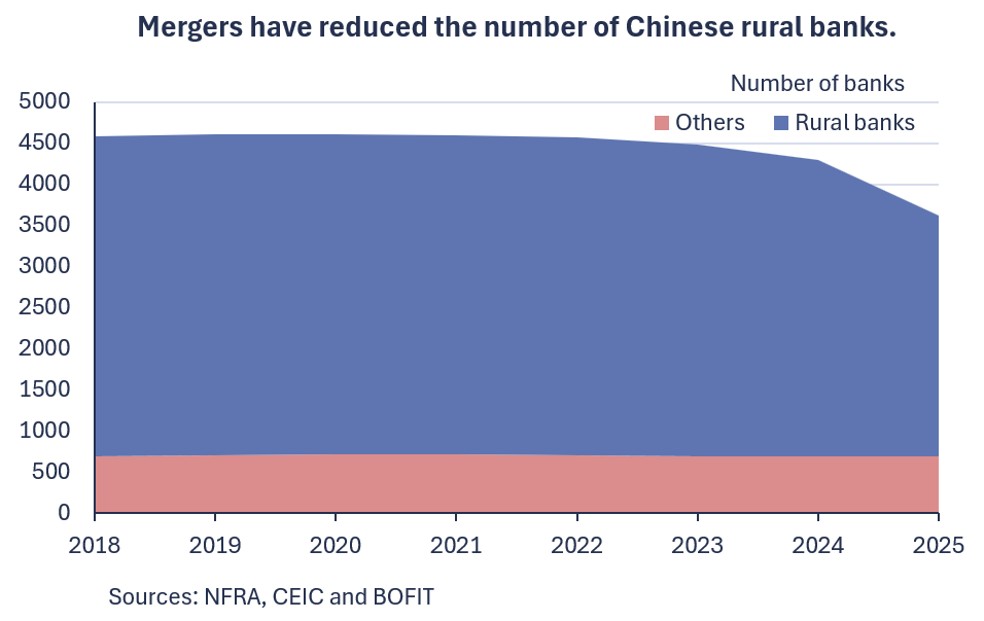
In recent years, small rural banks have found themselves caught up in the vast consolidation drive sweeping the Chinese banking sector. China’s National Financial Regulatory Administration (NFRA) report that at the end of last year there were almost a thousand fewer banks in China (3,619 banks) than at the end of 2021. By some estimates, the pace of rural bank mergers has continued to be brisk this year. Normally, the authorities in China have been more concerned about smaller banks than large banks. The government hopes that the consolidation of small banks into larger entities will to improve their profitability and capital adequacy.