BOFIT Weekly Review 38/2026
China moves towards a more stable real estate sector
At the end of August, Chinese officials issued an extensive package of new regulations that will significantly reshape the financing model of real estate developers. The reforms aim to reduce developer reliance on sales of yet-to-be-built apartments (pre-sales) and improve legal protection of apartment buyers. Above all, the authorities seek to make the sector’s operating model less risky.
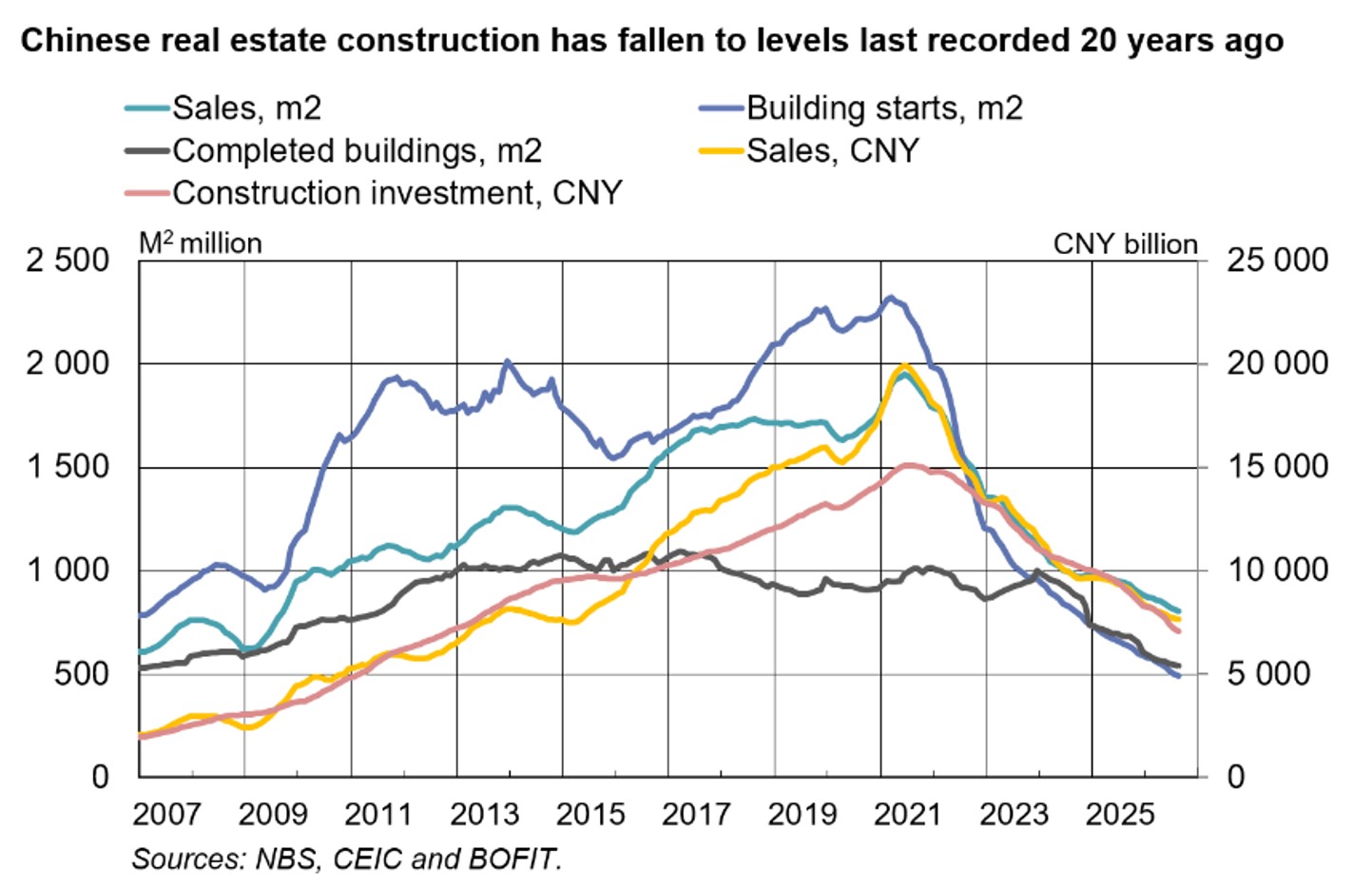
Selling of unbuilt apartments was a key feature of China’s real estate boom in the 2010s. Developers would launch their pre-selling efforts in the earliest construction phase and use the advance payments from buyers to finance new projects. While the sale of unbuilt properties provided developers with a cheap financing stream and supported rapid growth in the sector, it also meant that developers carried massive levels of debt. With the spectacular falls of several large developers, most notably Evergrande, in early 2021, construction of many apartments commissioned under the pre-selling model was abandoned, leaving a mountain of unfinished apartments and causing buyer confidence in the housing market to decline sharply.
Under the new rules, developers can initiate sales of unfinished apartments only after the core and frame of the building have been completed. Previously, sales were often allowed as soon as the foundation had been laid. In addition, the funds received from the presale must be kept in separate escrow accounts until the project’s completion, and mortgage funds cannot be released to developers prior to apartment completion. Officials are also encouraging local governments to favour projects that focus on sales of completed apartments rather than those using advance sales schemes.
Officials are also working to ease access to bank loans for both builders and buyers. The maximum maturity for construction project loans would be extended, and the financing focus shifted from developers to specific projects. To ease loan terms for prospective apartment buyers, the maximum debt-service-to-income ratio has been raised from 55 % to 60 %, along with an extension of maximum housing loan maturity from 30 to 40 years.
As the reforms do not apply to construction projects already underway, their effects are expected to become more visible from next year onwards. The reduction in funding from advance sales will make operating conditions particularly challenging for private developers and will likely reduce new project starts. At the same time, the position of state-owned developers is expected to strengthen further, as it is relatively easier for them to obtain bank loans and bond financing on better terms than private developers.
With the downturn in China’s real estate sector entering its fifth year, and previous policy support measures have failed to halt the market’s contraction. However, the latest reforms suggest that the government considers the most acute phase of the housing crisis to be largely passed and has moved on to developing a new operating model for the sector. The goal appears to be a more stable real estate sector in which rapid expansion driven by debt accumulation and pre-sales plays a more limited role than in the past.