BOFIT Weekly Review 28/2026
Global energy demand continued to rise last year; China remains reliant on energy imports despite increased domestic production
The Energy Institute’s latest Statistical Review of Global Energy shows that global energy demand grew last year by 1.7 % (in China 2.4 %). Renewable energy production grew fastest. In particular, solar power generation increased by as much as 30 % y-o-y. Nevertheless, 86 % of the world’s energy was still produced with fossil fuels. Global carbon dioxide emissions grew by 1.1 %, which was slightly slower than energy demand growth. CO2 emissions rose slightly in China, but US emissions growth was significantly higher.
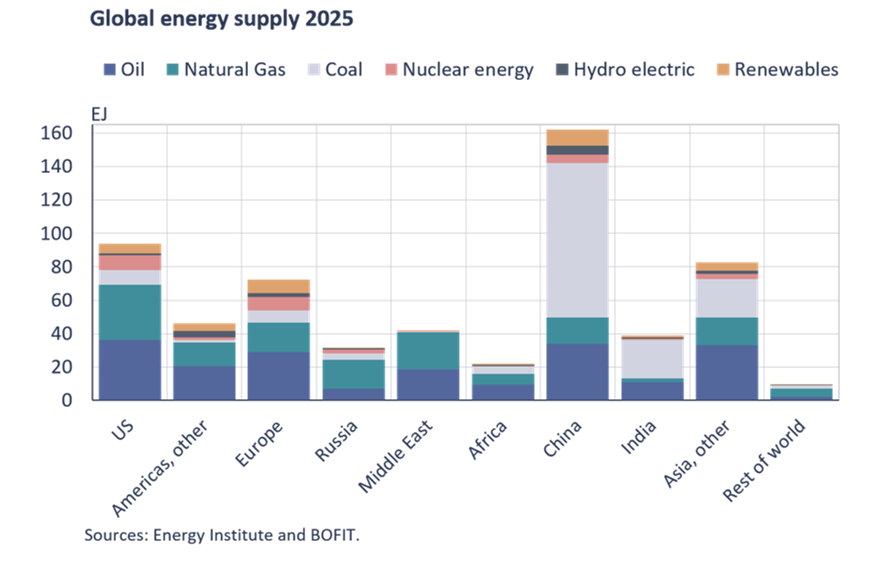
Global oil consumption grew by 1.3 % last year to 103 million barrels a day. Despite 3.5 % growth, oil production only reached 101 million barrels a day. China’s oil consumption grew by 2.7 %, the US by 1.3 %, India by 0.5 %, while EU oil consumption declined by 0.5 %. China last year further increased its strategic oil reserves, which as of end-2025 were estimated at 1.4 billion barrels, an amount sufficient to cover the country’s needs for just over 2.5 months. China’s oil refining capacity is slightly larger than that of the US (both have approximately 18 % of global capacity). Last year, however, the US share (20 %) of the world's oil refining was larger than China’s (18 %). 12 % of global oil refining takes place in the EU, 11 % in the Middle East, 7 % in India and 6 % in Russia.
Natural gas production rose last year by 1.6 %. The US was the world’s largest producer, accounting for 26 % of production, and the largest consumer with 22 % of consumption. Global demand for coal rose by 0.7 %, driven largely by increased US consumption (up 10 %) as the country increased its reliance on coal-fired plants. Coal consumption in China remained at the 2024 level.
Electricity accounts for about a fifth of global energy supply. Electricity’s rising share has been driven in particular by rapid electrification of transport in certain countries, particularly China, where electricity it accounts for nearly a fifth of the energy supply. Electricity consumption grew by 3 % last year. Solar, wind and nuclear each represented roughly 8–9 % shares of global electricity production. A third of electrical power is still generated by burning coal, while natural gas provides 22 % and hydroelectricity 14 %. About 2 % of global electricity generation last year went to data centres. Of global data-centre electricity demand, 40 % occurred in the US (equivalent to 7 % of US electricity generation), while China accounted for 26 % and Europe for 18 %.
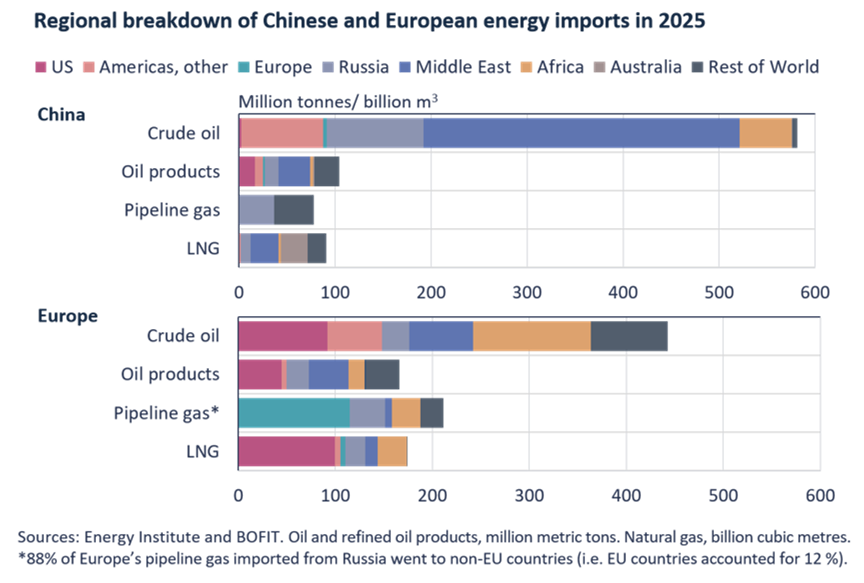
The Energy Institute’s Statistical Review includes an outlook for global energy trade. China is the world’s largest importer of oil and natural gas. Last year imports covered 73 % of oil consumption in China, 75 % in Europe and 86 % in India. Natural gas imports covered about 40 % of consumption in China and nearly 60 % in Europe. The US has long been a net exporter of natural gas and a net exporter of oil as well for the past three years.
China has sought to increase its own energy self-sufficiency by increasing domestic production in all energy sectors. Coal accounts for 57 % of the country’s energy production, followed by oil at 21 % and natural gas at 10 %. Based on the import dependence of these fuels, it can be roughly estimated that about one-quarter of China's total energy consumption still relies on imported energy. Despite the increased contribution of renewables in Europe, the continent continues to rely on imported energy. Oil accounts for 40 % of European energy consumption, and natural gas 24 %.