BOFIT Weekly Review 28/2026
IMF lowers global growth estimate for this year, but expects technological development to accelerate growth next year
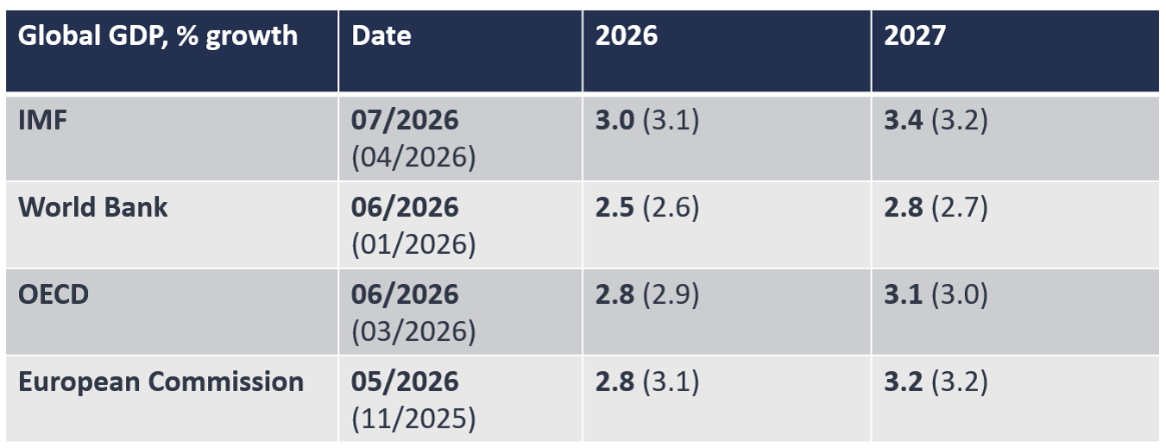
According to the July update of the IMF’s World Economic Outlook (WEO), global economic growth should slow from 3.5 percent last year to 3.0 percent this year, then recover to 3.4 percent next year. The forecast for this year fell by 0.1 percentage points from the IMF’s April WEO, but increased by 0.2 percentage points for the next year. The negative supply shock from the war in the Middle East has been partly offset by investment and exports from accelerated demand of products in the AI-adjacent technology value chain, such as chips and transformers. The growth forecast was lowered the most for countries dependent on oil and natural gas imports that only account for a small share in the global technology value chain, including countries in the Middle East and North Africa.
Global economic growth has been stronger than expected in the first quarter of 2026, due in part to an unanticipated upside surprise for countries exporting components supporting the AI boom. Economic growth in the four largest net exporters of AI components and equipment – Taiwan, South Korea, Thailand and Malaysia – beat the IMF’s earlier estimates by an average of 4.4 percentage points annualized. Despite a heavy dependence on energy imports, the South Korean economy grew by an annualized 7.5 % in the first quarter, led by the export boom in semiconductors and AI equipment. The IMF estimates that even China’s seasonally-adjusted economic growth in the first quarter of this year reached a blistering 8.1 % quarter-on-quarter pace annualized. Growth was driven by investment in infrastructure and explosive growth in high-tech manufacturing. Chinese domestic consumption remained subdued, however. The IMF raised its forecast for the Chinese economy by 0.2 percentage points to 4.6 % in 2026 and by 0.1 percentage points to 4.1 % in 2027. The World Bank’s just-released China Economic Update sees the Chinese economy growing by 4.4 % this year and 4.3 % next year.
The IMF expects the United States economy to grow by 2.3 % this year and 2.2 % next year. The numbers were essentially unchanged from the April WEO. The IMF now expects euro area growth of 0.9 % this year 1.2 % next year. The forecast for the current year was lowered by 0.2 percentage points due, among other things, to higher energy prices and weak consumer confidence.
The IMF forecasts global headline inflation at 4.7 % this year (4.1 % in 2025), then decline to 3.9 % next year. The new forecast raised the inflation projection from April by 0.3 percentage points for 2026 and by 0.2 percentage points for 2027. The outlook for higher inflation primarily reflects rising energy and food prices. Energy prices are about 25 % higher than before the Iran war. The average price of crude oil this year is projected to be around $89 a barrel. This corresponds to a 32 % increase in the price of crude oil and a 22 % increase in the price of natural gas from 2025. By the same token, fertiliser prices should rise by 26 % y-o-y and food prices by 8 % due to higher energy and transportation costs.
The IMF sees growth in the volume of global trade slowing from 5 % in 2025 to 3.5 % this year, then bouncing back to 4.3 % in 2027. Earlier frontloading of trade, US tariffs last year and this year’s Iran war affect the global trade dynamics.
The risks associated with the IMF’s April growth outlook have moderated, but are still to the downside. The IMF sees technology shock risks as a mixed blessing. If AI-related investment transforms rapidly into a productivity engine, medium-term growth could accelerate. On the other hand, overly optimistic projections of productivity enhancements, as well as unrealistically high share prices, could burst the AI bubble and unwind rapidly. The most immediate risk, however, is escalation of the conflict in Middle East. Oil inventories are already near multi-year lows. The WEO forecast assumes that opening of the Strait of Hormuz begins by mid-July and that pre-war supply conditions return to the global market by March 2027. The US bombed Iran again on Tuesday and Wednesday (July 7-8). US president Donald Trump claimed Iran had violated the terms of an agreed ceasefire, and from his point of view, considered the ceasefire moot.