BOFIT Weekly Review 26/2026
Chinese retail sales show on-year drop in May
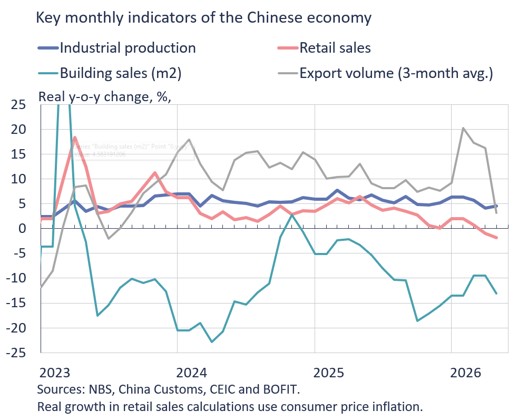
China has long followed dual economic growth tracks. Manufacturing, supported by exports, has done relatively well, while domestic consumption has struggled. Keeping with this pattern, May industrial output grew by 4.5 % y-o-y, with particularly robust growth registered by high-tech manufacturing (up 15 % y-o-y) and producers of IT- and other electronic devices (up 17 %). Car manufacturing also climbed 8 %, outpacing industrial output growth overall.
May retail sales, in contrast, contracted in nominal terms by 0.6 % y-o-y. The real decline after taking inflation into account was even greater. China’s National Bureau of Statistics (NBS) reporting on retail sales covers consumer goods and catering services. Car sales accounts for about 10 % of all retail sales. May car sales declined by 16 % y-o-y in nominal terms. Services sales grew faster than retail trade overall in the first five months of the year. The NBS, which only releases nominal year-to-date growth figures, reported that retail sales of services grew by 5.4 % in the January-May period. The NBS also released first time the combined growth figure for total retail sales of goods and services. It shows 2.8 % y-o-y growth in January-May (compared to nominal growth in retail sales (including catering services) of just 1.4 %).
The contraction in China’s real estate sector continued in May, with the volume of building sales measured by floorspace declining 14 % y-o-y. House prices continued to fall at the national level, although the declines in Beijing and Shanghai appear to have ceased recent months. The NBS monitoring sample, which covers apartment sales in 70 Chinese cities, shows that apartment prices on secondary markets declined by 6 % y-o-y in May, putting them at a level roughly 25 % below the 2021 peak.
Foreign trade was brisk in the first five months of this year. The value of goods exports in May rose by 19 % y-o-y (up 15 % in January-May), while goods imports climbed 28 % (up 24 % in January-May). Rising prices boosted the value of foreign trade, but volume growth was much more modest. China Customs reports that the volume of goods exports in May rose by 5 % y-o-y (up roughly 12 % y-o-y in January-May), while the volume of imports shrank by 2 % y-o-y in May (increase of about 9 % y-o-y in January-May). For example, although the value of crude oil imports grew by 15 % y-o-y in May, their volume fell by 29 %. Also, the value of exports and imports of high-tech equipment and components grew rapidly in the first five months of the year. Over 4 million cars were exported in January-May, an increase of more than 60 % from the same period in 2025. At the same time, the value of car exports rose by 28 %. Some 55 % of China’s exported automobiles had internal combustion engines, while 28 % were pure electrics and 17 % hybrids.
Higher global energy prices have caused Chinese producer prices to spike. Producer prices in May were up 3.9 % y-o-y (January-April increase 0.2 % y-o-y). The impact on consumer prices has been modest, however. May consumer price inflation was up 1.2 % y-o-y (January-April increase of 0.9 % y-o-y).