BOFIT Weekly Review 24/2026
OECD reports Chinese firms enjoy far more industrial subsidies firms in than other countries
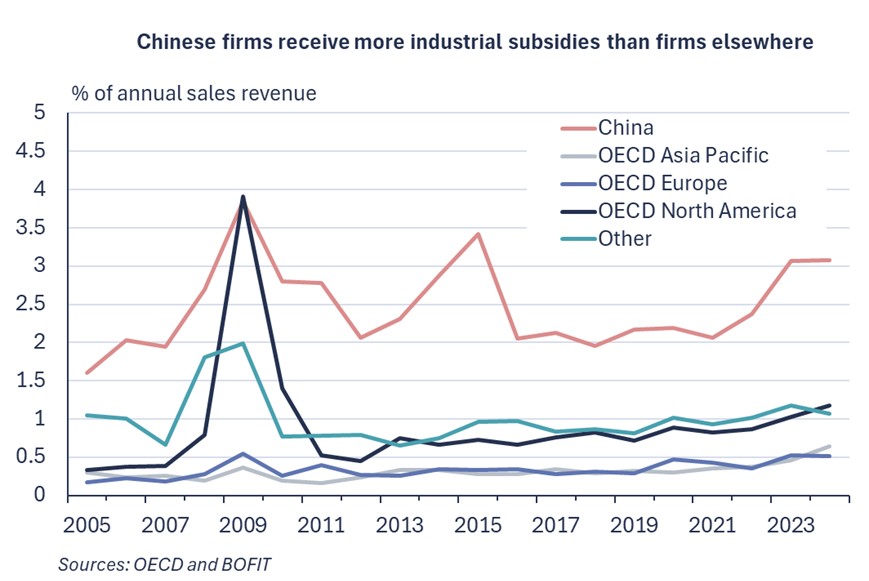
At the start of June, the Organisation for Economic Co-operation and Development (OECD) released a report based on its Manufacturing Groups and Industrial Corporations (MAGIC) database of subsidies to large industries. According to the report, industrial subsidies have increased globally in recent years, with companies at least 25 % state-owned on average receiving considerably larger subsidies shares than their privately-held counterparts. Geographically, Chinese firms have received considerably more subsidies than companies elsewhere throughout the sample period of 2005–2024. For example, in 2024, large Chinese firms received industrial subsidies averaging 3.1 % of their sales revenue. In comparison, industrial subsidies in Europe amounted to around 0.5 % of sales revenue and in North America to 1.2 % of sales revenue. Subsidies in India and Brazil, two other major emerging economies, were distinctly lower than in China.
The MAGIC database tracks 15 key industrial sectors. China's industrial subsidies for all sectors are distinctly higher than in other countries except for a narrow case involving solar panels. In 2023 and 2024, solar panel manufacturers in OECD countries enjoyed larger subsidies than their counterparts in China. The exception reflects efforts by Western countries to reduce dependence on Chinese manufacturers that dominate the global market for solar panels. Like in the rest of the world, industrial subsidies vary considerably from industry to industry in China. The biggest subsidies in recent years have gone to microchip manufacturers (subsidies over 8 % of sales revenues), while heavy machinery producers have come up short (1.5 % of sales revenues). The OECD report notes that industrial subsidies have significantly accelerated Chinese companies’ conquest of global markets. The OECD calculates that industrial subsidies accounted for up to 60 % of the increase in the export share of Chinese companies in international markets between 2005 and 2023.
The OECD divides industrial subsidies into three categories: government grants, tax concessions and below-market financing. About half of the subsidies to Chinese companies in 2024 came in the form of below-market financing (1.7 percentage points of net sales), but government grants (0.8 percentage point) and tax concessions (0.6 percentage point) were also significant.
The IMF assessed earlier this year China’s industrial subsidies to correspond to roughly 4 % of GDP. The IMF methodology differs from that used by the OECD and is not directly comparable. However, the IMF assessment points out that China’s land-use subsidies are also extensive, which are not captured in the OECD analysis.