BOFIT Weekly Review 22/2026
Trump-Xi summit in Beijing yields modest results
The positive news out of US president Donald Trump's state visit to Beijing this month included commitments from China to buy agricultural products and aircraft from the US. The previous face-to-face meeting of presidents Trump and Xi took place last October in Busan, South Korea. The original agenda for the Beijing summit included mutual easing of trade tensions, as well issues related to technological competition, artificial intelligence and cybersecurity. Technology issues, however, remained largely on the back burner, with no resolution on such matters as export restrictions on AI chips and other semiconductor devices. The US also made little progress in getting hoped-for Chinese support in de-escalating the Iran war.
The US and China announced plans to establish bilateral Boards of Trade and Investment to promote trade relations and dialogue between the two countries. China agreed to purchase 200 Boeing aircraft, as well as agricultural products worth $17 billion from the US during 2026–2028. China also promised to restore access to the Chinese market for the US beef industry. China seems to have enhanced its political capital from the deals. The US team refrained from bringing up concerns over a number of Chinese actions. The official statements from the summit failed to mention long-standing sore points for the US such matters as China’s industrial overcapacity and the excessive state subsidies. While China pressured president Trump to suspend US arms deals with Taiwan, US Secretary of State Marco Rubio said that the US position on Taiwan remains unchanged.
American firms in China are concerned about the deterioration of US-China relations. The CEOs of several large American corporations, including Nvidia’s Taiwan-born CEO Jensen Huang, were included in the American entourage. The United States Chamber of Commerce in China (AmCham) recently published the latest results of its survey of American firms operating in China. Companies were asked to name the five biggest challenges hindering their business. 64 % of respondents mentioned the slowdown of China’s economy, while 58 % noted the degradation of US-China relations. Among the top five challenges, 31 % of responding companies mentioned competition from local companies, 30 % overcapacity in industrial production and 26 % unclear legislation and regulatory environment. Nevertheless, 71 % of respondents said they had no plans to move production out of China, an increase of four percentage points from AmCham’s 2025 business survey.
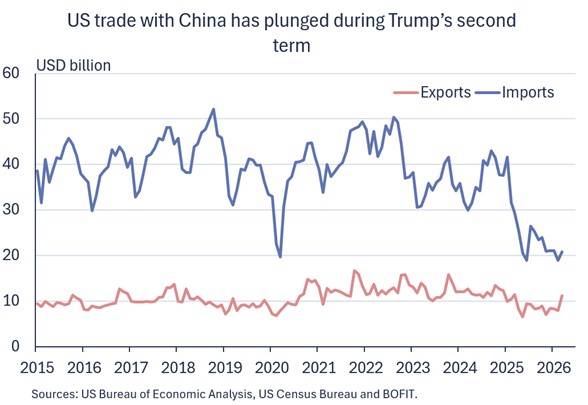
US trade with China has been depressed since the start of president Trump’s second term. US threats of elevated tariffs and heightened trade tensions have ravaged US-China bilateral trade. US goods exports to China last year fell by nearly 26 % to $106 billion, while imports of Chinese goods to the US declined by about 30 % to $308 billion. Trade modestly bounced back, however, when the US and China reached an agreement on tariffs last October. It should also be noted that China has a long history of evading tariffs by moving products through third countries. Among other things, Chinese companies have invested in factories and logistic hubs in many countries in Southeast and South Asia. The highest value of US imports from China are products in the categories of electronics and machinery & equipment. US exports to China consist largely of machinery, minerals and chemical products.