BOFIT Weekly Review 21/2026
Iran war and energy sector bombardment deal a double blow to Ukraine’s economy
Damage to Ukraine’s energy sector depressed first quarter growth
Preliminary figures from the State Statistics Service of Ukraine (Ukrstat) show the economy contracted for the first time in three years, falling by 0.5 % y-o-y in the first quarter of 2026. The combination of Russian bombing of energy facilities, an exceptionally cold winter and destruction of transport infrastructure hurt economic growth on a wide scale. Despite warmer weather in March and successful repairs that improved availability of electricity, recovery was held back by rising fuel and fertiliser prices caused by the Iran war.
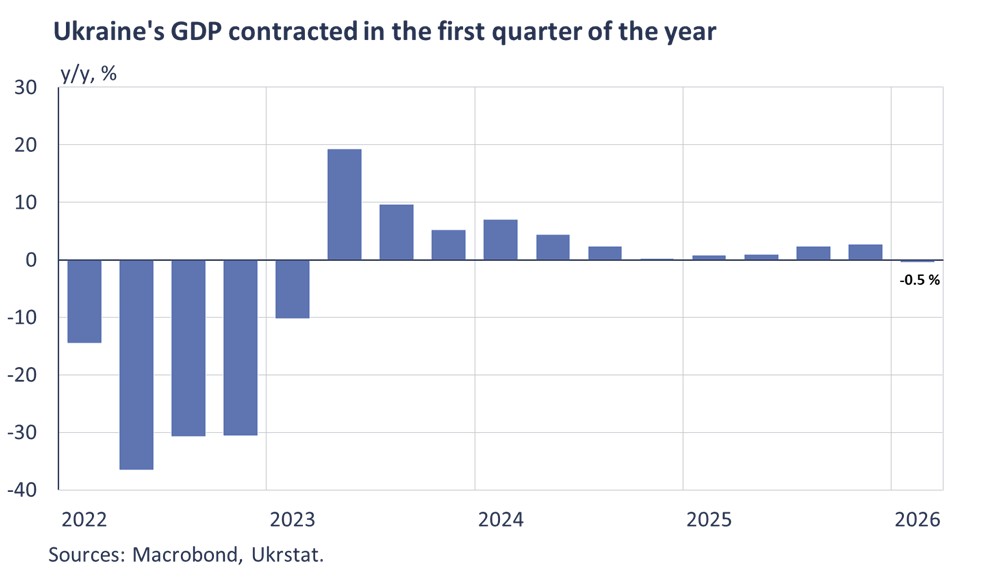
Industrial output fell by 1 % in the first quarter, mainly due to deteriorating conditions in the manufacturing sector. In addition to the electricity shortages, metal refining in processing industries was hurt by weak global demand for metals and the advent of the European Union's Carbon Border Adjustment Mechanism (CBAM) at the beginning of the year. CBAM is particularly hard on the price competitiveness of Ukrainian steel, which still relies on energy-intensive processes with large carbon footprints. Several members of the European Parliament have called for granting Ukraine a wartime exemption to CBAM.
Although the situation in the energy sector is still challenging, preliminary data from Ukraine’s economy ministry show growth accelerated to around 1 % y-o-y in April. Retail sales, mining and quarrying activity and defence sector production supported growth. In its April forecast update, the International Monetary Fund (IMF) kept its outlook for Ukraine’s 2026 economic growth unchanged at 2 % y-o-y. Other institutional forecasters, however, lower their growth forecasts for Ukraine to reflect its energy issues and rising global commodity prices. The World Bank and the National Bank of Ukraine (NBU) both revised down their 2026 economic growth forecasts to around 1 %.
In addition to its energy struggles, Ukraine faces acute labour shortages that restrain its growth potential. A recent survey conducted by Ukraine’s Institute for Economic Research and Policy Consulting (IER) found that nearly 70 % of firms see labour constraints as a serious problem for their businesses. Indeed, labour shortages were considered an even bigger problem than high prices of raw material inputs (56 %) and security issues (46 %).
Rising fuel prices boost inflation
Consumer price inflation accelerated to nearly 9 % in April, particularly due to higher global fuel prices from the Iran war. Fuel prices were up 36 % y-o-y in April on top of Russian damage to the energy sector. Inflation for raw food items, however, slowed moderately to around 8 % in April. The NBU expects inflation to accelerate in the coming months due to higher energy prices, as well as a weakening of the hryvnia’s exchange rate and rising wages. The NBU further estimates that inflation will start to decline early next year.
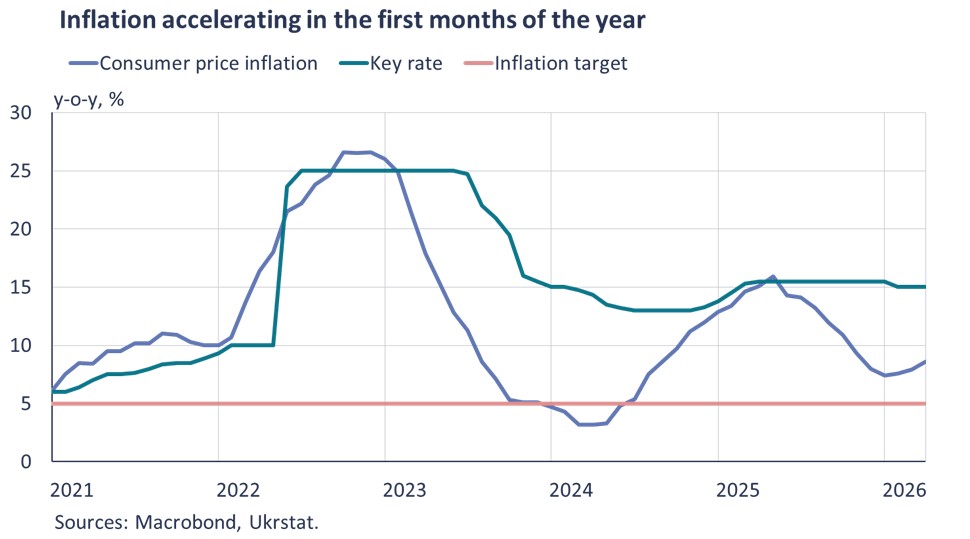
Despite the pick-up in inflation, the NBU kept its key interest rate unchanged at 15 % at its Monetary Policy Council (MPC) meeting in late April. According to NBU, the inflation expectations of consumers and businesses have not risen significantly and given the current slowdown in economic growth since the beginning of 2026, a hike in the key rate was rejected by the MPC. According to the NBU, if the pressure from fuel prices continue to intensify, raising the key rate has not been ruled out.
First tranche of EU’s €90 billion loan to be released in June; Ukraine’s slow progress on requisite reforms
After getting the green light from Hungary’s new government in April, EU member states approved a €90 billion loan for Ukraine for 2026–2027. Like previous EU assistance for Ukraine, the latest loan comes with strings attached – Ukraine needs to meet certain conditions or benchmarks to continue withdrawing funds. The new loan should cover about two-thirds of Ukraine's estimated financing gap during 2026 and 2027. In the new loan2, €30 billion will be provided in the form of macro-financial assistance through the Ukraine Facility framework. To receive the new loan funding, however, Ukraine must implement jointly agreed reforms as in the previous Ukraine Facility funding of¨€50 billion. The remaining €60 billion is ear-marked to defence and national security spending. Ukraine is scheduled to this year receive nearly €17 billion in macro-financial assistance and about €28 billion for defence this year. After the EU loan was approved, the Ukrainian government announced plans to increase defence spending this year. The increase still requires parliamentary approval, but such changes were anticipated as the original 2026 defence budget passed last December called for lower defence spending than in 2025.
Ukraine has had difficulties in implementing reforms in a timely manner to stay in compliance with the EU’s lending programmes and the IMF's 48-month Extended Fund Facility (EFF). More specifically, the Ukrainian government has struggled with implementing required reforms on time or shepherd needed adjustments such as changes to the tax code through the Verkhovna Rada, the country’s parliament. Because of its slowness in implementing reforms, Ukraine was denied access to a nearly €4 billion tranche last year. In April 2026, Ukraine submitted an implementation plan related to the Ukraine Facility, and following to the Europeans Commission's approval, was granted access to nearly €3 billion of the last year’s withheld funds. Ukraine still has a number of reforms left to implement to reach full compliance with EU funding with missed deadlines.
Implementation of the required measures of Ukraine’s latest EFF programme from the IMF has also experienced delays. The IMF decided to release a $1.5 bn tranche as prefinancing from the $8 billion EFF funding to Ukraine at the start of this year despite the fact that the parliament had yet to pass the required law amendments. A bill to simplify the country's tax system has yet to be brought before the parliament, and a bill to tax imported packages worth less than €150 failed to be passed before its end-March deadline. The IMF delegation is expected to visit Kyiv late this month to assess Ukraine’s progress in complying with EFF terms.