BOFIT Weekly Review 16/2026
China’s current account surplus hit an all-time high last year; net outflow of capital from China gathered strength
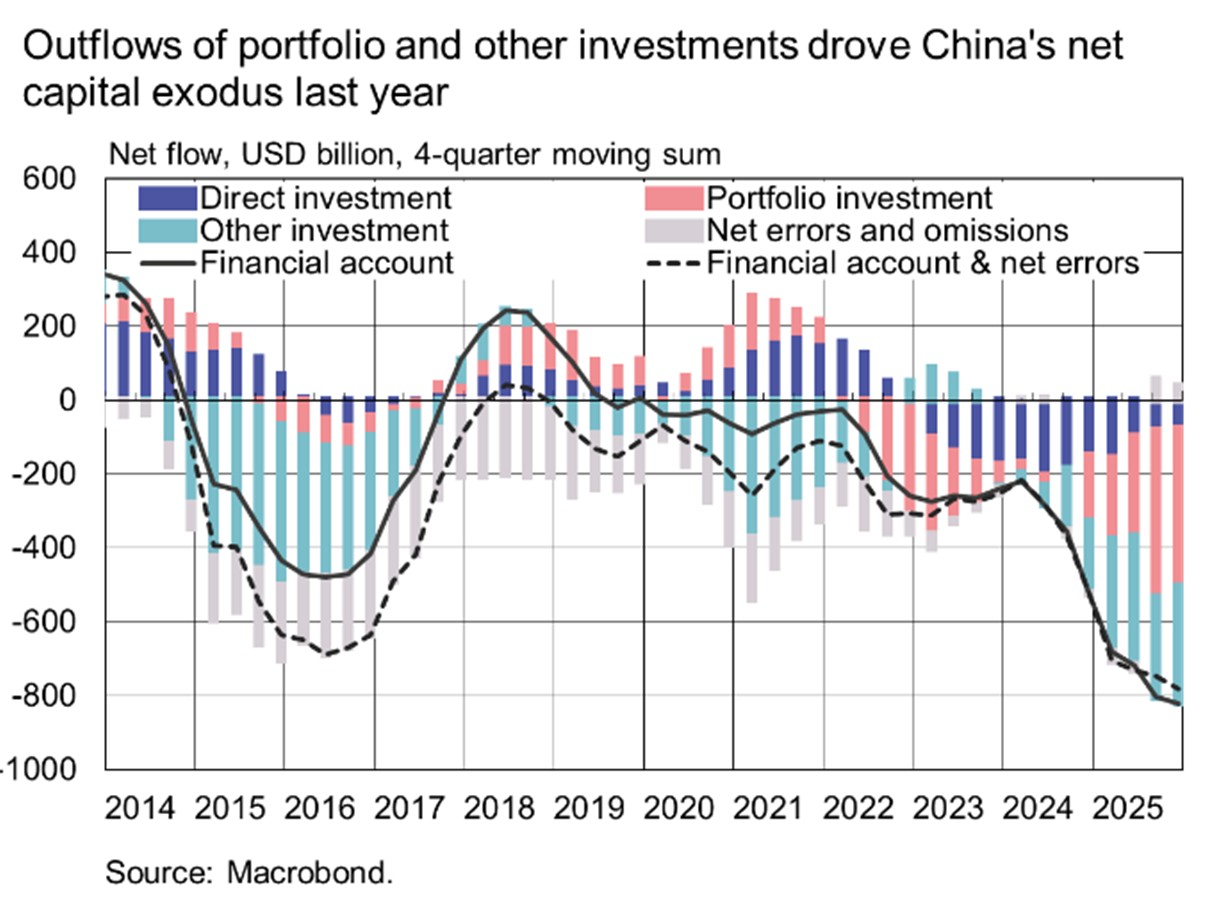
Balance-of-payments figures from China’s State Administration of Foreign Exchange (SAFE) show the country’s current account surplus in the fourth quarter of 2025 amounted to $244 billion (1,726 billion yuan). The goods trade surplus was $310 billion and the services trade deficit $49 billion. In addition, the net flow of factor income and current transfers included in the current account amounted to a deficit of $18 billion. The financial account deficit was $235 billion. For the year overall, the current account showed a strong surplus ($735 billion, 3.8 % of GDP) and the financial account a similar magnitude deficit ($774 billion).
The goods trade surplus increased towards the end of the year, reflecting strong export growth, especially in high-tech industries and products for the green transition. At the same time, it revealed sluggish import trends, which correlates with weak domestic demand. The large trade surplus has increased China’s foreign receivables as it sells more goods abroad that it imports from abroad. China’s services balance remains chronically in deficit. Indeed, the deficit has ballooned back to pre-pandemic levels, driven particularly by the recovery of Chinese travel abroad.
At the same time, the financial account shows a net outward flow. The direct investment category in the financial account describes capital flows related to company ownership and production, while portfolio investment reflects investment in securities (equities and debt). In addition, the financial account includes other investments (loans, deposits and trade credits), financial derivatives, as well as changes in foreign currency reserves.
In the fourth quarter of 2025, inward FDI to China amounted to $40 billion, while the outward FDI flow from China was $46 billion. The net flow for the entire year was negative as outward FDI amounted to $157 billion and inward FDI was only $80 billion.
Outward portfolio investment in the fourth quarter amounted to $97 billion, and $360 billion for all of 2025. At the same time, foreign investors reduced their investment positions in China by a total of $65 billion for all of 2025 (including a $20 billion decrease in the fourth quarter). This translates to a net outflow of portfolio investment of approximately $425 billion during 2025. BOFIT provides a deeper dive into portfolio flows and yuan-denominated cross-border flows in a recent BOFIT Policy Brief 1/2026.
The other items in the financial account also point to a net outflow of capital. For the category “other investment,” the deficit for the entire year was significantly larger than in previous years ($293 billion), bolstering evidence of strong net outward flows of capital also via other financial channels of the banking and corporate sectors. The deficit may imply increases in deposits abroad or increases in the volume of loans granted abroad.
Considering stocks rather than flows, ongoing surpluses and general investment flow trends over the years have significantly bolstered China's foreign wealth position. At the end of the year, Chinese foreign financial assets amounted to about $11.8 trillion, while foreign liabilities amounted to about $7.7 trillion. In net terms, China’s foreign investment position has grown to roughly $4 trillion (21 % of GDP). By this measure, China remains the world’s second largest net lender after Germany.
Despite a gain of $6 billion in the fourth quarter, China’s foreign currency reserves shrank last year by $47 billion. As of year’s end, China’s foreign currency reserves were valued at $3.74 trillion, an 8 % increase from a year earlier.