BOFIT Weekly Review 48/2026
Europe still depends heavily on trade with China
The latest updates of the Trade in Value Added (TiVA) database maintained by the Organisation for Economic Co-operation and Development (OECD) were released in mid-November. The TiVA indicators are based on inter-country input-output (ICIO) tables that allocate the added value of goods and services to the countries that produced them, allowing for indirect dependencies arising through other countries. While TiVA indicators allow for a more comprehensive assessment of trade, they are only available with rough sectoral breakdowns and appear only after considerable delay. The new TiVA 2026 edition data, for example, contains data up to 2024.
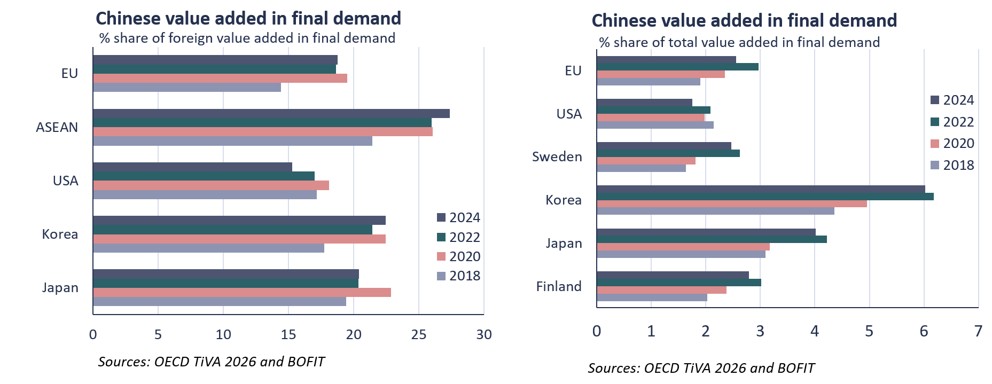
The latest TiVA indicators show China’s global role as a value-added producer has not diminished, which is no surprise, as China is still the world’s top manufacturing hub and the world's largest exporter. In 2024, China accounted for 19 % the foreign value added in final demand in the EU(28) (includes the UK). China’s share has remained roughly at that level throughout this decade. In 2024, 22 % of foreign value consumed in the EU(28) came from the US, 5 % from Switzerland, 4 % from India, 4 % from Norway and 4 % from Japan. Russia’s share has continued to decline, covering just 2 % of EU(28) value added in final demand. While the US notably seems to have slightly reduced China’s value added contribution in recent years, China has become an increasingly important source of value added for ASEAN countries in Southeast Asia. Half of the foreign value added consumed in Finland comes from elsewhere in the EU, while the US and China each account for just under 10 %, 5 % from the UK, 4 % from Norway and 3 % from India. Russia’s share was slightly over 1 %.
When domestic value added and foreign value-added are combined, China’s share of the EU’s total value added in final demand was 2.6 % in 2024. Finland was still quite close to the EU average, with 2.8 % of Finland’s total value added in final demand originating in China. Neither share has changed significantly in recent years (with the exception of 2022, when, likely due to covid restrictions, OECD indicators show domestic value-added consumption decreased significantly in the service sector). Finland is an average EU country from a sectoral perspective. Like the EU generally, most of Finland’s Chinese value added in final demand is provided by Chinese manufacturers.