BOFIT Weekly Review 48/2026
China’s October economic figures show domestic demand growth remains sluggish
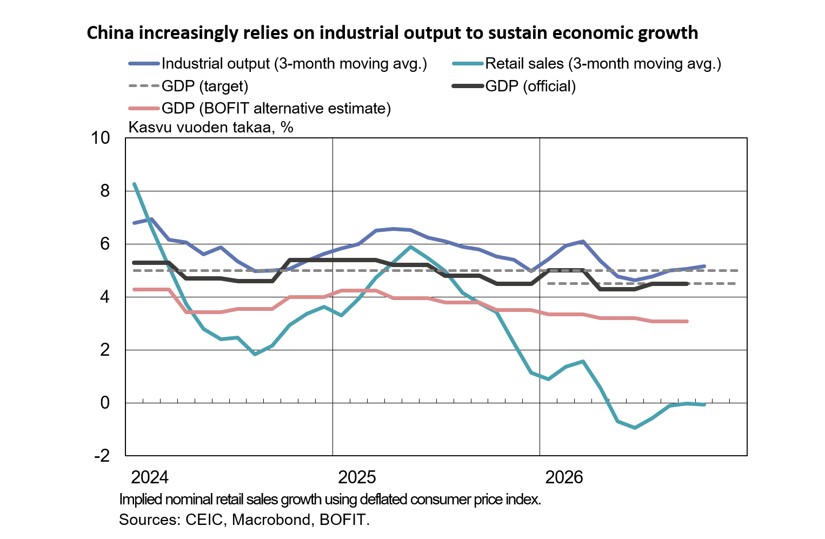
China’s October economic figures bolster the view that the performance of the Chinese economy continues to follow two distinct development paths. On one hand, trends in domestic consumption, particularly fixed investment, remain weak, and the downturn in the real estate sector continues. On the other, growth in industrial output remains buoyant, sustained by electronics and other high-tech export-oriented industries.
China’s National Bureau of Statistics (NBS) reports October retail sales grew by just 0.4 % y-o-y in nominal terms. Real retail sales, which takes inflation into account, likely contracted. Nominal retail sales, excluding car sales, grew by 2.5 %. Services trade growth outpaced gains in goods trade, but the overall domestic demand trend remained weak. Fixed investment contracted by 8 % y-o-y in the first ten months of the year. In addition to declines in industrial investment and investment in infrastructure, private investment declined by more than 10 % y-o-y.
Some of the weakness in fixed investment reflects the multi-year downturn in China’s real estate sector. Real estate investment declined by 22 % y-o-y in January-October. New building starts decreased by 24 %, while the volume of completed apartments, measured in terms of floorspace, was down by 27 %. Sales of new apartments slid 14 %.
Although industrial output growth slowed from previous months, it was still distinctly more robust than domestic demand in October. Industrial output grew by 4.8 % y-o-y in October, a slight slowing from 5.5 % in September and 5.2 % in August. Growth was largely supported by strong foreign demand for high-tech products. Production of computers, communications devices and other electronics increased by nearly 20 % y-o-y. Production of specialised machinery and electrical equipment also grew rapidly. In contrast, output contacted in e.g. the steel and mineral processing industries. Electrical vehicle (EV) production increased by 17 % y-o-y, even as car production overall fell by nearly 8 %.
Demand for high-tech products is also reflected in China’s rapidly growing foreign trade. The value of Chinese goods exports rose by 35 % y-o-y in October, while the value of imports climbed 42 %. Semiconductor exports, in particular, experienced high growth, rising by as much as 137 % y-o-y in value terms. Automobile exports were up by nearly 40 %. Import growth was largely driven by high-tech products. In January-October their share of import value increased by over 50 % y-o-y, while the value of semiconductor imports climbed by 65 %. The value of raw material imports also grew rapidly. Some of the rapid increase in the value of foreign trade is explained by price increases. For example, the value of semiconductor exports in September rose by 136 %, even as the export volume of semiconductors increased by barely more than 1 %.
Domestic consumer price inflation remains low, with consumer prices up by just 0.7 % y-o-y in October (0.9 % in September). Core inflation, which excludes changes in energy and food prices, was 0.8 %. The rise in producer prices, on the other hand, accelerated from 5 % in September to 5.7 % in October. The rise in producer prices was driven largely by increases in prices of mined products and other raw material inputs.