BOFIT Weekly Review 36/2026
People’s Bank of China releases independent 5-year plan for monetary policy
The five-year plan for 2026–2030 focuses on China’s emergence as an advanced financial powerhouse. While ambitious, the plan, at least according to released information, does not call for adjustments in the current monetary policy framework. Instead, the plan call for continuity to “steadily advance high-level financial opening up.” Chinese policymakers have long opened the country's financial markets cautiously through various special programmes. Unlike many government ministries and agencies, the People’s Bank of China (PBoC) has not typically published a five-year plan of its own.
In coming years, the PBoC will continue with the ongoing change of more market-based interest rate setting, as well as strengthening macroprudential and financial stability measures. Financing will be targeted to politically important sectors such as development of advanced technologies and the green transition. The PBoC says it will give markets a decisive role in setting exchange rates, but remains committed to keeping the yuan’s exchange rate “broadly stable at an adaptive and equilibrium level.” The international use of the yuan will be advanced, and offshore yuan markets and payment system will be developed. Domestic development of the digital yuan (e-CNY) will continue.
Revision of China’s central bank law is also underway. Amendments include specification of the responsibilities of the central bank, especially in implementation of macroprudential policy and regulation of financial markets, as well as formalising the legal status of the digital yuan. The amendments also include mechanisms to block or counter possible foreign sanctions against China. Reforms to the central bank law, which dates back to 2003, have long been under consideration. While the central bank remains under the authority of the State Council, the new draft law also emphasises the central role of the Central Committee of the Communist Party. The draft is being circulated for comment, and no timeline for its adoption has been announced.
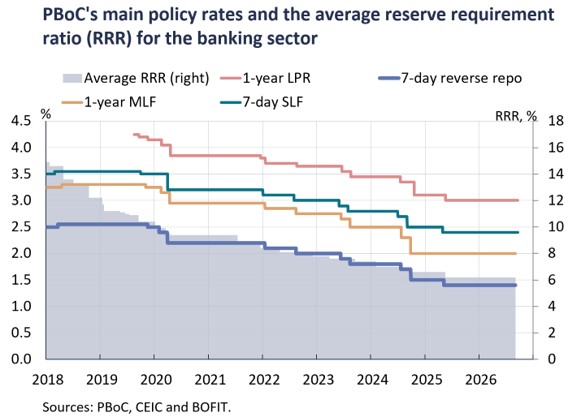
At the start of August, the PBoC held its semi-annual work conference. Among the takeaways was an increase in the lending quotas of central bank’s targeted lending programmes. In recent years, implementation of monetary policy has been more targeted, with low-cost financing directed to politically important sectors through various structural lending facilities. PBoC also said it has increased oversight of loan pricing. In its latest monetary policy report, the PBoC stated it would promote a broader set of loan pricing benchmarks. This summer several banks were permitted to use the money market rate (depository institutions repo rate, DR) instead of the central bank’s benchmark loan prime rate (LPR) as a reference rate. These measures aim at lowering financing costs and increasing the role of markets in loan pricing. To better affect short-term interest rates and market liquidity, the PBoC in June added the possibility to providing overnight financing as necessary as part of its open market operations. The shortest pricing tools earlier were seven-day instruments. China’s key policy rates and bank reserve requirements have not been adjusted since spring 2025. China’s leadership has long described monetary policy stance as appropriately accommodative, but no actual easing measures have been taken recently.