BOFIT Weekly Review 6/2026
China’s birth rate fell to a record low last year
The National Bureau of Statistics (NBS) reports that just 7.9 million children were born in China last year –the lowest figure since statistical records began in the 1950s. The number of births in 2019 was still 14.7 million. The number of deaths last year also rose to 11.3 million. Thus, China’s population contracted by 3.4 million to 1.405 billion as of end-December. The working-age population (defined in China as 16–59-year-olds) fell by 6.6 million to 851 million, while the number of persons over the age of 60 climbed by 13 million to 323 million.
Migration has negligible impact on China’s overall population trends. The number of urban-dwellers rose last year to 954 million, while the number of rural residents declined to 451 million. In the late 1990s, the urban-rural ratio was the reverse. The urban population has also increased due to a broadened definition of city-dweller.
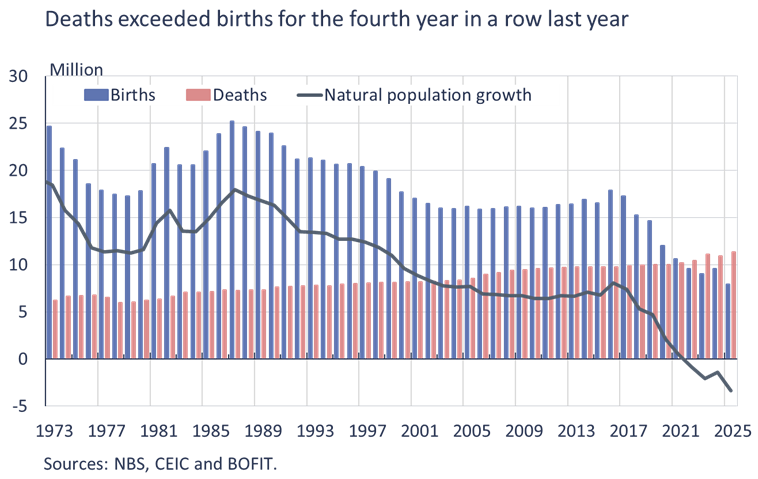
China has introduced a range of measures to boost the birth rate. The government moved last year to reduce the cost burden of starting a family by introducing a child benefit and lowering pre-school fees (BOFIT Weekly 32/2025). These changes have yet to show a positive impact on the birth rate. Instead, China’s birth rate last year fell to 5.63 per thousand, while the total fertility rate (number of children a woman is expected to have in her lifetime) is estimated to be fallen below 1.0 (replacement rate is 2.1).
The number of marriages in China, which the number of births follows, also continues to decline. Barely 6 million marriages were registered last year, down from more than 10 million marriages in 2018. The government last May made it possible for couples to choose the most convenient jurisdiction for their marriage registration, regardless of their household registration (hukou) location. This change was particularly beneficial for internal migrants, eliminating the requirement to return to their hometowns to get married. Several regions also offer money or consumer coupons, as well as extended honeymoon leave for newlyweds. Many regions have also started to offer incentives for having babies.
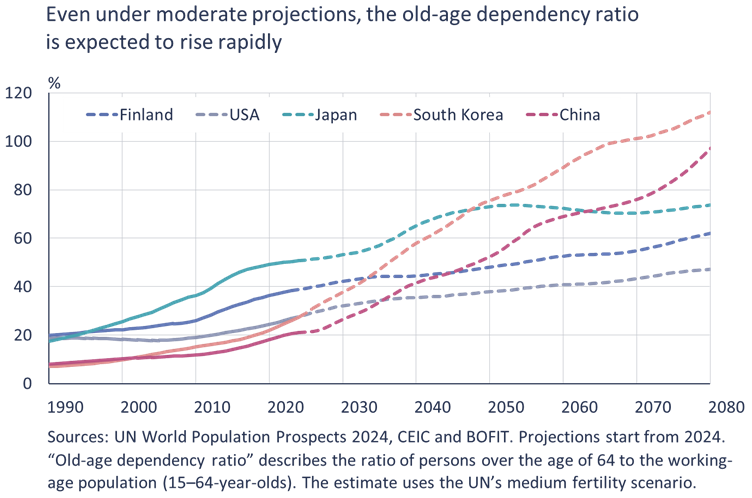
China's old-age dependency ratio (persons 65 and over relative to 15–64-year-olds) is still a relatively healthy 21 %, about the same level as Japan and Finland in the mid-1990s. Based on UN population projections, China’s dependency ratio would reach Finland’s current level by the late 2030s and Japan’s current level before 2050. The weakening of the dependency ratio may be even faster than this. The estimates are based on the UN’s median fertility scenario. The most recently updated estimate from 2024 still projected 8.7 million births in China last year, with the birth rate remaining above 8 million a year through the late 2040s.