BOFIT Weekly Review 2/2026
With latest round of export bans, China-Japan economic relations deteriorate further
On Tuesday (Jan. 6), China’s commerce ministry announced new restrictions that immediately cease exports of dual-use products to Japan. Dual-use products are goods, software or technologies that can be used in both civilian and military applications.
The commerce ministry did not specify which product groups would be subject to the new restrictions, but an earlier catalogue of dual-use products covers a wide range of chemical and biological substances, as well as products, machinery, materials, software, and technologies related to nuclear energy, missiles, and drones. China justified its decision on the grounds of safeguarding national security, noting the Japanese prime minister’s statements about Taiwan late last year which it considers a serious breach of bilateral relations.
China-Japan relations, already long strained, became more tense in November after Japan’s new prime minister Sanae Takaichi, participating in debates in the National Diet (Japan’s bicameral parliament) that a Chinese attempt to take Taiwan by military means would create an “a situation threatening Japan’s survival”. Under Japan’s national security law, this would allow the use of its Self-Defense Forces. Takaichi later added that Japan could also be forced to react if China attacked U.S. warships sent to break a potential blockade of Taiwan.
Takaichi’s comments provoked a strong reaction from Beijing. On top of official protests and threats, China warned Japan of military losses, encouraged Chinese citizens not to visit Japan and restricted cultural and educational exchanges. As of mid-November, China postponed minister-level meetings, restricted food imports and indicated broader trade sanctions were in the works. With the breakdown of diplomatic talks, China reiterated demands that Takaichi retract her statements, threatening the full range of possible responses.
The ban on dual-use products could have profound economic impacts for Japan. The restrictions apply to raw materials, technologies and components critical to the country’s industries, particularly manufacture of semiconductors and electronics, the car industry, aerospace, materials and high-tech manufacturing. The Nomura Research Institute estimates that over 40 % of Japan’s 2024 goods imports from China fell under the dual-use product definition.
China is Japan’s most important source of imports, and its second-most important export destination after the United States. At the end of 2025, China accounted for about 23 % share of Japan's goods imports and about 17 % of Japan’s exports. Japan's most important exports to China include semiconductors and other manufacturing equipment, electronic parts and plastics. Imports from China consist mainly of telecommunications equipment, computer equipment and textiles. According to Japan’s foreign ministry, China is the most significant foreign operating environment for Japanese firms. In 2023, Japanese firms in China operated from over 31,000 sites. Japan’s importance as a trading partner of China has been diminishing in recent years. At the end of 2025, Japan accounted for roughly 4 % of Chinese goods exports and 6 % of Chinese imports.
On the same day that China’s commerce ministry published it export ban on dual-use products, the Communist Party of China’s official English-language mouthpiece China Daily declared that Beijing was considering additional restrictions on exports of rare earths to Japan. Even if Japan has diversified its acquisition of critical minerals since China last limited rare earth exports in 2010, Japan by some estimates is dependent on China for roughly 60 % of such products.
While China is still Japan’s largest trading partner, Japan’s share of China’s foreign trade has shrunk
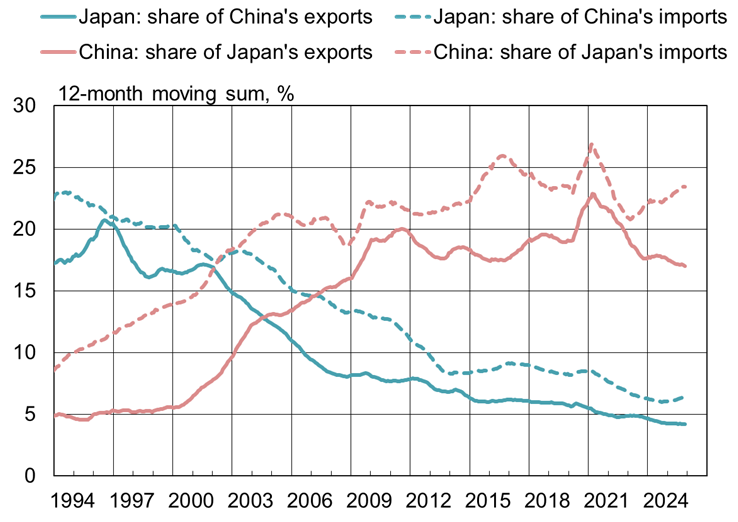
Sources: Macrobond, Ministry of Finance, China Customs and BOFIT.