BOFIT Weekly Review 13/2026
Higher oil prices bring at least temporary relief for the Russian economy
The outlook for Russia’s economic performance, which stumbled in the first two months of this year, is becoming even gloomier. While the recent spike in global oil prices due to the Iran war has brought Russia at least temporary economic relief, the longer-term impacts of the war depend largely how long elevated oil prices persist. A brief surge in oil prices would provide only limited support for Russia’s economy this year.
The outlook of the Russian economy will be discussed in greater detail on Monday (Mar. 30), when BOFIT holds its annual Russia briefing (in Finnish). In conjunction with the event, we are releasing our Forecast for Russia 2026–2028 and a BOFIT blog post assessing the impacts of various oil price developments on the Russian economy.
Russia’s economic development was weak in January
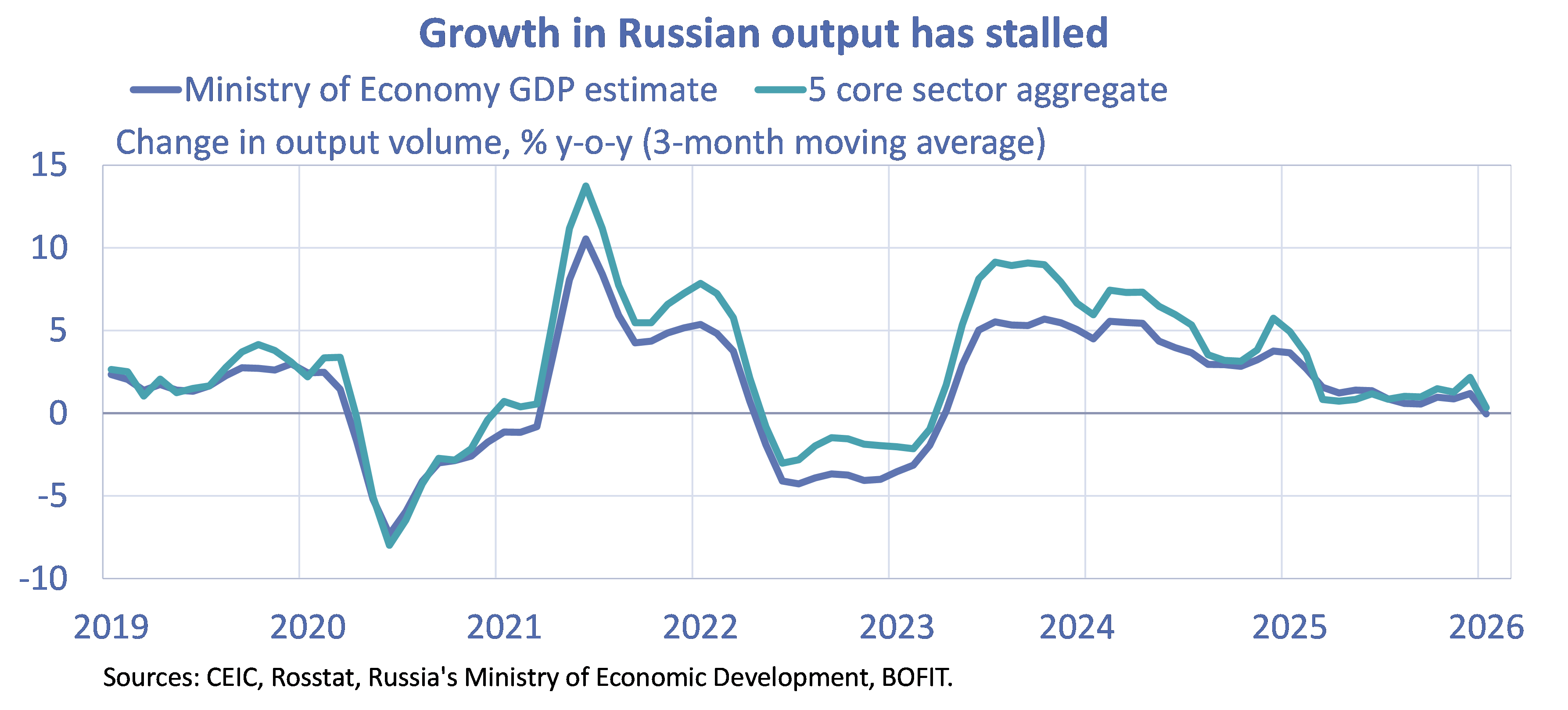
Russia’s economic development ministry preliminarily estimates that GDP contracted by 2 % y-o-y in January. The ministry assesses that some of the weak performance reflects last year’s high reference basis, as well as the fact that January 2026 had two fewer workdays than January 2025. Although one should be cautious to draw conclusions based on a single month’s development, it is clear that the performance of the Russian economy experienced across-the-board weakening at the start of the year.
While Rosstat's headline figures show industrial output contracted by 1 % y-o-y in January, seasonally- and workday-adjusted figures show January industrial output was unchanged from December. Rosstat does not publish seasonally- and workday-adjusted output figures of other sectors of the economy. In any case, particularly the construction sector saw sharp weakening as output contracted by 16 % y-o-y in January.
Consumer-driven branches continued to grow in the start of the year. The volume of retail sales increased by nearly 1 % y-o-y in January, while consumer services grew by nearly 3 %. The rise in wages slowed significantly in December, but the average real wage still increased by 2 % y-o-y. Inflation kicked up again, however, in the beginning of the year. If the wage growth deceleration has continued this would erode consumer purchasing power and could then depress growth in consumption-driven branches.
The weakening economic situation is also evident in surveys of Russian corporations. The composite indicator of the monthly business survey by the Central Bank of Russia (CBR) has sharply declined in the past months. The March reading of the indicator was nearly as low as in spring 2022 in the immediate aftermath of Russia’s full-on invasion of Ukraine. In other recent corporate surveys, the majority of respondents also felt that their company’s situation has deteriorated in the first months of this year or they expect deteriorating conditions in coming months. Problems mentioned by firms include increased costs and payment arrears. For example, a survey conducted by the Russian Union of Industrialists and Entrepreneurs (RSPP) at the end of 2025 found that delinquent payments rose as the most often mentioned problem by respondents. Over 40 % of firms, i.e. a larger share of firms than during the Covid-19 pandemic, stated payment arrears were hurting their businesses.
Federal budget oil & gas revenues down by half
Russia’s government finances faced strong headwinds in the first two months of this year. Preliminary finance ministry figures show that federal budget revenues contracted by 10 % y-o-y in January-February. Revenue growth was hit particularly hard by a sharp drop in oil & gas revenues, which were down by nearly 50 % for the two-month period. Much of the decline was due to plunging export prices for Russian oil.
The International Energy Agency (IEA) estimates that the export price of Russian oil averaged just $46 a barrel in January-February, down from $65 a barrel in the same period in 2025. The average discount on Russian oil against comparable oil grades in January-February was $23 a barrel, up considerably from the average 2025 discount of $13 a barrel. The IEA also estimates that the volume of exported oil decreases particularly in February.
Federal budget revenues from sources other than oil & gas rose by 4 % y-o-y in January-February. The growth in revenues reflected the two-percentage-point hike in value-added tax (VAT) rates. The hike raised VAT revenues by 11 % y-o-y, while other combined revenue streams declined by 5 %.
Federal budget spending increased by 6 % y-o-y in the first two months of this year. Budget expenditures rose slightly faster in the first two months of the year than the budget plan, while budget revenues in the period came in below the budget forecast. The federal budget deficit in January-February, which already nearly reached the planned budget deficit for this year, was about 3.4 trillion rubles (1.5 % of GDP).
The government currently plans to cover this year’s budget deficit mainly by taking on additional government debt. In January and February, the government also withdrew a total of roughly 400 billion rubles from the National Wealth Fund to cover the deficit. As of end-February, the National Wealth Fund held roughly 4 trillion rubles in liquid assets.
Key rate gradually declining
In line with market expectations, the CBR lowered its key rate by 50 basis points at its rate-setting meeting on March 20. The key rate now stands at 15 %. The CBR has implemented a series of similar rate cuts since last summer as inflation and economic growth has slowed.
The central bank reported that the acceleration in inflation in the first two months of this year largely reflected transitory factors, particularly the increase in VAT rates that went into effect at the start of this year. The CBR said that the change in seasonally adjusted annualized rate (SAAR) of consumer prices in January-February was about 10 %, but inflation seemed to have slowed in recent weeks. In annual terms, consumer prices were up by 6 % in February.
CBR governor Elvira Nabiullina said that the Middle East conflict has increased uncertainty about trends in the Russian economy and price development, but it is still too soon to specifically assess these impacts. The guidance for the upcoming CBR rate meeting in April was that the CBR will assess the need of further rate cuts, but this will not be done as a matter of course. Inflation risks are still heightened by such factors as geopolitical tensions. Nabiullina also mentioned the risk stemming from looser fiscal policy noting that higher borrowing by the government would require tighter monetary policy.
Higher oil prices provide at least temporary support for the economy
Russia’s weak economy in the first months of this year is likely to see at least temporary relief from the spike in global oil prices in recent weeks. Higher oil prices typically boost Russian GDP growth, as well as increase export earnings and government revenues. Oil & gas last year accounted for over half of Russian goods exports and nearly a quarter of federal budget revenues.
Benchmark Brent oil has averaged around $96 a barrel in March. Bloomberg estimates that the price of Urals-blend crude has risen sharply in recent weeks to around $60 a barrel. Besides higher world market prices, Russian oil exports have been eased by the temporary lifting of US sanctions on Russian oil. Russia’s budget framework for this year is based on an assumption that the export price of Russian oil this year will average $59 a barrel. Even at this price level, the consolidated budget remains in deficit and government spending does not rise in real terms.
The longer-term impact of oil prices on the Russian economy largely depends on how long and how high oil prices remain. Moreover, Russia’s economic performance has deteriorated sharply this year, so a small windfall in oil prices is insufficient to substantially change the overall course of the economy. The government’s fiscal room to manoeuvre has so far neither increased much even with higher oil revenues.