BOFIT Weekly Review 12/2026
No major shifts in economic policy under China’s newest five-year plan
The National People’s Congress (NPC) last week approved China’s 15th five-year plan (2026–2030). The plan conforms with the Communist Party’s policy statement released last autumn and areas of policy emphasis announced earlier. Over the coming five years, China will focus especially on technological advancement, economic self-sufficiency and national industrial development, and thus policies remain on the same path as earlier. Based on the plan, it seems unlikely that the Chinese economy will experience any significant structural changes.
The five-year plan highlights numerous priority fields, including such frontier technologies as quantum technology, 6G networks, hydrogen and fusion energy, biomanufacturing, brain-computer interfaces and embodied AI (physical systems such as robots, drones and autonomous vehicles). The use of artificial intelligence is to be widely promoted in society in accordance with the AI+ programme presented last year. China will also continue to promote a low-carbon economy and the green transition. Fossil fuels will be replaced by wind, solar and nuclear power, the hydrogen economy developed, geothermal energy promoted, the electrical grid strengthened and electrical power storage capacity increased. In addition, the plan mentions for example further development of the shipbuilding industry and space technology such as satellites. Moreover, strengthening of state-owned companies will continue in coming years.
The discussion in China has lately focused on increasing domestic consumption, but the plan does not include measures which would significantly bolster the position of households. Moreover, many proposed actions are tilted more on supporting the industry than boosting the consumption (e.g. development of electrical vehicle charging networks and upgrading old apartments to smart homes). The five-year plan also calls for strengthening consumer protections, encouraging people to have children, and support for families with children through such measures as improving guidance and health care services for pregnant women and families with babies and encouraging firms the help employees achieve a better work-life balance. Targeted investment should seek, among other things, to encourage the involvement of private actors in public projects and motivate private firms to increase their R&D efforts. Moreover, the government will strive to reduce internal barriers to trade.
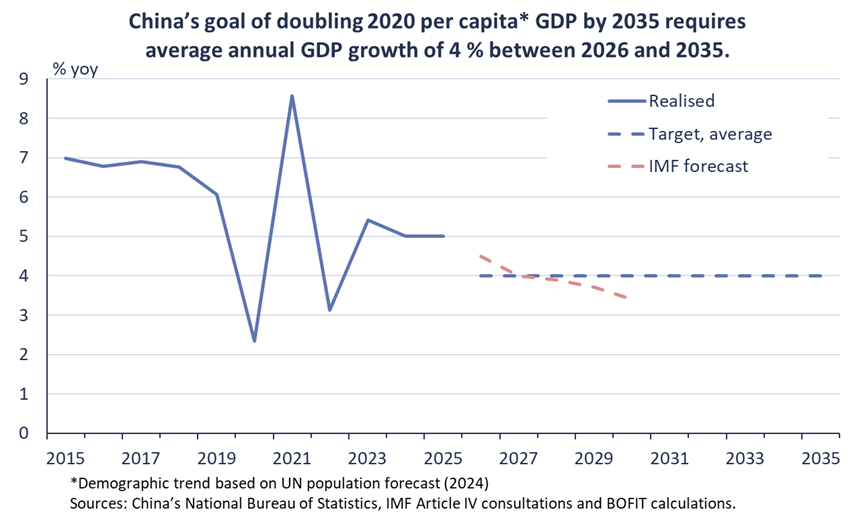
The current plan to double China’s 2020 per capita GDP by 2035 is reiterated in the plan. If GDP gains since 2020 are included, and based on current demographics from the UN's latest population forecast for China (2024), the economy would need to grow at an average rate of 4 % a year over the next decade to achieve this quite ambitious target. The latest IMF forecast, for example, has China falling short of this target over each of the next five years, and it is difficult at this point to imagine Chinese GDP growth accelerating significantly in 2031–2035. Clinging too tightly to numerical political targets over the previous decade resulted in rapid growth in public indebtedness, especially for regional governments, as well as real estate bubbles and large financial messes that are still being cleaned up. There is an inherent danger, therefore, that setting new binding long-term numerical targets generates similar problems.