BOFIT Weekly Review 9/2026
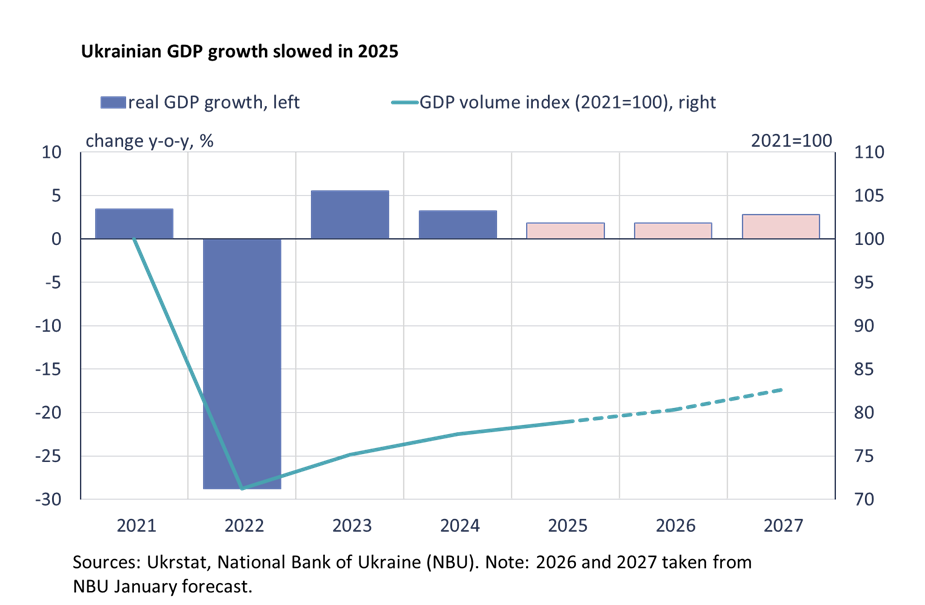
Despite devastating attacks, Ukraine’s economy grew by nearly 2 % last year
Energy sector destruction held back Ukrainian economic growth in late 2025
Ukraine’s 12-month GDP growth slowed in the final months of last year to slightly below 2 %, down by over one percentage point from a year earlier. Economic growth was sustained especially by household consumption and government spending increases, primarily the defence sector and related investment. Household purchasing power strengthened with the rapid rise in real wages (up 7 %). Exports grew modestly as destruction of transport infrastructure limited growth. Import growth surged on higher energy imports, especially in the final months of the year. The overall impact of foreign trade on GDP growth was negative.
Energy shortages and loss of crucial production facilities reduced industrial output last year (down by 2.4 % y-o-y). Production in the mining & quarrying sector fell by 11 % y-o-y due to attacks on oil & gas production facilities and Russian occupation of the Pokrovsk coal mining district in the first half of the year. The lack of skilled labour and power outages, especially in the final months of last year, caused large bottlenecks in all industrial branches. Manufacturing, however, continued to show positive growth (up 1 %) due above all to growth in military-industrial branches. Ukraine’s defence industries, particularly drone manufacturing, have become economic successes with promising prospects for export growth in coming years. Our most recent BOFIT blog post discusses Ukraine’s wartime resilience and the rise of its defence sector.
Even with weather conditions delaying harvests last year, Ukraine’s 2025 agricultural output increased slightly from 2024. Sales prices for Ukraine's key grain crops were low, reducing the value of agricultural output overall. At the same time, Ukrainian farmers faced increasing difficulties in exporting their products to global markets due to Russian attacks focusing on rail and port infrastructure critical to exports. In addition, quotas on exports to EU countries entered into force in October, reducing quotas from earlier levels. The change stranded large quantities of food products for export, which had to be sold on the domestic market at reduced prices.
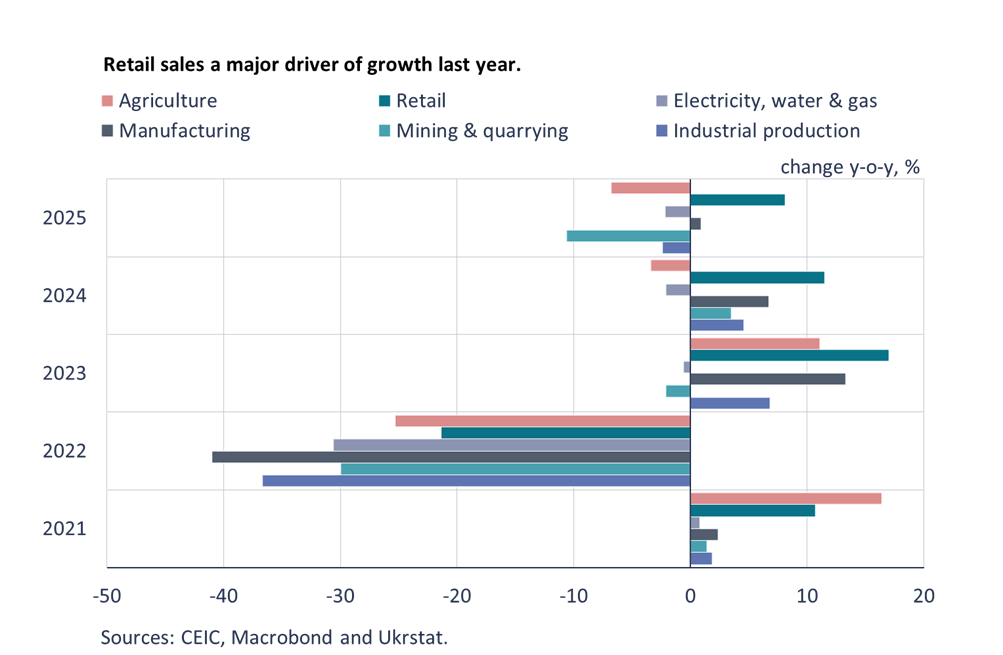
Even with Russia’s massive campaign to destroy Ukraine’s energy infrastructure, electricity, gas & water supply only fell by 2.2 % last year. In the first nine months of 2025, decentralised renewable energy solutions allowed production volumes to remain higher than in 2024 (although the situation deteriorated considerably in the fourth quarter of 2025). Intensified bombing and drone attacks on the energy sector, as well as an exceptionally cold winter, resulted in daily electrical power outages of 8 hours or longer.
Last year war recovery costs increased by more than $60 billion
The fifth in a series of joint annual reports from the Ukrainian authorities, the World Bank, the European Commission and the UN on Ukraine’s war damage and reconstruction needs (Rapid Damage and Needs Assessment, RDNA5) put the total costs of the war to Ukraine as of end-2025 at $588 billion (about 500 billion euros), or roughly three times Ukraine’s 2025 GDP. The estimate assumes that reconstruction takes place over the next 10 years. The RDNA4 assessment put total costs at $524 billion.
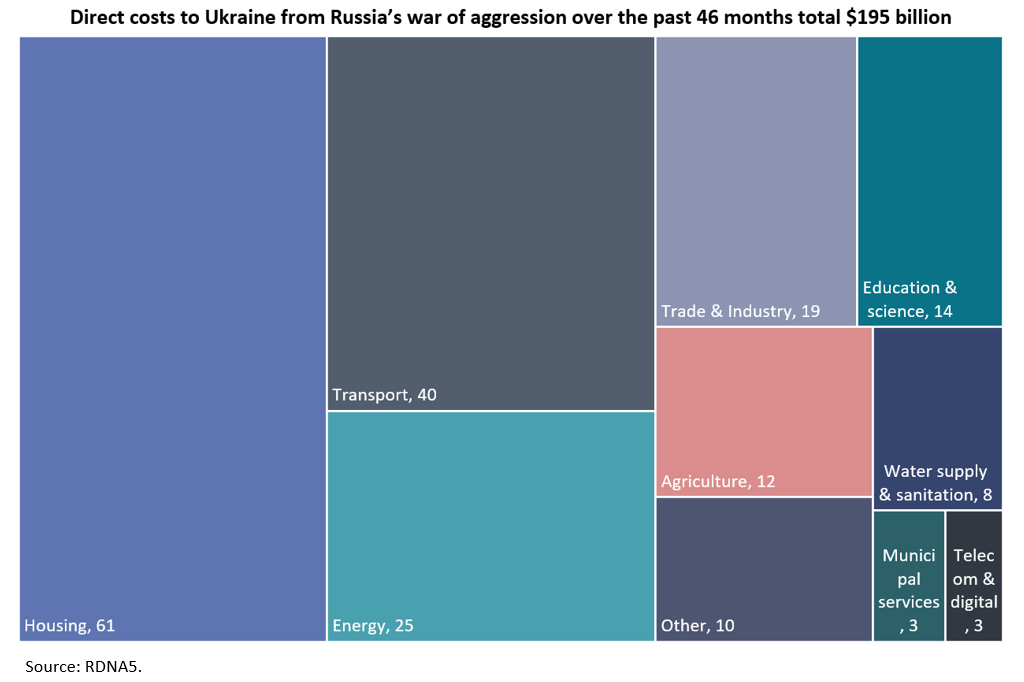
The direct cost of damage from full-scale war at the end of 2025 amounted to $195 billion (166 billion euros), an increase of about 11 % from end-2024. The greatest destruction involved residential buildings, transportation and logistics infrastructure, as well as the energy sector. The largest growth in damage costs was suffered by the transport sector (up 24 %) due to attacks on the railway network and ports. Damage to the energy sector also increased by more than a 20 % last year. Most of the damage occurred in areas close to the front line and in large cities.
IMF board approves new $8.1 billion loan package for Ukraine
Ukraine’s latest 4-year $8.1 billion IMF Extended Fund Facility (EFF) stumbled late last year after Ukraine’s parliament, the Verhovna Rada, resisted IMF demands for tax code revisions and elimination of wartime exemptions to raise revenues. The IMF calls for tax code changes included reducing the value-added tax (VAT) threshold for individual entrepreneurs to 1 million hryvnias, or roughly 20,000 euros (while the finance ministry sought a level of 2-4 million hryvnias) and removal of the duty-free exemption for parcels valued at less than 150 euros. The IMF executive board in their meeting on Feb 26th agreed to drop the required actions, reclassifying them as measures to be implemented during the EFF period. Following approval, the IMF authorized as immediate disbursal of $1.5 billion.
Although the EFF amount is modest in relation to Ukraine’s financing needs, it serves as a door-opener to larger pools of support such as the EU’s 90-billion-euro loan for 2026 and 2027, which is conditioned on approval of the IMF’s loan facility. The funding decisions are urgent as Ukraine’s current funding and own revenues run out at the end of March. The IMF’ revised estimate projects Ukraine’s funding needs to be reach $136.5 billion over the program period.