BOFIT Weekly Review 8/2026
Price pressures remain subdued in China
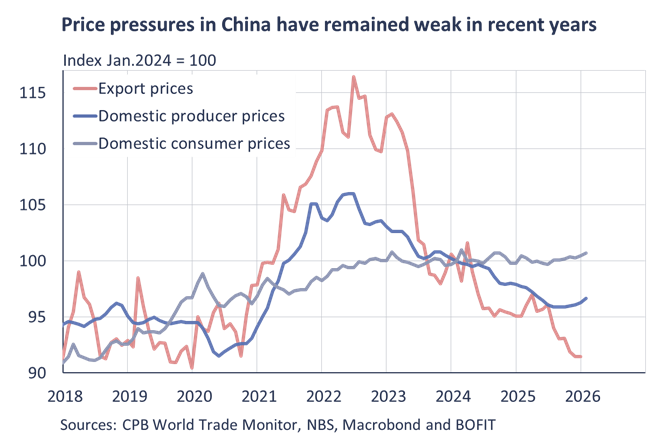
Inflation in China remained low throughout 2025. Overall, the price developments affirm the picture of an economy where domestic demand is weak, the industrial sector suffers from overcapacity issues, and the prolonged crisis in the real estate sector weighs on both households and firms. While China has avoided actual deflation, consumer price inflation for the year as a whole was essentially zero. Inflation picked up slightly in the final months of last year, climbing to 0.8 % in December. In January 2026, inflation slowed again to 0.2 %.
The subcategories of consumer price index confirm that overall demand has remained weak. Food prices fell by an average of 1.4 % last year. Housing costs were essentially flat, and transportation prices fell by nearly 3 %. Prices of consumption goods declined slightly (- 0.3 %). Service inflation for all of last year was only 0.5 %, reflecting household cautiousness. The negative contributions of food and energy prices kept consumer price inflation low overall. Core inflation, which excludes volatile food and energy prices, averaged 0.8 % last year. It rose gradually over the year, reaching 1.2 % in December, before slowing again to 0.8 % in January 2026.
Industrial sector continued to face downward price pressures. Producer prices fell by 2.6 % on average last year, and the 12-month change in producer prices was still -1.4 % in January 2026. The biggest declines were seen in mining & quarrying (-9 %) and raw materials (-3.4 %). Producer prices in the car industry declined by nearly 3 % last year, with the same pace of decline continuing in January 2026.
China’s export prices in the end of 2025 were about 4 % lower than a year earlier and down by nearly 10 % from two years earlier. The broad-based decline in industrial producer prices and overcapacity issues have enabled lower export prices, boosting China’s price competitiveness on international markets. China’s focus on exports provides cover for weak domestic demand, but at the same time it encourages companies to keep their prices competitive outside the country. The situation suggests that industrial price pressures may remain weak going forward.
It has become increasingly difficult to monitor Chinese inflation in recent years. The NBS no longer releases as much price data as earlier, and up-to-date information on the weightings of components of the consumer and producer price indices, for example, are not reported. Energy prices remain partially regulated by the government, and official apartment price statistics only cover certain cities. Thus, official inflation figures give only a partial picture of price trends in the Chinese economy.
Overall price levels in the economy can be assessed using the GDP deflator. The NBS does not publish an official GDP deflator, but it can be derived as the difference between nominal and real GDP growth. Calculated this way, China’s GDP deflator for 2025 was -1 %. Observers over the years have speculated that China could be smoothing its real GDP trends by adjusting the deflator used in its calculation. In BOFIT’s own alternative GDP estimate, the deflator is recalculated using different methods, and based on this approach, overall price developments last year would have been slightly positive, at +0.2 %.