BOFIT Weekly Review 8/2026
Half of Chinese regions missed their growth targets last year; big differences in living standards persist
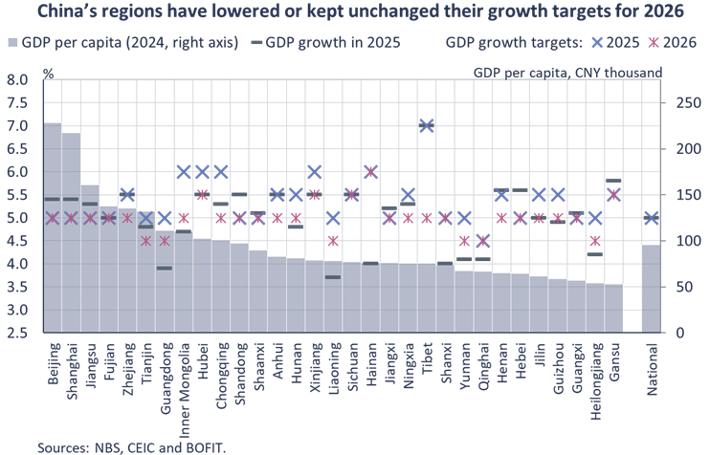
China’s National Bureau of Statistics (NBS) reports that economic growth in the country’s 31 administrative regions last year ranged between 3.7 % in Liaoning province to 7 % in the Tibet autonomous region. In Guangdong, China’s largest province, growth only reached 3.9 %. Growth in the next largest provinces Jiangsu (5.3 %) and Shandong (5.5 %), as well as in Shanghai (5.4 %) and Beijing (5.4 %) municipalities exceeded the national 5 % GDP growth. Last year, 16 regions failed to hit their growth targets. Regional-level figures have historically been fraught with problems. Since 2020, when the NBS took over compilation of regional GDP statistics, at least the aggregate total reported regional GDP figures have been very close to the national GDP.
Not a single region raised its GDP target this year, while 16 regions reduced their targets and 15 kept their targets unchanged from 2025. Tibet again set a 7 % target, while the targets of other regions are in the range of 4.5–6 %. Guangdong is targeting growth of 4.5–5 %, while Beijing and Shanghai are pursuing an “about 5 %” growth. The 2026 national GDP target, which will be announced at the National People’s Congress in March, is expected to be between 4.5 % and 5 %. In light of the reduced GDP growth targets, the growth targets for the current 2026–2030 five-year plan seems quite ambitious for most regions. For example, Guangdong is still targeting average growth of 5 % a year over the next five years, even if annual growth in the last five-year plan (2021–2025) only averaged 4.7 %. Shanghai and Jiangsu are also targeting a 5 % growth average over the next five years, while Beijing is looking at an average of 4.5–5 % growth. These ambitious rates reflect an effort to commit to growth in line with president Xi Jinping’s goal of doubling China’s 2020 GDP by 2035.
Income and development levels vary considerably across the country. China’s richest regions are the Beijing and Shanghai municipalities, where average per capita disposable incomes last year amounted to roughly 90,000 yuan (about 11,000 euros). The average disposable income in population-rich Guangdong province was about 54,000 yuan, (6,600 euros), well above the national average of around 43,000 yuan (5,300 euros). The lowest disposable income per capita was in Gansu province with 28,000 yuan (3,500 euros). Nominal disposable income growth ranged between 4 % and 7 %, and was highest in the poorer provinces. There are only marginal differences in the regional price trends reported by the NBS. The fastest rise in consumer prices last year was reported for Anhui province (+0.5 %). Elsewhere, the change in consumer prices varied between -0.3 % and +0.2 %.
While China’s economy is slightly smaller than that of the EU, the economies of its largest provinces Guangdong and Jiangsu exceed that of Spain. The size of the next largest provincial economies, Shandong and Zhejiang, are similar in size to that of the Netherlands. The combined output of these four regions accounts for 35 % of Chinese GDP. The country’s smallest region, Tibet, has an economy smaller than that of Estonia. The most recent available figures for GDP per capita, a rough measure of living standards, are from 2024. China’s GDP per capita is less than a third of the EU level. China’s richest regions, Beijing and Shanghai, boast GDP per capita levels roughly on par with the Czech Republic and Portugal. Four other provinces (Jiangsu, Fujian, Zhejiang and Tianjin) also have GDP per capita levels above that of Bulgaria, the EU’s poorest member. China’s poorest provinces (Gansu and Heilongjiang) have GDP per capita levels only a quarter that of the richest provinces.