BOFIT Weekly Review 5/2026
EU-India free-trade agreement creates basis for developing economic relations
Indian prime minister Narendra Modi and European Commission president Ursula von der Leyen announced a major free-trade agreement on Tuesday (Jan. 27) at their summit in New Delhi. The parties also said that the EU had committed to providing 500 million euros over the next two years to accelerate India’s long-term sustainable industrial transformation and reduce greenhouse gas emissions. The parties agreed to intensify cooperation in technology development and defence, as well as enhance labour mobility.
The trade agreement significantly lowers EU-India barriers to trade. Most tariffs on goods will be gradually phased out over a transition period and eventually eliminated completely. The tariffs that remain apply to products, such as certain agricultural products, that the parties consider sensitive domestically. The agreement also promotes trade in goods and services by strengthening regulatory frameworks, clarifying processes such as customs clearance and dispute resolution, as well as provides clarity on movement between the two regions in terms of business travel, professional mobility, tourism-linked services and cultural engagement.
The agreement is the result of a long, difficult negotiations process. The first discussions, which took place nearly two decades ago, generated modest results. From the EU’s perspective, the problem has been India’s strong desire to protect its companies from foreign competition. Compromise was never really an option in any category. As a result, the talks were put on pause until they were restarted in 2022. Talks will continue on an investment agreement and an agreement on geographical indications that specifies determination of production sites for goods and services traded.
The free-trade agreement brings about a substantial lowering of trade barriers, especially in India, which has traditionally maintained protectionist trade policies. The signing of the agreement indicates a change in India's trade policy and its desire to develop long-term trade relations with the EU. Comments by Indian experts suggest India and the EU were partly driven into each other’s arms by the threat of China and US unpredictability. Many countries are reassessing their trade policies to find ways to increase predictability in their economic environments.
The next step for Europeans will be to publish the agreement in the EU’s official forums. The commented document will then be submitted to the Council of Europe for consideration, and ultimately voted on by the European Parliament. The process will not necessarily go smoothly as evident from the fate of the EU-Mercosur trade agreement signed two weeks ago but yet to be ratified. The European Parliament voted to refer the EU-Mercosur agreement to the European Court of Justice for evaluation, which could delay the agreement’s entry into force by several years.
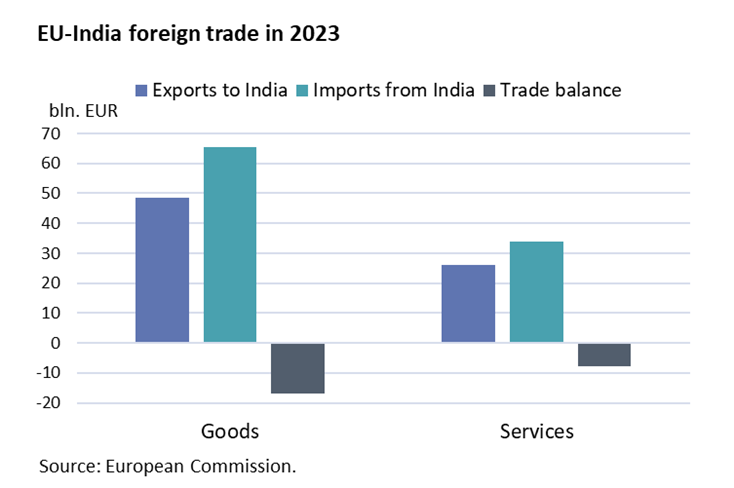
When the EU-India trade agreement enters into force, it is expected to significantly boost EU-India trade. Trade in goods and services between the two countries at present is less than 200 billion euros a year (figure), which corresponds to roughly 2 % of EU foreign trade and 10 % of India’s foreign trade. The European Commission predicts that trade could double over the next five years as a result of the agreement. At its core, the agreement lays out a path long-term development of trade relations.