BOFIT Weekly Review 3/2026
Russia’s economic development has weakened in many sectors
Russia’s output growth slowed further in November. The economic development ministry’s preliminary estimate shows that on-year GDP growth was was close to zero, although the ministry noted there were two fewer working days than a year earlier. Consumer demand remained brisk, but was also influenced by temporary factors. This year, Russia’s economic growth is expected to remain modest. In the latest forecasts, Russia’s GDP is projected to grow by about one percent this year. There are major risks to economic development, however, as long Russia pursues its war of aggression in Ukraine.
War-supporting industries grow as other industries stumble
Output in the extractive industries grew by just under 1 % y-o-y in November. Natural gas production contracted, while coal production remained at the same level as a year earlier. Russia has ceased to release figures on crude oil production. According to Bloomberg sources oil production still increased in November but dropped sharply in December. Extraction, refining and export of crude oil has been complicated by Ukrainian drone strikes on oil infrastructure and US sanctions.
The dual-track performance of the Russian economy is clearly evident in the manufacturing data. Manufacturing output overall contracted by 1 % y-o-y in November. While output rose briskly last year for industries linked to the war effort, nearly all other industries experienced output declines. Production of passenger vehicles continued to contract last year, with car production volumes still less than half of their pre-invasion levels. Production of machinery & equipment contracted by 6 % y-o-y in January-November, while manufacturing of electrical equipment fell by 5 %. For example, the output of excavators declined by 24 %, washing machines 22 %, refrigerators 13 %, and bridge cranes 6 %.
Corporate results, especially in industry, have also deteriorated. In January–October last year, the combined profits of all companies were 10 % smaller than a year earlier. In the mining sector, profits fell by 40 %, and in manufacturing by 10 %. Coal production and the wood‑processing industry performed the worst: in these sectors, combined corporate earnings were negative in January–October.
Russia’s manufacturing output grew in January-November 2025 mainly in military-related industries
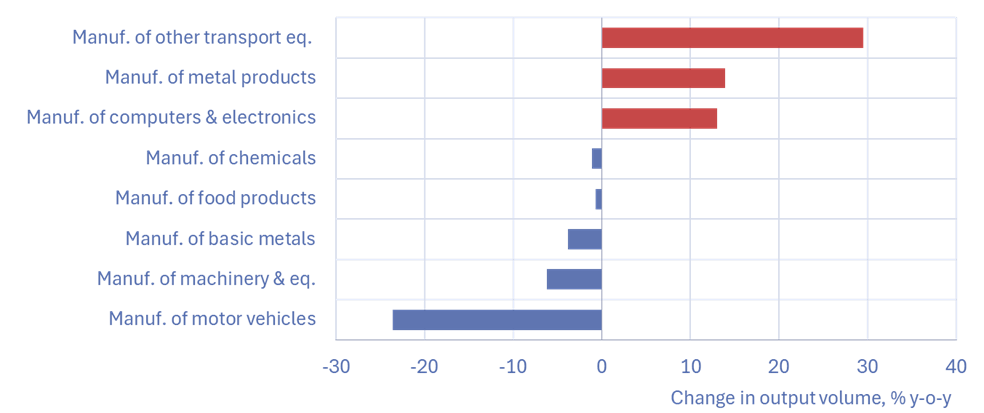
Sources: Rosstat, BOFIT.
Consumers increased purchases ahead of tax hikes
Retail sales growth slowed in November, but the volume of sales was still up by 3 % y-o-y. Consumer demand was sustained by strong employment and rising wages. The unemployment rate in Russia remained at a record-low level of around 2 % in November. In October, the average real wage was up by 6 % y-o-y, while the average real pension declined slightly.
Retail sales were likely boosted by a consumer rush to purchase goods in October and November on expectations of impending price and tax hikes. Consumers braced for an increase in the automobile recycling fee at the start of December, and increases in the value-added tax (VAT) at the start of January. Certain forward-looking indicators, however, suggest consumer demand already started to fade towards the end of last year.
Although car sales saw a spike in October-November, the 2025 trend for car sales overall was weak. For all of 2025, sales of new passenger cars were down by about 17 %. Car sellers report that the drop in sales was driven by hikes in recycling fees and high interest rates. Sales of Avtovaz, Russia’s largest carmaker and the producer of the familiar Lada make, saw its sales fall by roughly 25 %. Media reports claim that Chinese brands accounted for 52 % of new car sales in Russia last year. The share of imported cars in new car sales decreased apparently due to higher recycling fees. According to the Russian office of the Association of European Businesses (AEB), electrical vehicles (EVs) accounted for 1 % of new car sales in Russia last year.
Key rate lowered again in December
At the December inflation meeting, the Central Bank of Russia (CBR) board decided to cut the key rate by 50 basis points, continuing a series of rate cuts since June. The key rate, which stood at a record 22 % last June, presently stands at 16 %. The minutes of the CBR’s December meeting released at the end of last month show that the board debated three rate-setting actions: keeping the key rate unchanged, lowering by 50 basis points or lowering by 100 basis points.
The minutes reveal that the arguments for keeping the key rate unchanged were backed by evidence of rising inflation expectations, an acceleration in corporate borrowing in recent months, as well as risks related to budget spending. The majority nevertheless supported another rate cut, noting that inflation and demand pressures appear to be subsiding or subject to transient factors. All participants agreed that inflation risks are still elevated and that a pause in rate cuts might be needed in upcoming meetings. Achieving the inflation target will require that the CBR maintains a tight monetary stance over a prolonged period. The CBR expects to reach its 4 % inflation target by the end of this year.
Inflation has gradually slowed down. In November, consumer prices still rose nearly 7 % y-o-y. According to the central bank’s preliminary estimate, inflation slowed slightly further in December. However, inflation is expected to accelerate again in January. At the beginning of the year, VAT was increased by 2 percentage points. In addition, regulated prices for municipal services and certain other services were raised again in January.