BOFIT Weekly Review 51/2025
Transient factors accounted for some of India’s recent robust GDP growth performance
Latest data show that Indian GDP in July-September grew 8.2 % y-o-y. Private consumption growth accelerated to 7.9 %, reflecting the lowering of the Goods and Services Tax (GST) in September. On the other hand, growth in fixed investment slowed slightly and public consumption began to decline. Net exports also trended negatively. The shifts likely reflect protectionist winds in international trade and temporary domestic factors such as the spike in gold demand during the autumn Diwali “Festival of Lights” celebrations.
The impact of transient factors was also evident in industry-specific production figures. Growth in agriculture and construction slowed slightly, while growth in services and manufacturing accelerated. Particularly positively surprised manufacturing growth at 9 % y-o-y. Monthly indicators imply particularly robust growth in production supporting the construction sector and durable consumer goods, which have seen strong sales since the GST reform.
India’s economic growth is expected to slow down in the last months of 2025. The IMF currently forecasts Indian GDP to grow by 6.6 % for all of this year, while the Reserve Bank of India (RBI) expects overall 2025 growth of 6.8 %. Indeed, a number of business and consumer surveys already signal a slowdown in output growth is underway. Slowing growth is particularly evident in manufacturing, which saw the purchasing manager index (PMI) fall by over four points in November to a reading of 56.1.
Consumer price inflation has remained stubbornly below the RBI’s official annual inflation target of 2–6 % in recent months. October consumer prices rose by a mere 0.25 % y-o-y, the lowest rise this century. Thanks to bumper harvests in recent years, India’s reserve food stocks are overflowing, which has led to a drop in food prices. Tax cuts on goods and services also contribute to lower food prices. The RBI cut its inflation outlook in December in part due to the benign food supply situation. On December 5, the RBI lowered the key policy rate by 25 basis points to 5.25 %.
The IMF Article IV consultation staff report for India was published in November and evaluates that the Indian economy has performed well during the past year. Moreover, growth is seen to be on a strong footing as inflation is well under control and the government has made modest headway in reducing its elevated public debt. The IMF expects economic growth in coming years to remain at roughly the same level as recent years. Downside risks include possible disruptions of foreign trade due to geopolitical tensions. Upside risks include acceleration of economic reforms in India.
There was positive economic reform news last month, when prime minister Narendra Modi’s government announced the implementation of the “Four Labour Codes.” Modi’s governing coalition likely delayed implementation of the labour law overhaul, which was approved by parliament six years ago, to allow time for discussions with various interest groups, including trade unions and regional governments. The reforms simplify and streamline labour laws, extend employee rights with respect to e.g. employment contracts and social security, as well as make it easier for employers to hire temporary workers.
Indian inflation has cooled dramatically this year
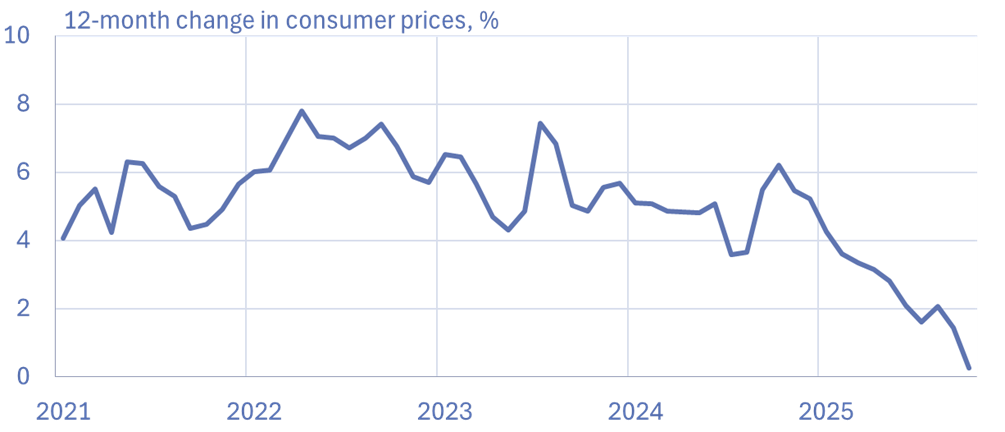
Source: Indian Ministry of Statistics and Programme Implementation.